




By : Julius Konton
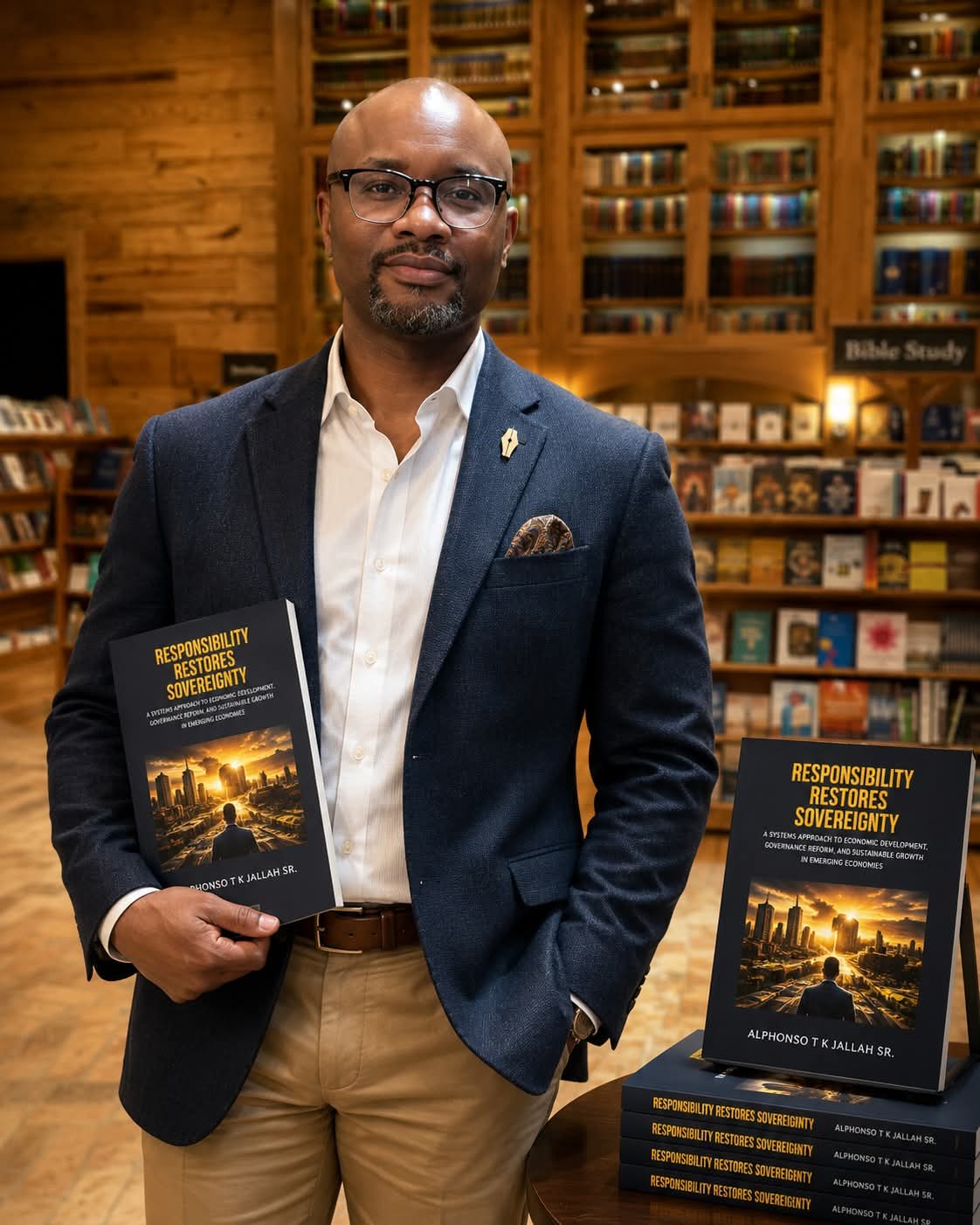
Liberian author, development advocate, and systems thinker Alphonso T.K. Jallah Sr. has revealed that his newly published book, Responsibility Restores Sovereignty, is more than an academic work, it is a personal journey and a comprehensive blueprint for transforming individuals and nations from poverty and dependency to prosperity, responsibility, and genuine freedom.
The publication presents a bold argument that while political independence is an important milestone, it is insufficient on its own to guarantee sustainable development.
Instead, Jallah contends that lasting freedom is achieved when nations build strong institutions, empower citizens, promote entrepreneurship, and cultivate a culture of responsibility.
A Journey Born from Poverty
Reflecting on his early life, Jallah disclosed that he was born into extreme poverty and deprivation in Liberia, where his family struggled to meet even the most basic needs.
He recalled watching his hardworking parents labor tirelessly, yet they often found it difficult to pay school fees or provide essential educational materials.
Those experiences, he said, prompted a lifelong question that shaped his thinking:
“Why do some nations consistently create prosperity and opportunities for their citizens while others continue to struggle for survival?”
Growing up, many attributed Liberia’s challenges to colonial history, global inequality, and circumstances beyond national control. However, Jallah said his Christian faith inspired him to challenge that explanation.
“If one Creator made humanity,” he explained, “I could not accept that God intended abundance for some nations while condemning others to perpetual poverty.”
Mindset Over Resources
According to Jallah, years of study and personal experience eventually led him to a profound conclusion: the greatest obstacle facing many nations is not necessarily a lack of natural resources but the belief systems that shape how those resources are managed and utilized.
His argument echoes findings from international development institutions.
According to the World Bank, countries with stronger governance, accountable institutions, higher productivity, and greater investment in human capital consistently experience faster and more sustainable economic growth than countries with abundant natural resources but weak institutions.
Similarly, the International Monetary Fund (IMF) has repeatedly emphasized that institutional quality, innovation, and private-sector development are critical drivers of long-term prosperity.
Africa, despite possessing nearly 30% of the world’s known mineral reserves, significant agricultural potential, and one of the world’s youngest populations, continues to face major development challenges.
The United Nations estimates that more than 460 million Africans still live in multidimensional poverty, underscoring the need for systemic reforms alongside resource development.
Independence Is Not Enough
One of the central messages of Responsibility Restores Sovereignty is the distinction between political independence and genuine national freedom.
According to Jallah, independence grants nations the authority to govern themselves, but sovereignty can only be fully realized when countries possess the economic capacity to determine their own future.
He argues that nations become truly free when citizens collectively embrace responsibility for solving local challenges, developing domestic resources, investing in education, strengthening institutions, and creating systems that unlock human potential.
Lessons from the United States
Jallah said his migration to the United States further strengthened his understanding of how sustainable prosperity is created.
Observing the American economy, he concluded that long-term economic success is driven by innovation, entrepreneurship, productivity, capital formation, and institutions that encourage ordinary citizens to pursue extraordinary ideas.
“Nations grow,” he emphasized, “when ordinary people are empowered to create extraordinary solutions.”
Introducing the Circular Flow Governance Model
A major contribution of the book is Jallah’s proposed Circular Flow Governance Model, a development framework designed to transform dependency into productivity.
The model advocates stronger collaboration among households, businesses, governments, financial institutions, educational systems, and development partners to ensure that wealth, investment, employment opportunities, and innovation continuously circulate throughout society rather than being lost through inefficiency or dependency.
According to the author, such an approach can strengthen local economies, expand entrepreneurship, create jobs, and enhance national resilience.
A New Perspective on Global Migration
Jallah also positions the book within the growing international debate on migration.
According to the United Nations International Organization for Migration (IOM), an estimated 304 million international migrants were living outside their countries of birth in recent years.
Many leave not because they reject their homelands but because they seek greater economic opportunities, security, education, and improved living standards.
Jallah believes migration should not be viewed solely as a border management issue.
Instead, he argues that governments and development partners should focus on creating environments where citizens can thrive, innovate, build businesses, and achieve prosperity within their own countries.
A Call to Action
Describing the publication as a movement rather than simply a book, Jallah called on policymakers, educators, entrepreneurs, development practitioners, and citizens to embrace a new philosophy centered on accountability, innovation, and national ownership.
“This is more than a book,” he declared. “It is a call for a new mindset. It is a call for responsibility.
It is a call for nations and individuals to move beyond independence and achieve true freedom.
Because when responsibility is restored, sovereignty follows.”
As governments across Africa and other developing regions seek sustainable pathways toward inclusive economic growth, institutional reform, and job creation, Responsibility Restores Sovereignty enters the global development conversation with a compelling message: enduring national transformation begins not merely with political independence but with responsible leadership, empowered citizens, productive systems, and a shared commitment to building prosperity from within.


