
By: Julius Konton
Liberia has taken a major step toward closing its long-standing infrastructure deficit as the Saudi Fund for Development (SFD) signals strong interest in financing key sections of the country’s northern road network, a move expected to unlock agricultural production, boost cross-border trade, and accelerate economic growth.
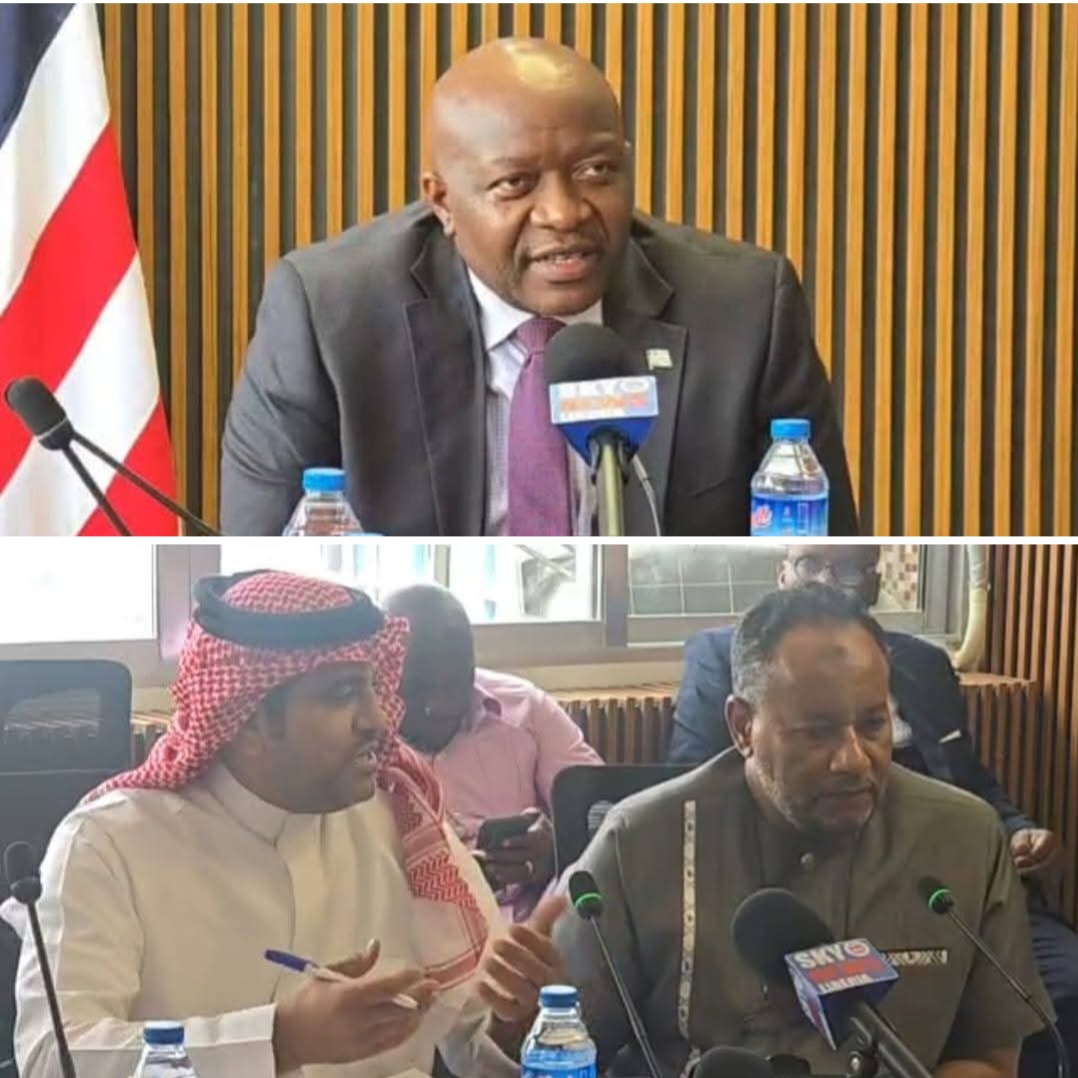
Speaking during a high-level engagement with development partners, Minister of Finance and Development Planning, Augustine Kpehe Ngafuan, disclosed that the Saudi Fund is primarily interested in the Konia–Voinjama corridor, a strategic segment of the broader.
Gbarnga–Mendicorma highway.
If concluded as government Minister Ngafuan expect, the commitment would mean that every leg of the Gbarnga–Mendicorma corridor would be fully financed, marking one of the most comprehensive road funding arrangements in Liberia’s post-war history.
“It will mean that the Government of Liberia, under the able leadership of President Joseph Nyuma Boakai, has secured financing commitments for the full stretch of road from Gbarnga Mendicorma,” Ngafuan said, describing the development as “significant and transformative.”
A Strategic Economic Corridor
The Gbarnga–Salayea–Mendicorma axis cuts through Bong and Lofa counties, two of Liberia’s most agriculturally productive regions.
Together, the counties account for an estimated 35–40% of Liberia’s domestic food production, including rice, cassava, cocoa, coffee, and vegetables, according to national agriculture estimates.
The corridor also supports artisanal and semi-industrial mining, cross-border commerce with Guinea and Sierra Leone, and regional markets that serve more than 700,000 people.
Poor road conditions have historically increased travel time between Gbarnga and Voinjama to six to eight hours during the rainy season, sharply raising transportation costs and post-harvest losses estimated at 25–30% for perishable goods.
With full pavement, Finance and Development Planning Minister Augustine Kpehe Ngafuan said project travel time could be reduced by more than 50%, significantly improving supply chains and household incomes.
Cross-Border Trade and Revenue Growth
Minister Ngafuan further revealed that discussions are ongoing for Saudi support to extend road funding toward Yeala, near the Guinea border, where a major customs post operates approximately six kilometers from Zorzor.
“Once that road is paved, trade movement will increase significantly and government revenue will rise,” he noted.
Liberia currently loses millions of U.S. dollars annually due to inefficient border access and informal trade routes.
Improved road access to the Yeala customs post is expected to formalize trade flows, enhance customs collection, and strengthen regional integration under ECOWAS protocols.
‘Baking the Bread’: Development Beyond Appearances
Using a metaphor that resonated with both officials and citizens, Ngafuan likened the government’s infrastructure drive to “baking bread”, a process that may not appear glamorous at first but is essential for long-term results.
“Before you have bread, it must be baked.
The baking process is not always attractive, but it is necessary,” he said.
“What we are doing with our colleagues from the Saudi Fund is part of that baking process.”
He emphasized that improved roads would lower transportation costs, raise farm-gate prices, increase disposable income, and reduce the cost of basic goods creating a multiplier effect across local economies.
A History of Saudi Partnership
Saudi Arabia’s development footprint in Liberia dates back several decades.
Minister Ngafuan recalled that the Saudi Fund was a principal financier of the Roberts International Airport (RIA) runway expansion, a project that restored Liberia’s capacity to receive wide-body aircraft and strengthened regional air connectivity.
The Saudis are also key financiers of the Gbarnga–Mendicorma highway, which began in 2017, alongside a consortium of Arab development partners, including:
Kuwait Fund for Arab Economic Development which committed funding for the Salayea–Konia corridor
OPEC Fund for International Development (OFID) – finalizing financing arrangements for the same corridor
Arab Bank for Economic Development in Africa (BADEA) – signed an initial US$30 million agreement, including a US$700,000 grant for health facilities along the corridor
ARREST Agenda and Institutional Reform
Beyond roads, the government is leveraging development partnerships to support institutional reform under President Boakai’s ARREST Agenda for Inclusive Development.
Last week, the government launched an US$18 million resource mobilization project, largely funded by development partners, aimed at:
Strengthening revenue generation in the mining sector
Supporting Liberia’s transition to Value Added Tax (VAT)
Providing 28 vehicles to the Liberia National Police
Supporting the Liberia Anti-Corruption Commission, Judiciary, and other state institutions
Fast-Tracking Results Amid Public Pressure
Acknowledging public impatience for visible progress, Ngafuan disclosed that the government has adopted a two-track approach.
While negotiating long-term financing with international partners, Liberia has also approved a legislative-backed concession with PAVIFORT, a Sierra Leone based firm, to begin works on the Mendicorma–Voinjama corridor.
Mobilization is already underway, signaling that construction will proceed even as financing discussions continue, he added.
Saudi Delegation Signals Broader Support
Speaking in Arabic through an interpreter, the head of the Saudi delegation reaffirmed his country’s commitment to Liberia’s development, stating that the Saudi Fund is prepared to study and consider financing for any priority national project.
The delegation will assess conditions on the ground before reporting back to Riyadh for further action.
Notably, discussions are also ongoing for US$45–47 million in potential support for Liberia’s electricity sector, though talks remain at a preliminary stage.
“It is a good day for Liberia,” Ngafuan concluded.
“Our friends are back, and they have always been critical to Liberia’s development journey.”
