


By: Julius Konton
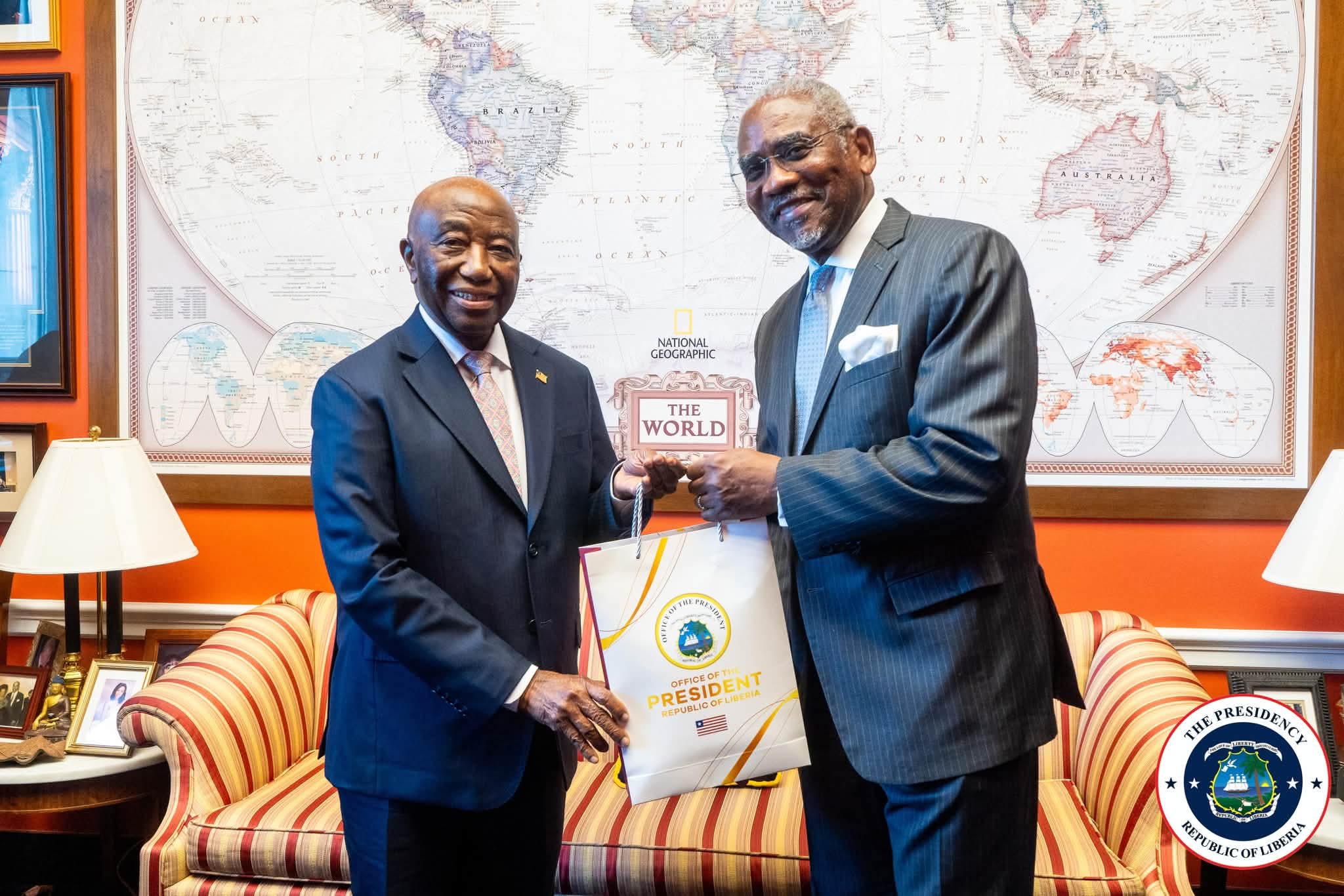
President Joseph Nyuma Boakai Sr. has intensified Liberia’s diplomatic engagement in Washington, holding high-level discussions with U.S. Congressman Gregory W. Meeks on strengthening bilateral relations, expanding economic cooperation and advancing shared interests in peace, security and multilateral diplomacy.
The meeting with Meeks, the Democratic representative for New York’s 5th Congressional District and Ranking Member of the U.S. House Committee on Foreign Affairs, formed part of President Boakai’s ongoing diplomatic mission in the United States. According to Liberia’s presidential release, the discussions focused on transforming the longstanding relationship between Monrovia and Washington into deeper practical cooperation in trade, investment, energy, infrastructure, security and institutional development.
The House Foreign Affairs Committee’s current membership listing confirms Meeks as the committee’s Ranking Member.
President Boakai used the engagement to outline his administration’s priorities, including democratic governance, peace and security, economic transformation, energy development, infrastructure and job creation.
He stressed that Liberia’s period of relative peace and political stability should translate into measurable improvements in living standards, including employment opportunities, stronger public institutions and increased private investment.
The emphasis on economic diplomacy comes as Liberia seeks to expand its participation in international markets and attract capital into sectors capable of generating employment and long-term growth.
Trade provides an important measure of the scale and potential of the bilateral economic relationship.
According to the U.S. Trade Representative, total U.S.-Liberia trade in goods and services was estimated at $493.9 million in 2025, a decline of 15.4 percent from 2024. Goods trade accounted for $180.9 million, comprising $108.7 million in U.S. exports to Liberia and $72.2 million in U.S. imports from Liberia. Services trade was considerably larger at an estimated $313 million.
Liberia remains eligible for the African Growth and Opportunity Act, or AGOA, and the two countries have maintained a Trade and Investment Framework Agreement since 2007.
The talks also carried significance beyond bilateral economics because of Liberia’s position on the United Nations Security Council for the 2026–2027 term.
The UN General Assembly elected Liberia and four other countries to two-year non-permanent terms beginning January 1, 2026, giving Monrovia a seat alongside the five permanent members and other elected members of the 15-member council.
Liberia’s current term marks its return to the Council after its previous membership in 1961, according to UN records.
President Boakai’s Washington engagement therefore comes at a moment when Liberia is seeking to use both its bilateral relationships and its multilateral role to advance national and regional priorities.
The Security Council seat provides Monrovia with a diplomatic platform on international peace and security, while closer engagement with U.S. policymakers could support dialogue on issues ranging from West African stability and development financing to investment and institutional cooperation.
Liberia is scheduled to assume the Council presidency in December 2026, under the UN’s rotating monthly presidency system.
The historical dimension of the relationship also gives the engagement particular importance.
The United States formally recognized Liberia in 1862 and established diplomatic relations in 1864.
The U.S. diplomatic mission in Monrovia was elevated to embassy status in 1949.
The relationship has subsequently encompassed political cooperation, development assistance, trade, health, security and other areas of bilateral engagement.
President Boakai was accompanied at the meeting by Foreign Affairs Minister and Dean of the Cabinet Sara Beysolow Nyanti; Minister Without Portfolio Hadja Mamaka Bility; National Security Advisor Samuel Kofi Woods; Director General of the Cabinet Nathaniel T. Kwabo; and Executive Assistant to the President Morie Nemah.
As the president continues his U.S. engagements, the central challenge for Liberia is translating longstanding diplomatic goodwill into concrete economic and development outcomes.
With bilateral goods and services trade still below $500 million annually and Liberia occupying a prominent multilateral role at the United Nations, the Boakai administration is seeking to position the relationship around investment, employment, infrastructure, energy, security and broader economic opportunity for Liberians.


