
By: Julius Konton
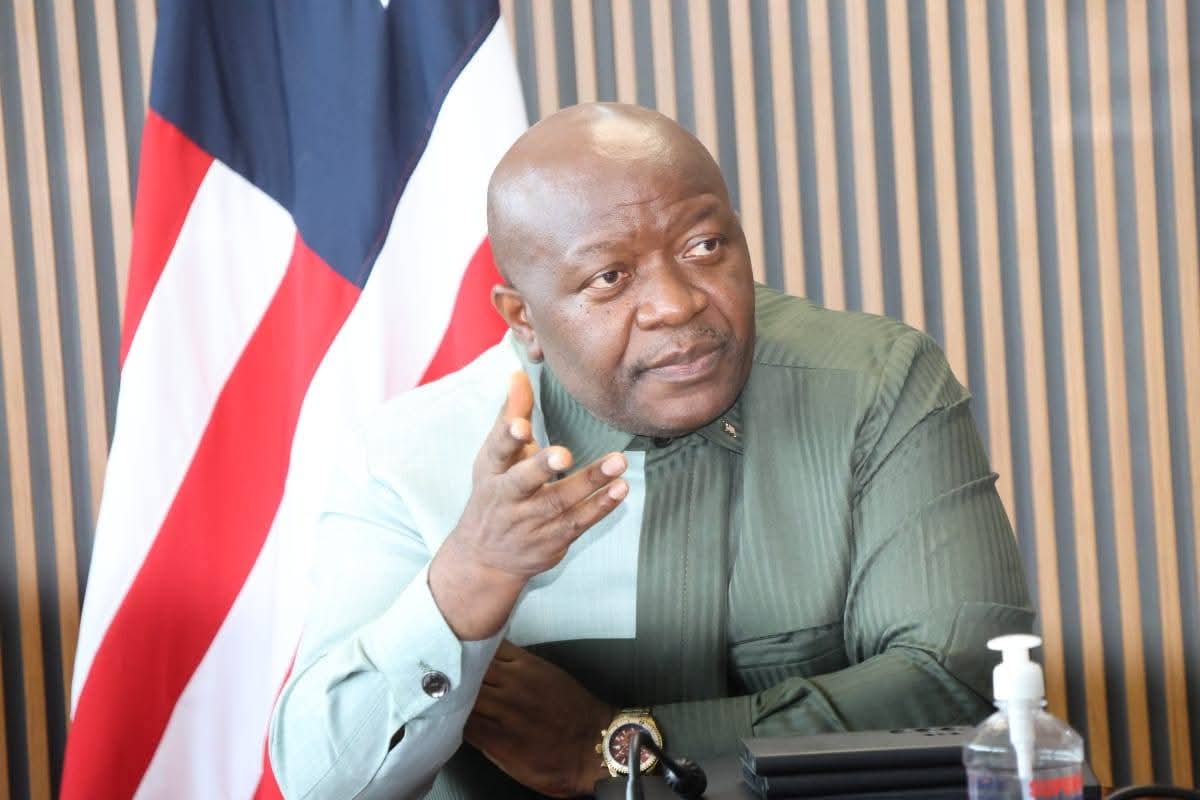
Liberia’s Finance and Development Planning Minister Augustine Kpehe Ngafuan has outlined an ambitious national vision aimed at rebuilding the country’s economic foundations beyond post-war recovery, declaring that the government is not merely restoring what existed before the civil conflict but laying the groundwork for a modern and resilient economy.
Speaking at the Millennium Challenge Corporation (MCC) Exit Conference Final Meeting on Compact Development near Monrovia, Minister Ngafuan emphasized that Liberia’s development agenda is anchored on transforming the energy sector, strengthening infrastructure, and mobilizing partnerships with international development institutions and the private sector.
According to the minister, Liberia is entering what he described as “a new day and a new age of development”, one that seeks to build a stronger economic backbone capable of generating sustainable growth and unifying the country after decades of instability.
“We are not simply trying to go back to the pre-war status,” Ngafuan said. “We are rebuilding our country for a new era, creating a stronger economic foundation that will support growth, stability, and opportunity for the Liberian people.”
Energy Identified as Liberia’s Most Critical Development Constraint
At the center of Liberia’s economic transformation strategy is the energy sector, which policymakers and international partners have long identified as one of the country’s most significant barriers to economic growth.
Liberia remains one of the countries with the highest electricity costs and lowest access rates in West Africa.
According to World Bank data, less than 35 percent of Liberia’s population currently has access to electricity, with access in rural areas dropping below 10 percent.
The situation is particularly challenging for businesses.
Electricity tariffs in Liberia have historically ranged between US$0.25 and US$0.35 per kilowatt-hour, significantly higher than the global average and well above the cost in many neighboring countries.
Ngafuan argued that addressing the energy deficit could unlock economic growth across sectors including manufacturing, agriculture, mining, and services.
“The private sector is often described as the engine of growth,” the minister said. “But I want to amend that statement: the engine of the private sector is power. If we materially address the power challenge in Liberia, we empower businesses, we empower job creation, and we empower economic growth.”
$1.2 Billion Energy Roadmap Under ‘Mission 300’
The Liberian government has already developed a comprehensive energy compact under the “Mission 300” initiative, a major electrification strategy supported by the World Bank and the African Development Bank (AfDB).
The roadmap is estimated to require more than $1.2 billion in investments, targeting improvements across the entire electricity value chain, including:
Power generation
Transmission infrastructure
Distribution networks
Regional energy integration
Private sector participation
Mission 300 is part of a broader continental initiative aimed at connecting 300 million Africans to electricity by 2030, addressing one of Africa’s most pressing development challenges.
Ngafuan explained that Liberia intends to mobilize resources from multiple stakeholders to achieve this goal.
“Our intention is to bring all players on board, government, the private sector, and development partners to support generation, transmission, and distribution,” he said.
“We are taking this process extremely seriously.”
Legacy of War Still Haunts Liberia’s Infrastructure
Liberia’s current infrastructure deficit is closely tied to the destruction caused by two civil wars between 1989 and 2003, which devastated the country’s economy and critical infrastructure.
One of the most symbolic casualties of the conflict was the Mount Coffee Hydropower Plant, the country’s main electricity generation facility before the war.
The plant was heavily damaged during the fighting, leaving Liberia without reliable electricity for nearly two decades.
The facility was eventually rehabilitated and reopened in 2016 with support from international partners, including the United States, the European Union, Germany, and Norway.
Today, Mount Coffee produces roughly 88 megawatts of electricity, though demand continues to exceed supply.
Ngafuan acknowledged that rebuilding such infrastructure has been a slow and complex process.
“Liberians have endured years of hardship,” he said. “The war destroyed critical infrastructure like the Mount Coffee Hydro facility, and rebuilding these systems takes time, resources, and strong partnerships.”
MCC Compact Development Process Underway
The ongoing discussions with the Millennium Challenge Corporation (MCC) represent a critical step toward unlocking new development financing for Liberia.
The MCC, a United States government development agency, provides large-scale grants known as “compacts” to countries that demonstrate strong governance, economic freedom, and investment in their citizens.
Liberia previously benefited from a $257 million MCC Compact (2016–2021) that focused largely on improving the electricity sector and strengthening the Liberia Electricity Corporation (LEC).
The new compact development process currently underway could lead to another significant investment package, though the final funding amount will depend on project proposals and evaluation results.
Ngafuan noted that the development process typically takes 18 months to two years, but Liberia intends to move as quickly as possible.
“There are processes that we cannot reroute because they are beyond our control,” he said. “But those that are within our control, we will move swiftly.”
Partnership with the United States and Development Partners
The finance minister also used the occasion to express gratitude to the United States Embassy in Monrovia and the MCC team for their guidance and technical support during the compact development discussions.
He urged international partners to continue supporting Liberia’s development journey not for political leaders, but for the broader population seeking economic opportunity.
“Continue to support Liberia not for President Boakai or for me but for the Liberian people who are yearning for development,” Ngafuan said.
He added that the government views the partnership with international institutions as critical to achieving its economic goals.
Two Weeks of Technical Engagements
According to Ngafuan, Liberian officials and development partners spent two weeks conducting intensive technical consultations, including workshops focused on identifying the root causes of economic constraints.
The discussions were held in Monrovia and Ganta, Nimba County, bringing together government experts, development partners, and technical specialists.
These sessions focused on areas such as:
Energy sector reform
Infrastructure development
Economic diversification
Institutional capacity building
Ngafuan praised both Liberian technical teams and international partners for what he described as a productive and collaborative process.
“It has not been a walk in the park,” he acknowledged.
“But we operated in the spirit of partnership and mutual understanding.”
Development as a Tool for National Unity
Beyond economic growth, Ngafuan argued that development can also play a crucial role in strengthening national unity and long-term peace.
He stressed that when citizens see tangible improvements in infrastructure, employment, and economic opportunity, they become stronger stakeholders in maintaining stability.
“The more we develop our country, the more we unite our people,” he said.
“When development comes, citizens have a stake in peace.”
A Race Against Time
For Liberia’s government, the challenge now lies in converting ambitious plans into concrete projects.
The country still faces multiple structural challenges, including:
Limited fiscal space
Heavy reliance on foreign aid
High youth unemployment
Weak infrastructure outside major cities
Yet Ngafuan remains optimistic that Liberia’s partnerships with institutions such as the World Bank, AfDB, MCC, and the United States Government will help accelerate progress.
“We are on a noble journey,” he said. “The road will not be easy, but with the partnerships we have built, we believe Liberia will succeed.”
