
By: Julius Konton
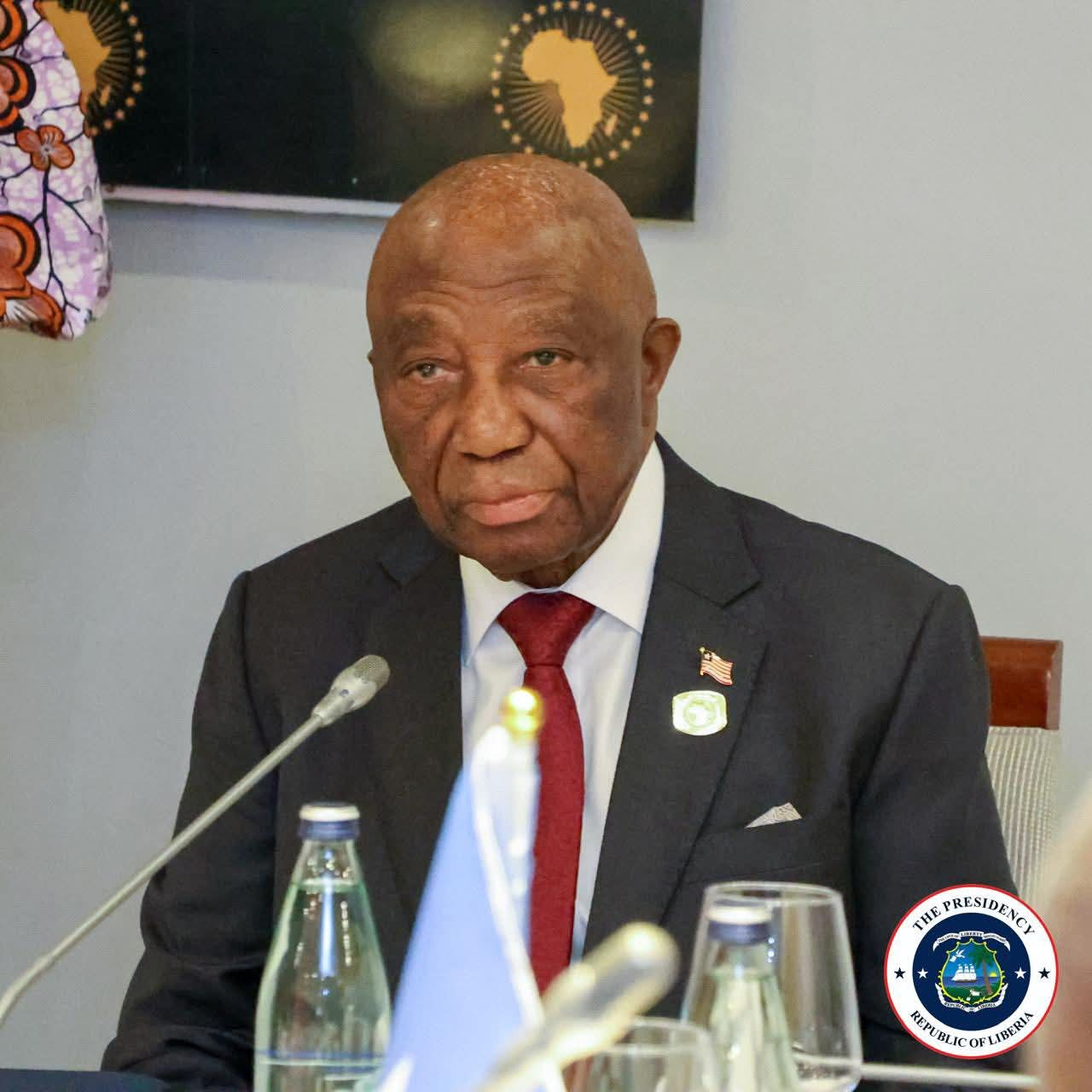
President Joseph Nyuma Boakai Sr. has called for sweeping, system-wide reform of the United Nations, urging African nations to speak with unity and clarity as the global body prepares to elect its next Secretary-General.
Speaking at a High-Level Breakfast Consultation on the Future of the United Nations at the Marriott Hotel on the margins of the African Union Summit, President Boakai described the UN as standing “at a crossroads,” grappling with prolonged conflicts, expanding humanitarian crises, fragile development gains, and declining public trust in multilateral institutions.
“For nearly 80 years, the United Nations has embodied the hope that cooperation would prevail over conflict,” Boakai told African and international leaders. “Yet today, its relevance and effectiveness are being tested as never before.”
Africa’s Historic Stake in the United Nations
Boakai reminded delegates that while Africa was underrepresented at the UN’s founding in 1945, the continent has since become central to the Organization’s mission. Africa today accounts for 54 of the UN’s 193 member states more than 28 percent of the General Assembly and hosts the majority of UN peacekeeping and political missions worldwide.
Liberia, he noted, holds a unique place in UN history.
It is one of only four African countries that were original signatories to the UN Charter, underscoring Africa’s long-standing, if often overlooked, engagement with global multilateralism.
The UN currently deploys over 70,000 peacekeepers, with more than half stationed in Africa, while the continent receives a significant share of UN humanitarian and development assistance, reflecting both its strategic importance and persistent vulnerabilities.
Reform Pressures Mount Across Global Blocs
Boakai acknowledged that calls for UN reform have intensified across political and geographic lines.
European powers including France, United Kingdom, Germany, and Japan have advocated for a leaner, more efficient UN system, emphasizing oversight, coordination, and measurable results.
Meanwhile, emerging powers such as China and India, alongside the Non-Aligned Movement, have pushed for reforms that reflect current geopolitical realities and strengthen the voice of developing countries.
Across Africa and the Global South, leaders continue to demand predictable financing, stronger conflict prevention mechanisms, and better coordination among UN agencies operating at country level.
Beyond Budgets: A Systemic Challenge
While welcoming renewed commitments by major contributors particularly the United States to settle outstanding financial obligations to the UN, Boakai cautioned that funding alone will not resolve the Organization’s deeper challenges.
“An underfunded UN cannot function effectively,” he said. “But the difficulties confronting the Organization are not only financial, they are systemic.”
According to UN budget data, the Organization’s regular biennial budget stands at approximately US$6.8 billion, while peacekeeping operations rely on a separate, often delayed funding stream.
Persistent arrears, management inefficiencies, and overlapping mandates have further strained operations.
Reform, Boakai argued, must therefore address priority-setting, mandate implementation, institutional coordination, and leadership effectiveness in an increasingly fragmented global order.
Africa’s Collective Platform and the C10
The Liberian leader praised the work of the African Union Committee of Ten (C10), established to advance Africa’s common position on UN reform, particularly Security Council restructuring.
The C10, he said, has ensured Africa remains a principled and strategic actor in global reform debates, reinforcing the need for collective engagement rather than fragmented national approaches.
UN Secretary-General Selection: A Defining Moment
Boakai linked the reform debate to the imminent selection of the next UN Secretary-General, describing the process as “far more than administrative.”
The Secretary-General, he said, will define the Organization’s credibility, reform momentum, and moral authority at a time of global uncertainty.
As Liberia chairs the African Group at the UN in New York this month, Boakai said the moment was opportune for Africa to reflect on its shared expectations amid growing debate over regional rotation, leadership renewal, and the constraints of second terms.
“Africa must not be a peripheral participant or passive observer,” he stressed.
“We represent more than a quarter of UN membership and bear a disproportionate share of global challenges.”
A Call for Unity and Courage
In closing, Boakai urged African states to engage constructively with global partners while insisting that reform addresses relevance, effectiveness, and trust, not budgets alone.
“The future of the United Nations will be shaped by those who lead with clarity and courage,” he said. “Africa must be among them speaking with one voice and committed to a multilateral system that truly serves all nations.”
