




By: Julius Konton
Liberia has renewed its call for accelerated global nuclear disarmament, urging nuclear-armed states to honor their obligations under the Treaty on the Non-Proliferation of Nuclear Weapons (NPT) while reaffirming the right of countries to access nuclear technology for peaceful development.
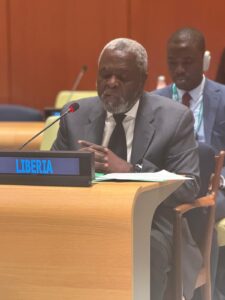
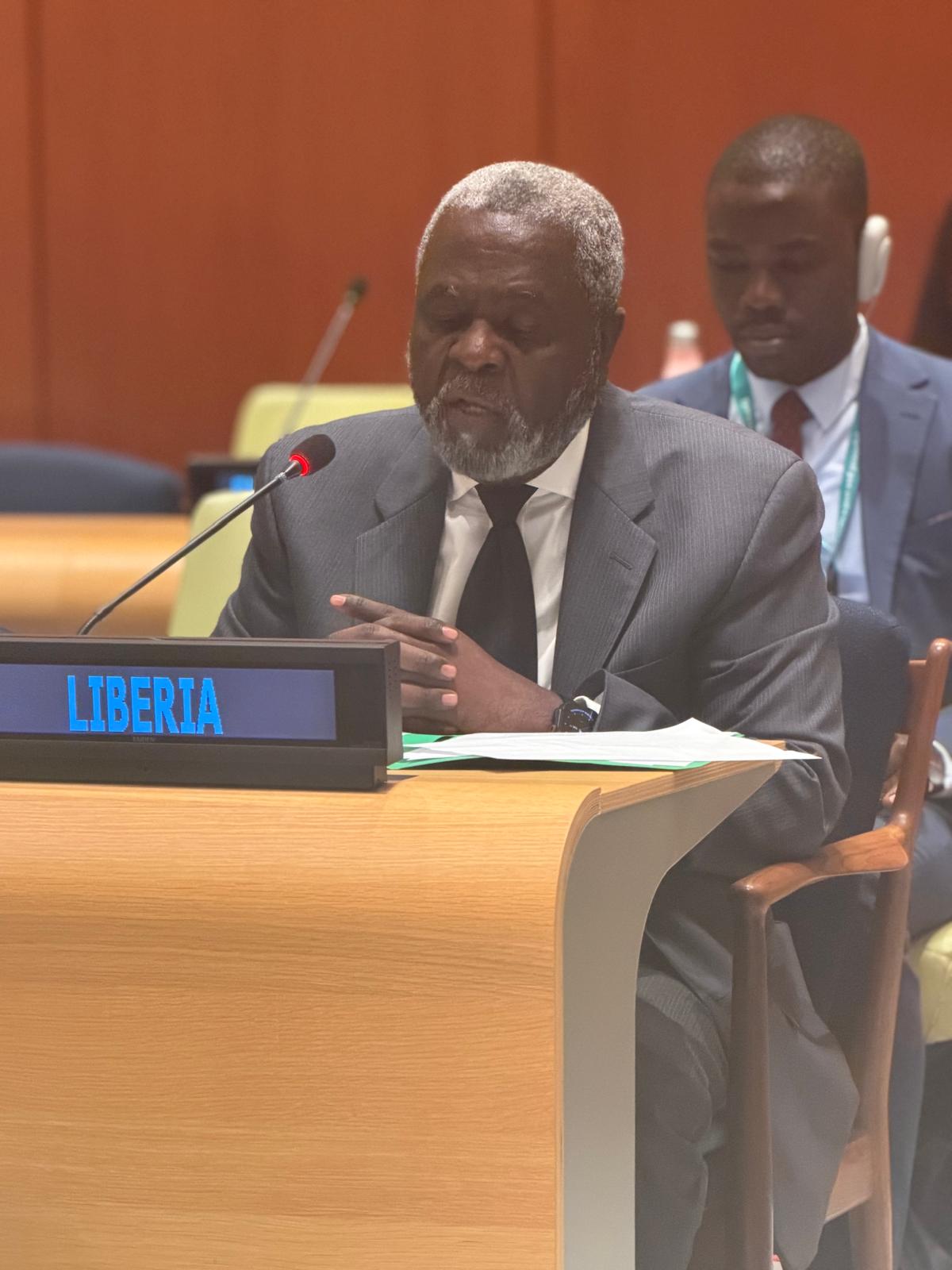
Delivering Liberia’s position during a high-level plenary meeting at the United Nations in New York on September 29 to commemorate the International Day for the Total Elimination of Nuclear Weapons, Liberia’s Permanent Representative to the United Nations, Ambassador Lewis G. Brown II, called on states that remain outside the NPT to join the treaty and urged nuclear-weapon states to fulfill their disarmament obligations under Article VI.
The UN meeting came amid renewed international concern over the future of global arms control.
The United Nations says nuclear disarmament has been a central concern since the organization’s first General Assembly resolution in 1946, adopted only months after the atomic bombings of Hiroshima and Nagasaki.
The International Day for the Total Elimination of Nuclear Weapons is observed annually on September 26, while the 2026 high-level plenary meeting was held at UN Headquarters on September 29.
The Liberian appeal comes as the global nuclear arsenal remains substantial despite decades of arms-control and disarmament negotiations.
According to the Stockholm International Peace Research Institute (SIPRI), the nine nuclear-armed states, the United States, Russia, United Kingdom, France, China, India, Pakistan, North Korea and Israel possessed an estimated 12,187 nuclear warheads at the beginning of 2026.
Of that total, approximately 9,745 warheads were in military stockpiles potentially available for use, while an estimated 4,012 were deployed with operational forces.
SIPRI estimates that between 2,100 and 2,200 nuclear warheads were maintained on high operational alert, primarily on ballistic missiles.
Russia and the United States together account for approximately 83 percent of the world’s military stockpiled nuclear warheads, according to SIPRI, underscoring the disproportionate role of the two largest nuclear powers in global arms-control negotiations.
SIPRI also reported in 2026 that all nine nuclear-armed states continued to modernize their arsenals during 2025, while warning that the long-term decline in global nuclear inventories could be reversed as the dismantlement of retired weapons slows and new warheads enter stockpiles.
Against that backdrop, Ambassador Brown reiterated Liberia’s support for the principle that nuclear war must never be fought.
He described the NPT as a critical pillar of international peace and security and called for greater compliance with its obligations, particularly the commitment by nuclear-weapon states to pursue negotiations toward nuclear disarmament.
Brown warned against defining international security solely through the possession of nuclear weapons, arguing that a security system based on the threat of mutual destruction cannot provide a durable foundation for peace.
“Security built on mutual annihilation is not peace; it is merely an armistice with catastrophe,” Brown said, according to Liberia’s statement.
He further emphasized the humanitarian consequences of any nuclear exchange, noting that a nuclear detonation would have consequences extending far beyond military targets and could overwhelm humanitarian and emergency-response systems.
Liberia’s position is rooted in the three broad pillars of the NPT: nuclear non-proliferation, nuclear disarmament and the peaceful use of nuclear energy.
Article VI commits the parties to pursue negotiations in good faith on effective measures relating to the cessation of the nuclear arms race and nuclear disarmament, as well as a treaty on general and complete disarmament under effective international control.
At the same time, the treaty recognizes the right of its parties to develop and use nuclear energy for peaceful purposes in conformity with their non-proliferation obligations.
Article IV specifically provides for international cooperation in peaceful nuclear research, technology and applications.
Liberia therefore called for a balanced approach that combines stronger disarmament and non-proliferation measures with expanded access to peaceful nuclear technology.
Brown reaffirmed Liberia’s support for the International Atomic Energy Agency’s safeguards and verification mechanisms, which are designed to help ensure that peaceful nuclear activities are not diverted toward weapons programmes.
Liberia also backed greater international cooperation in the peaceful application of nuclear science and technology, including potential uses in healthcare, agriculture, food security, scientific research and broader development.
Under the NPT framework, non-nuclear-weapon states accept safeguards intended to verify compliance and prevent the diversion of nuclear material from peaceful purposes toward nuclear weapons.
For developing countries, peaceful nuclear applications can contribute to areas such as medical diagnosis and treatment, agricultural research, food irradiation, water management and industrial applications when deployed under appropriate international safeguards.
Liberia’s intervention comes at a particularly sensitive moment for the global nuclear order.
The 2026 SIPRI assessment found that arms-control arrangements have weakened while major nuclear powers continue to modernize their arsenals.
SIPRI also noted growing risks associated with technological developments, including artificial intelligence, cyber capabilities and advanced delivery systems that could complicate nuclear decision-making.
The UN General Assembly’s 2026 commemoration likewise highlighted the continued presence of more than 12,000 nuclear warheads worldwide and the fact that more than 2,000 remain on high operational alert.
The UN warned that the global stockpile could begin growing again if new warheads enter arsenals faster than older weapons are dismantled.
The concerns represent a significant change from the post-Cold War period, when the global nuclear inventory generally declined as Russia and the United States dismantled retired weapons.
SIPRI now says the pace of dismantlement is slowing while several nuclear-armed countries are expanding or modernizing their capabilities.
For Liberia, the answer to the growing nuclear risk lies in diplomacy, multilateral institutions, verification and sustained dialogue rather than escalating nuclear competition.
Brown reaffirmed Monrovia’s support for multilateralism and international cooperation, emphasizing the importance of strengthening institutions responsible for non-proliferation, verification and peaceful nuclear cooperation.
Liberia’s message at the United Nations was ultimately framed around a broader vision of international security, one in which diplomacy takes precedence over confrontation, international law over unilateral pressure, and human security over the continued accumulation of weapons capable of catastrophic destruction.
As the international community confronts renewed geopolitical tensions and a changing nuclear landscape, Monrovia is calling for the commitments contained in the NPT and broader UN disarmament framework to move beyond diplomatic declarations and into measurable action.
The UN’s own historical record underscores the longevity of that objective: nuclear disarmament was already identified as an international priority in the organization’s first General Assembly resolution in 1946, eight decades before Liberia delivered its latest appeal.


