


By: Julius Konton
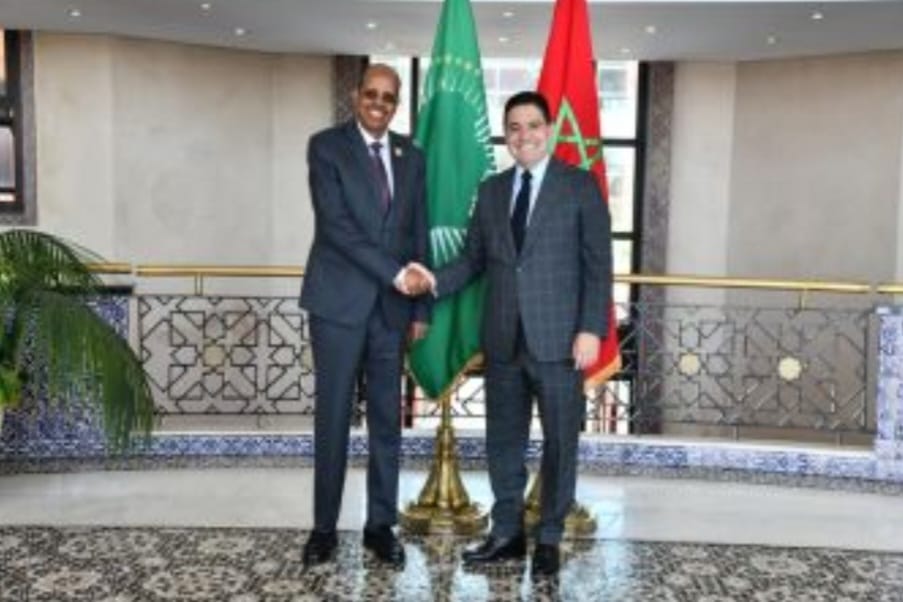
Morocco’s Minister of Foreign Affairs, African Cooperation and Moroccan Expatriates, Nasser Bourita, held high-level talks Wednesday in Rabat with the Chairperson of the African Union Commission, Mahmoud Ali Youssouf, in a meeting that signals renewed momentum in Africa’s continental integration and development agenda.
The discussions took place against the backdrop of the 58th session of the Conference of African Ministers of Finance, Planning and Economic Development, convened by the United Nations Economic Commission for Africa in Tangier from March 8 to April 3, 2026. The conference, one of Africa’s most significant economic policy platforms, has drawn policymakers from over 50 African countries, representing economies with a combined GDP exceeding $3 trillion.
Advancing Agenda 2063: A Continental Blueprint
Central to the Rabat talks was the acceleration of Agenda 2063, the African Union’s long-term blueprint aimed at transforming Africa into a global powerhouse through inclusive growth and sustainable development.
Bourita and Youssouf explored mechanisms to institutionalize cooperation between Morocco and the AU Commission, focusing on:
Infrastructure development and regional connectivity
Trade integration under the African
Continental Free Trade Area (AfCFTA)
Climate resilience and energy transition
Digital transformation across African economies
According to AU data, full implementation of AfCFTA alone could increase intra-African trade by over 50% by 2030, while lifting tens of millions out of poverty.
Morocco’s Expanding Role in African Diplomacy
Since rejoining the African Union in 2017 after a 33-year absence, Morocco has rapidly positioned itself as a key diplomatic and economic actor on the continent.
The AU Commission Chairperson commended Morocco’s growing contribution to peace, security, and development initiatives under the leadership of King Mohammed VI.
Morocco has invested billions of dollars in African banking, telecommunications, agriculture, and renewable energy sectors, particularly in West and Central Africa.
Notably, Morocco’s recent election to a third term on the AU Peace and Security Council (PSC) underscores its rising influence in continental governance.
The PSC plays a critical role in conflict prevention and resolution across Africa, where over 20 active conflicts and political crises currently demand coordinated intervention.
Peace, Security, and Regional Stability in Focus
Beyond economic cooperation, the Rabat meeting addressed pressing security challenges, including:
Terrorism in the Sahel region
Political instability in parts of West and Central Africa
Maritime security in the Gulf of Guinea
Migration flows and human trafficking
Africa continues to bear a disproportionate share of global instability, accounting for nearly 40% of UN peacekeeping missions worldwide. Both leaders emphasized the need for African-led solutions, enhanced intelligence-sharing, and stronger institutional frameworks.
Tangier Conference: A Platform for Economic Transformation
The UNECA conference in Tangier has served as a critical forum for aligning fiscal and development policies across African states. Discussions this year have centered on:
Debt sustainability, with Africa’s external debt surpassing $1.1 trillion
Inflation control amid global economic shocks
Climate financing gaps estimated at $250 billion annually
Industrialization and value-chain development
Youssouf’s participation in the conference highlights the AU Commission’s effort to synchronize political leadership with economic policymaking across the continent.
A Strategic Partnership with Continental Implications
Analysts view the Rabat meeting as part of a broader geopolitical recalibration within Africa, where regional powers like Morocco are playing increasingly prominent roles in shaping continental priorities.
By strengthening ties with the AU Commission, Morocco is not only reinforcing its diplomatic footprint but also contributing to the operationalization of Africa’s long-term vision for unity, peace, and prosperity.
As Africa navigates complex global challenges from economic volatility to security threats the evolving partnership between Morocco and the African Union could prove pivotal in determining the continent’s trajectory over the coming decades.


