
By: Julius Konton
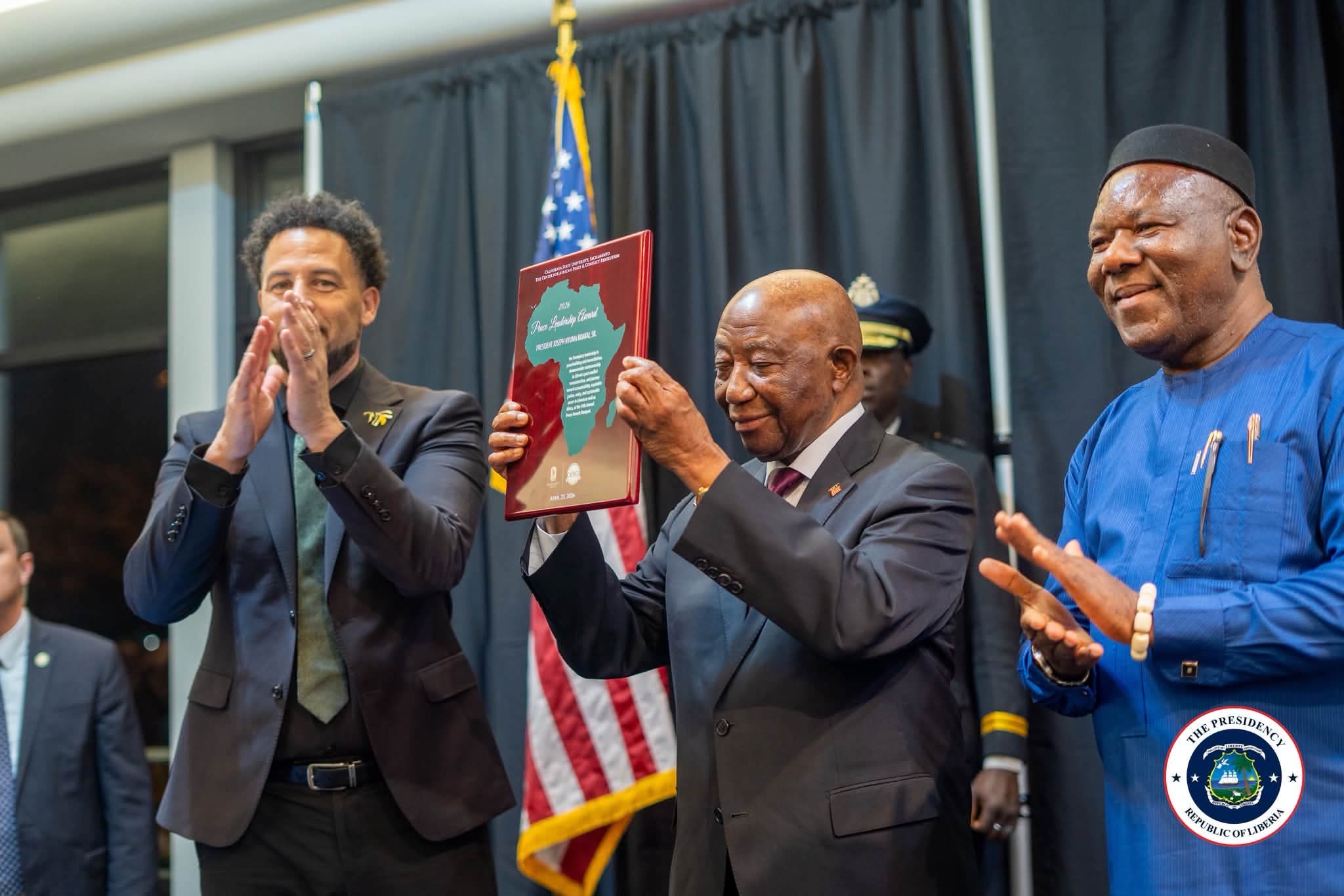
Liberian President Joseph Nyuma Boakai Sr. has called for renewed international cooperation to safeguard global peace and security after receiving one of the world’s notable annual peace honors during ceremonies in the United States.
Speaking at the 30th Anniversary of the Center for African Peace and Conflict Resolution (CAPCR) at California State University, Sacramento, President Boakai was presented the 34th Annual Peace Award under the theme “Honoring Our Peace Heroes.”
The Liberian leader used the platform to urge governments, institutions, and citizens worldwide to unite against rising instability, extremism, inequality, and geopolitical tensions threatening international peace.
“Peace must be continuously protected. No nation is too small to contribute, and no voice is too quiet to matter,” President Boakai declared before an audience of diplomats, academics, students, and African diaspora leaders.
Liberia’s Transformation from Conflict to Stability
Boakai highlighted Liberia’s own painful but inspiring journey from civil war to democratic recovery.
Liberia’s two civil wars between 1989 and 2003 claimed an estimated 250,000 lives, displaced nearly half the population, and devastated infrastructure and institutions.
Yet since the signing of the Accra Peace Agreement in 2003, the West African nation has held multiple peaceful democratic elections and maintained relative political stability.
The President said Liberia’s post-war progress demonstrates that peace can flourish where fairness, inclusion, justice, and rule of law are prioritized.
“Our democratic transition became possible because Liberia chose reconciliation over revenge and institutions over division,” he noted.
UN Security Council Role
Boakai further announced that Liberia intends to use its 2026–2027 tenure on the United Nations Security Council to advance diplomacy, dialogue, and international cooperation.
Liberia was elected as a non-permanent member of the Security Council, returning to the body for the first time in more than six decades.
Analysts say the move marks a significant diplomatic milestone for a country once synonymous with conflict.
The President said Liberia would advocate:
Preventive diplomacy
Stronger multilateral cooperation
Peaceful dispute resolution
Youth inclusion in governance
Regional security partnerships
Warning Over Africa’s Youth Crisis
A major focus of Boakai’s keynote address was Africa’s demographic future.
According to the United Nations, sub-Saharan Africa is the world’s youngest region, with nearly 70% of its population under age 30. By 2050, one in every four people on Earth is projected to be African.
Boakai warned that without education, jobs, and political inclusion, millions of young Africans could become vulnerable to unrest, organized crime, violent extremism, and forced migration.
“Young people must become engines of innovation and peace not casualties of neglect,” he said.
He urged African governments to invest heavily in:
Skills training
Entrepreneurship
Civic education
Digital literacy
Leadership fellowships
Youth mentorship programs
Education Reform and Technology
The Liberian President also called for a new education philosophy across Africa, one that teaches peacebuilding, critical thinking, patriotism, and technology from primary school through university.
He emphasized the role of digital platforms in combating misinformation, strengthening civic participation, and promoting cross-border solidarity.
“Technology must be used to educate, connect, and heal not divide,” he said.
Diaspora Engagement
Boakai further appealed to Africans living abroad to play a greater role in reconciliation and development efforts across the continent.
He noted that peace leadership should not be limited to presidents or diplomats, but should include students, entrepreneurs, educators, religious leaders, and communities worldwide.
About CAPCR
The Center for African Peace and Conflict Resolution (CAPCR) was founded in 1996 at California State University Sacramento during the post-Cold War period, when many African nations were grappling with civil conflict.
For three decades, the institution has focused on:
Mediation training
Policy research
Conflict prevention
Leadership dialogue
Governance advocacy
Peace recognition awards
Its annual Peace Award has honored distinguished leaders and institutions promoting peace, democracy, and reconciliation.
Award Acceptance
President Boakai thanked organizers for the recognition and said the award would strengthen his resolve to serve Liberia, Africa, and the wider international community.
“I accept this honor as motivation to continue working for a prosperous Liberia, a peaceful Africa, and a more just world.”
Global Significance
Boakai’s award comes at a time when conflicts persist in several regions, including parts of Africa, Eastern Europe, and the Middle East, while economic shocks and climate pressures intensify social tensions globally.
Observers say Liberia’s transformation from war-torn state to advocate for peace gives Boakai’s message added moral authority on the international stage.
