
By: Akoi M. Baysah, Jr.
Artificial intelligence is rapidly transforming the global media landscape, shifting the focus from mere adoption to effective utilization as the key driver of journalistic competitiveness.
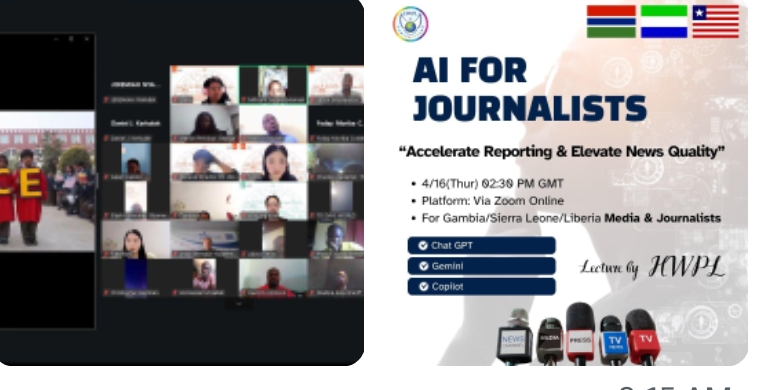
Against this backdrop, Heavenly Culture, World Peace, Restoration of Light (HWPL) on April 16 conducted an online training session aimed at strengthening the capacity of African journalists in AI-based reporting.
The virtual program, held via Zoom, brought together about 50 media professionals from Liberia, Sierra Leone, and The Gambia.
The training emphasized practical, hands-on applications of AI tools that can be directly integrated into newsroom workflows.
Facilitators highlighted that in today’s media environment, journalists are no longer competing with artificial intelligence itself, but with peers who are better equipped to use these technologies efficiently.
Participants were introduced to leading AI platforms, including ChatGPT, Gemini, Claude, and Grok. Each tool was presented based on its strengths, ranging from research and writing to document analysis and real-time verification.
Trainers encouraged a “toolset approach,” combining multiple platforms depending on the task, rather than relying on a single solution.
A key takeaway from the session was the need to view AI not simply as an automation tool, but as a collaborative assistant that enhances productivity while preserving human editorial judgment.
HWPL stressed that core journalistic principles—accuracy, fairness, and verification, remain indispensable, particularly as AI-generated content can appear credible despite potential inaccuracies.
The training also addressed ethical concerns, including the risks of misinformation and the misuse of AI-generated visuals. Participants were urged to clearly label synthetic content and uphold transparency to maintain audience trust.
Beyond technical skills, the initiative underscores broader goals of digital transformation, peace journalism, and cross-border collaboration.
By equipping journalists with relevant AI competencies, the program aims to bridge information gaps and foster stronger professional networks across the region.
Lead trainer Joseph Joe noted that responsible usage, not speed of adoption, will define the credibility of modern journalism.
He expressed hope that the training would empower journalists to adapt to technological changes while safeguarding public trust.
As AI continues to evolve, it is not only reshaping newsroom tools but also redefining the role and responsibilities of journalists in an increasingly digital world.
