
By: Julius Konton
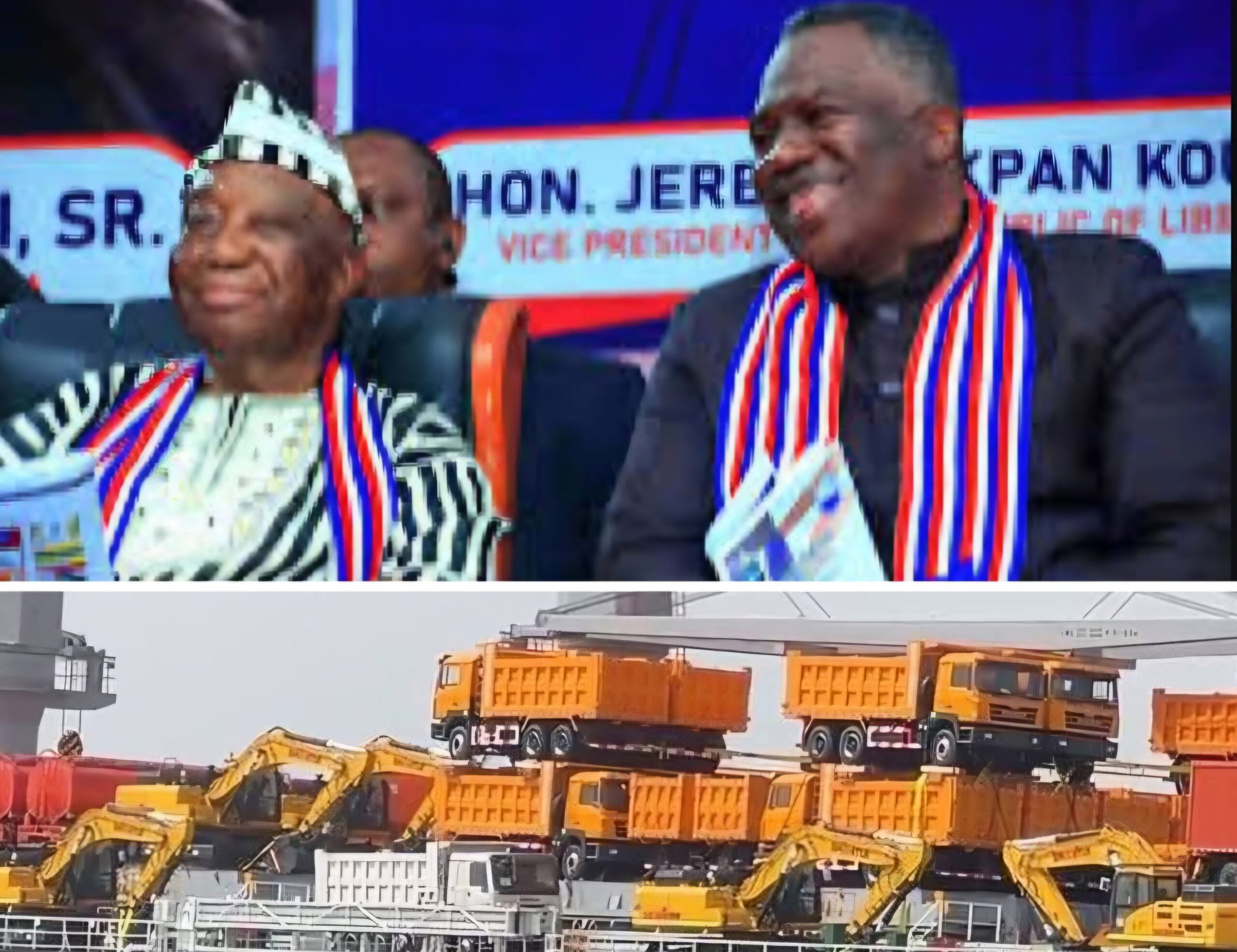
In a major step toward addressing Liberia’s long-standing infrastructure deficit, President Joseph Nyuma Boakai on Monday personally witnessed the arrival and offloading of the first batch of 137 earth-moving machines at the National Port Authority, operated by APM Terminals, marking a significant milestone in the government’s national road construction agenda.
The delivery represents the fulfillment of a key campaign and governance pledge by the Boakai’s administration to rehabilitate and expand Liberia’s road network, one of the most critical bottlenecks to economic growth, regional integration, and service delivery in the West African nation of Liberia.
A Symbolic and Strategic Moment
Standing on the bustling docks of the Freeport of Monrovia, President Boakai led a high-level delegation of cabinet ministers, senior government officials, and development planners to observe firsthand the unloading process, followed by a guided inspection tour of the heavy-duty equipment.
The machines popularly known as “yellow machines” include graders, bulldozers, excavators, compactors, and loaders, which are expected to form the backbone of a decentralized road construction and maintenance program across all of Liberia’s 15 counties.
“This is not just about machines,” a senior official noted. “It is about restoring mobility, connecting farmers to markets, reducing transport costs, and accelerating national development.”
Addressing a Historic Infrastructure Gap
Liberia has historically struggled with inadequate road infrastructure.
According to public works estimates, less than 20 percent of Liberia’s road network is paved, with many rural communities cut off during the rainy season.
Poor road access has long hindered agricultural productivity, access to health care, education, and domestic trade.
Successive governments have acknowledged that roads remain one of the most capital-intensive but transformative investments for Liberia’s post-war recovery and long-term development.
The arrival of the equipment signals a shift from heavy reliance on external contractors toward state-owned road-building capacity, a model increasingly adopted by developing economies seeking cost efficiency and sustainability.
Governance, Transparency, and Accountability Measures
In a move aimed at ensuring transparency, accountability, and long-term maintenance, President Boakai has already constituted a presidential task force to oversee the deployment, use, and upkeep of the equipment.
The task force is chaired by former Minister of National Defense J. Brownie Samukai, and comprises engineers, auditors, and logistics experts tasked with preventing misuse, politicization, or premature deterioration of the assets.
Government officials say the framework includes:
Centralized asset tracking
County-based deployment schedules
Operator training and certification
Maintenance and spare-parts management systems
Nationwide Impact Across All Counties
According to the Ministry of Public Works and development planners, each of Liberia’s fifteen counties will receive a designated share of the machines, ensuring equitable distribution and reducing historic regional disparities in infrastructure investment.
The initiative is expected to:
Open farm-to-market roads
Improve access to mining and forestry corridors
Support county-level development agendas
Reduce transport costs and travel times
Government Commendation and Economic Outlook
Among the first senior officials to publicly commend the initiative was the Minister of Finance and Development Planning Augustine Kpehe Ngafuan, who praised the leadership of President Boakai and Vice President Jeremiah Kpan Koung.
“I extend profound congratulations to President Joseph Nyuma Boakai and Vice President Jeremiah Kpan Koung for the decisive leadership that culminated in the arrival of the first batch of 137 pieces of earth-moving equipment to be deployed across our counties to enhance national development,” Ngafuan said.
He acknowledged that Liberia’s development journey remains ongoing but emphasized measurable progress.
“While we are not yet where we want to be, we are certainly not where we used to be.
Today is better than yesterday and tomorrow will be better than today,” he added.
Government sources indicate that additional batches of equipment are expected in subsequent phases, alongside complementary investments in road financing, local contractor empowerment, and skills development.
As Liberia continues to pursue its ARREST Agenda for Inclusive Development, analysts say the success of this initiative will ultimately be measured not by the arrival of machines alone, but by kilometers of roads built, communities connected, and livelihoods improved.
For now, the sight of heavy machinery rolling onto Liberian soil has become a powerful symbol of renewed state capacity and a tangible sign that, for many Liberians, long-awaited roads may finally be within reach.
