
By: Julius Konton
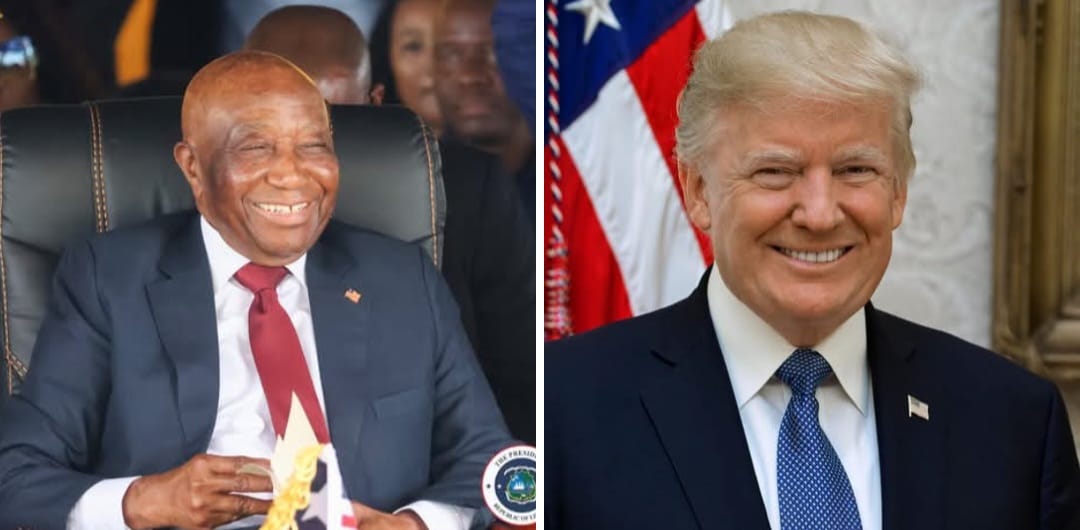
Liberian President Joseph Nyuma Boakai, Sr. on Sunday, December 21, held a cordial telephone conversation with United States President Donald J. Trump, underscoring renewed diplomatic engagement between the two longtime partners at a pivotal moment in Liberia’s national and international trajectory.
According to the Executive Mansion, the high-level discussion focused on mutual strategic interests, including regional peace and stability in West Africa, democratic governance, economic development, and security cooperation.
The exchange comes as Liberia consolidates recent governance reforms and assumes a more prominent role on the global stage.
President Trump conveyed warm greetings to President Boakai and the people of Liberia, while reaffirming Washington’s recognition of the historic relationship between the two nations, a bond dating back more than 175 years.
Liberia, founded in 1847 by formerly enslaved people from the United States, remains America’s oldest diplomatic partner in sub-Saharan Africa.
President Boakai welcomed the engagement and highlighted his administration’s priorities centered on institutional reform, anti-corruption efforts, inclusive economic growth, and national development.
He emphasized Liberia’s commitment to democratic stability at a time when parts of the region continue to grapple with political transitions and security threats.
A Relationship Anchored in History and Measurable Support
The United States has historically been Liberia’s largest bilateral partner.
Since the end of Liberia’s civil war in 2003, the U.S. government has provided over US$2.4 billion in assistance, supporting peacekeeping, democratic institutions, healthcare, education, and infrastructure development.
American support played a critical role in post-war stabilization, including backing the UN Mission in Liberia (UNMIL), which helped disarm more than 100,000 combatants before its drawdown in 2018.
In recent years, U.S. assistance has increasingly emphasized governance reforms, private-sector growth, and security-sector professionalization, aligning with Liberia’s national development agenda.
Liberia remains a major beneficiary of U.S. programs such as USAID, PEPFAR, and the Millennium Challenge Corporation (MCC), which has invested hundreds of millions of dollars in electricity expansion, road rehabilitation, and institutional strengthening.
Security Council Seat Adds Global Weight
The call also comes on the heels of Liberia’s assumption of a non-permanent seat on the United Nations Security Council, a position that elevates the country’s diplomatic profile and influence on global peace and security matters.
Liberia now joins a select group of nations tasked with shaping responses to international conflicts, sanctions regimes, and peacekeeping mandates.
Government officials say the Boakai–Trump conversation reflects ongoing diplomatic engagement as Liberia seeks to leverage international partnerships to advance its development priorities while contributing to global stability.
Both leaders expressed optimism about sustained dialogue and cooperation between Monrovia and Washington.
Observers note that the engagement signals potential renewed momentum in U.S.–Liberia relations, particularly in areas of security cooperation, democratic governance, and economic investment, at a time when Liberia is positioning itself as a stabilizing voice in West Africa.
Editor’s Note:
This article examines the diplomatic and strategic significance of the recent telephone conversation between Liberian President Joseph Nyuma Boakai, Sr. and United States President Donald J. Trump, situating the exchange within the broader historical and geopolitical context of U.S.–Liberia relations.
Beyond the symbolism of high-level engagement, the report highlights measurable dimensions of the partnership spanning security cooperation, governance reforms, and development assistance while underscoring Liberia’s growing international profile following its assumption of a non-permanent seat on the United Nations Security Council.
Readers are invited to view the Boakai–Trump call not merely as a routine diplomatic courtesy, but as an indicator of renewed momentum in a 175-year-old relationship at a moment when Liberia is seeking to consolidate democratic gains and project stability in West Africa.
