
By: Julius Konton
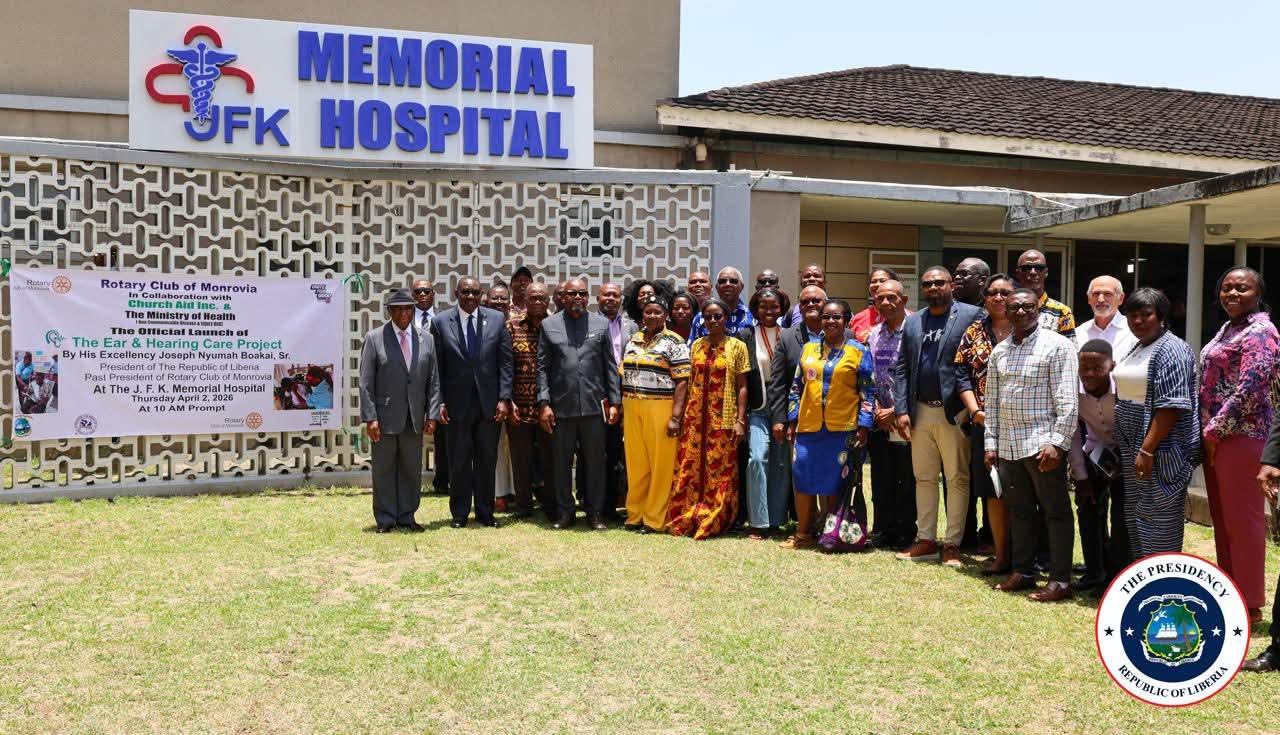
Liberia has taken a significant step toward strengthening its healthcare system with the official launch of a nationwide Ear and Hearing Care Project at the John F. Kennedy Memorial Medical Center (JFK), backed by international and local partners.
The initiative, spearheaded by the Rotary Club of Monrovia in collaboration with United for Good Rotary and Church Aid Incorporated, was formally unveiled by President Joseph Nyuma Boakai, Sr., who used the occasion to call for sustained domestic investment in healthcare infrastructure.
“All efforts should be directed toward building facilities here that serve our people,” President Boakai declared. “Not everyone can afford to seek treatment abroad, and that reality must guide our national priorities.”
US$60,000 Boost to Critical Hearing Services
At the launch, medical equipment valued at over US$60,000 including advanced hearing aid devices was donated to JFK Medical Center.
The equipment is expected to significantly improve diagnosis and treatment for thousands of Liberians living with hearing impairments.
Health officials say the intervention addresses a critical gap in specialized care, particularly in audiology services, which have historically been under-resourced in Liberia.
A Growing Global Health Concern
The initiative comes amid alarming global trends.
According to the World Health Organization (WHO):
1.5 billion people worldwide nearly 20% of the global population live with some degree of hearing loss
By 2050, projections indicate that 1 in 4 people could be affected
Hearing loss remains one of the most neglected public health challenges, particularly in low- and middle-income countries
Experts warn that untreated hearing loss can lead to social isolation, reduced economic productivity, and cognitive decline, making early detection and treatment essential.
Reviving Specialized Care at JFK
The launch also marks a revival of specialized Ear, Nose, and Throat (ENT) services at JFK Medical Center once a cornerstone of Liberia’s healthcare system.
Historically, JFK operated a fully functional ENT unit from 1972 to 1989, before years of civil conflict and systemic challenges disrupted services.
Under the government’s ARREST Agenda, efforts are now underway to restore and modernize these services. Key developments include:
Over 3,000 patients treated since late 2022
Approximately 60% of cases related to ear and hearing conditions
Expansion of screening services from a single unit to multiple specialized facilities
Increased focus on early detection among children, where hearing loss is often acquired
Plans to integrate hearing care into national health policy frameworks
Health authorities say these measures are already yielding measurable improvements in patient outcomes.
Reducing Medical Tourism
President Boakai emphasized the urgent need to reduce reliance on overseas medical treatment a long-standing challenge for Liberia.
“For too long, the instinct has been to travel abroad for care,” he said.
“But the majority of our citizens cannot do so. Our responsibility is to ensure quality healthcare is accessible right here at home.”
His administration has identified healthcare system strengthening as a key pillar of national development, with JFK Medical Center positioned as a flagship institution.
Progress Amid Persistent Challenges
While acknowledging ongoing constraint ranging from infrastructure gaps to workforce shortages President Boakai expressed optimism about recent improvements.
“Development does not happen overnight,” he noted. “It requires commitment, consistency, and partnerships such as this one.”
He praised the Rotary Club for its sustained humanitarian contributions, highlighting its role during periods of national crisis.
Beyond Health: Expanding Community Impact
In a related development, the Rotary Club announced a US$102,000 project to construct safe water facilities in rural Montserrado County further expanding its footprint in public health and community development.
Access to clean water remains a critical issue in Liberia, with the World Bank estimating that a significant portion of the population still lacks reliable potable water sources, particularly in rural areas.
A Model for Public-Private Partnership
The Ear and Hearing Care Project underscores the growing importance of partnerships between government, civil society, and international organizations in addressing Liberia’s development challenges.
Analysts say such collaborations are essential for:
Bridging funding gaps in public health
Introducing modern medical technologies
Building long-term institutional capacity
As Liberia confronts both domestic healthcare challenges and global health trends, the launch of the hearing care initiative represents a strategic investment in specialized medicine and preventive care.
For many Liberians, it also signals a broader shift toward a future where quality healthcare is not a privilege sought abroad, but a service reliably delivered at home.
