


By: Julius Konton
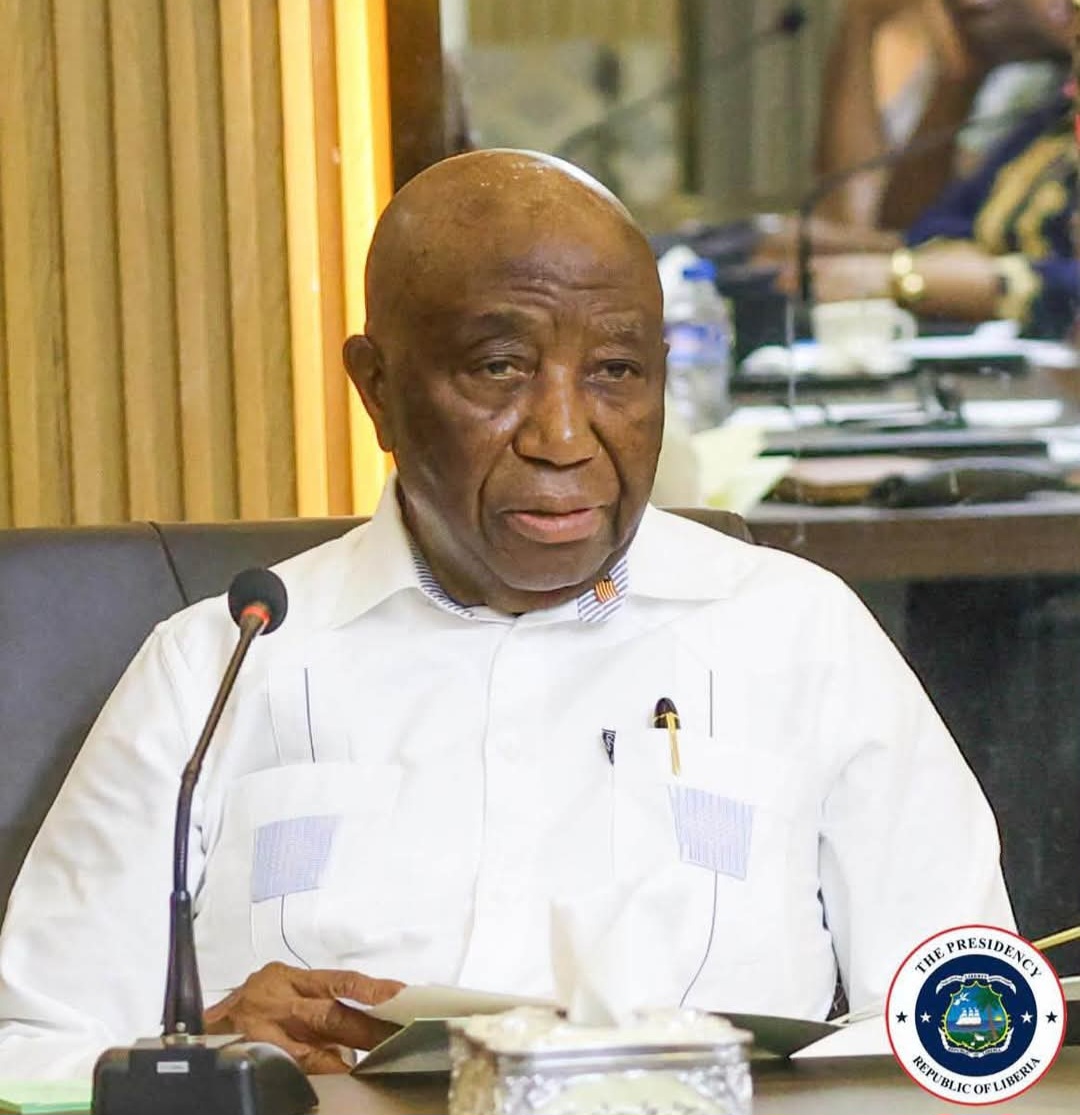
President Joseph Nyuma Boakai Sr. has brokered a multi-party agreement aimed at ending the latest impasse at the University of Liberia (UL), directing university authorities, faculty, staff and government institutions to abandon confrontation and work toward the orderly restoration of normal academic and administrative operations.
The agreement followed extensive consultations between President Boakai, acting in his capacity as Visitor to the University of Liberia, and representatives of the Faculty and Staff Association, the University Administration and the Board of Trustees.
The intervention comes at a critical moment for Liberia’s premier public university, where disagreements over working conditions, outstanding obligations, institutional governance and the state of university infrastructure have threatened to disrupt normal operations.
President Boakai urged the stakeholders to put students and the long-term interests of the institution ahead of institutional differences, warning that threats, ultimatums and public confrontation cannot provide sustainable solutions to problems confronting the university.
“The University of Liberia is bigger than any individual or disagreement. Our students must not become casualties of institutional differences. We must find solutions, restore confidence, and move this University forward,” President Boakai said.
One of the most significant outcomes of the negotiations is a government commitment to address the retirement-benefit concerns of eligible University of Liberia employees.
Under the agreement, the Government, through the Ministry of Finance and Development Planning, will remit US$2.4 million to the National Social Security and Welfare Corporation (NASSCORP) to facilitate the immediate enrollment of eligible university employees.
The parties also agreed that 40 percent of outstanding salaries owed to eligible beneficiaries will be included in the 2027 National Budget for consideration.
The measures are intended to address long-standing financial concerns among employees while creating a framework for resolving outstanding obligations in a structured manner.
US$2.4M and 40% Salary Commitment at a Glance
Measure
Government/Stakeholder Commitment
NASSCORP payment
US$2.4 million
Outstanding salaries
40% proposed for inclusion in 2027 Budget
Classroom chairs already secured
6,000
Additional chairs to be procured
14,000
Potential total chair supply
20,000
Infrastructure monitoring
Weekly reports to the President
Infrastructure Takes Center Stage
Beyond employee benefits, President Boakai directed renewed government attention to the deteriorating physical condition of the University of Liberia.
Rather than immediately proceeding with the proposed construction of a new classroom building, the agreement prioritizes the renovation and rehabilitation of existing university facilities.
The Ministry of Public Works will lead the rehabilitation initiative and is expected to establish clear implementation timelines.
To strengthen accountability, a special monitoring mechanism will be established comprising representatives of the University Administration, faculty, the Board of Trustees and senior government officials.
The committee will monitor implementation and submit weekly progress reports to President Boakai.
The arrangement effectively places the university’s infrastructure recovery under a more closely supervised government-university framework.
The agreement also addresses one of the most visible challenges facing students: inadequate classroom furniture.
Stakeholders were informed that 6,000 classroom chairs have already been secured, while arrangements are being made to procure another 14,000 chairs.
If completed, the initiative would provide a combined 20,000 chairs, representing a significant improvement in classroom capacity and learning conditions.
The furniture commitment is particularly important for a university operating across multiple campuses and colleges, where overcrowding and inadequate instructional facilities have historically been among the challenges confronting public higher education in Liberia.
The current dispute carries significance beyond an ordinary labor or administrative disagreement because of the University’s extraordinary place in Liberia’s national history.
The University of Liberia traces its origins to Liberia College, founded in 1862, and became a full university in 1951.
The institution opened its doors to its first students in February 1863, with seven students under the leadership of Liberia’s first President, Joseph Jenkins Roberts, who became the first president of Liberia College.
The university’s first building had its cornerstone laid on January 25, 1858, several years before classes formally began.
Its early financing came from the New York Colonization Society and the Trustees of Donations for Education in Liberia.
The institution subsequently evolved into the University of Liberia in 1951, establishing itself as one of the country’s most important centers for higher education, professional training, public service and national intellectual development.
The university is currently marking its 75th anniversary as a university, following its elevation from Liberia College to university status in 1951.
The institution launched its Diamond Anniversary celebrations in February 2026.
Today, the university operates four campuses, Capitol Hill, Fendall, the Medical School at Fendall, and Starz-Sinji in Grand Cape Mount County according to its official history.
The latest impasse is not the first major disruption to the University’s operations.
UL’s own historical record notes that Liberia College faced serious institutional difficulties during its early decades and was forced to close its doors on several occasions.
The university’s more recent history has also been shaped by Liberia’s political instability and civil conflicts.
Historical accounts record major disruptions during the late 1970s, 1980s and civil-war period, with the university suffering damage and interruptions to academic activities.
That history gives the current negotiations added importance.
For a country whose education system was repeatedly disrupted by war and political instability, prolonged institutional disputes at the nation’s flagship public university risk affecting not only students and employees but also Liberia’s broader human-capital development.
The transformation of the University of Liberia illustrates the dramatic expansion of higher education in Liberia.
When Liberia College opened in 1863, only seven students were enrolled.
By 1956, five years after becoming a university, enrollment had risen to 259 students.
The institution subsequently expanded its academic offerings, including professional education and medical training, becoming an important pipeline for Liberia’s civil service, legal profession, education sector, health system and other areas of national development.
Its significance today extends beyond its campuses: generations of Liberian professionals, public officials, educators, journalists, lawyers, medical practitioners and scholars have passed through the institution.
As part of the new agreement, both the Faculty and Staff Association and the University Administration agreed to withdraw recent statements that contributed to heightened tensions.
They also committed themselves to renewed engagement based on respect, constructive dialogue and sustained institutional cooperation.
President Boakai emphasized that disagreements within the university must be resolved through established institutional processes rather than threats, ultimatums or confrontation.
He also called on all stakeholders to respect the University’s leadership structure, the authority of the Board of Trustees and established procedures for resolving institutional disputes.
The President’s intervention places his administration in the position of balancing two competing imperatives: responding to legitimate concerns raised by university employees while protecting the continuity of academic activities for thousands of Liberian students.
The government commitments announced under the agreement including the US$2.4 million NASSCORP payment, proposed inclusion of 40 percent of eligible outstanding salaries in the 2027 Budget, infrastructure rehabilitation and procurement of up to 20,000 classroom chairs represent concrete steps intended to rebuild confidence.
But implementation will ultimately determine whether the agreement produces a durable resolution.
The creation of a monitoring mechanism and the requirement for weekly reporting to the President appear designed to prevent the commitments from remaining merely promises on paper.
The next phase will therefore be critical.
University administrators, faculty leaders, staff representatives, trustees and government ministries must translate Saturday’s agreement into measurable actions while maintaining the academic calendar and minimizing further disruption to students.
For President Boakai, the challenge now extends beyond brokering an agreement. His administration must ensure that the financial, infrastructure and institutional commitments contained in the deal are implemented within credible timelines.
For the University of Liberia, the episode presents an opportunity to address longstanding structural problems while strengthening communication and trust among its governing bodies, employees and students.
And for Liberia’s students, the immediate priority is straightforward: a stable university where teaching, learning, examinations and academic administration can proceed without recurring institutional crises.
President Boakai expressed appreciation to the negotiating parties for their flexibility and willingness to find common ground, describing the agreement as an important step toward restoring stability and normalcy at Liberia’s historic public university and his alma mater.
The President now expects all parties to focus on the remaining measures required for the orderly resumption of normal academic and administrative activities.
The consultations brought together senior representatives of the University’s major governance structures.
The Faculty and Staff Association delegation was led by Professor Alahaji Morris Dukuly.
The University Administration was headed by Dr. Layli Maparyan, President of the University of Liberia, accompanied by Vice President Dr. Lester Z. Tenny.
The University’s Board of Trustees was represented by its Chairman, Senator Numene T. H. Bartekwa.
Government officials participating included Justice Minister Cllr. Oswald N. Tweh; Minister of Local Government Francis Sakilah Nyumalin; Minister of Education Dr. Jarso Malley Jalleh; Senior Presidential Advisor Dr. Augustine Konneh; Presidential Legal Advisor Bushuben Keita; Director of the Cabinet Nathaniel T. Kwabo; and Deputy Minister of State for Public Affairs Anthony V. Kesselly.


