
By : Julius Konton
President Joseph Nyuma Boakai has returned to Liberia following a successful diplomatic mission to Ethiopia, where he participated in the 39th Ordinary Session of the Assembly of Heads of State and Government of the African Union (AU).
The high-level summit, held in Addis Ababa, brought together leaders from the continent’s 55 member states to deliberate on peace and security, regional integration, governance reforms, and Africa’s long-term development agenda.
Liberia’s participation reaffirmed its recommitment to multilateral diplomacy and continental cooperation under President Boakai’s administration.
Science Diplomacy on the Sidelines of the AU Summit
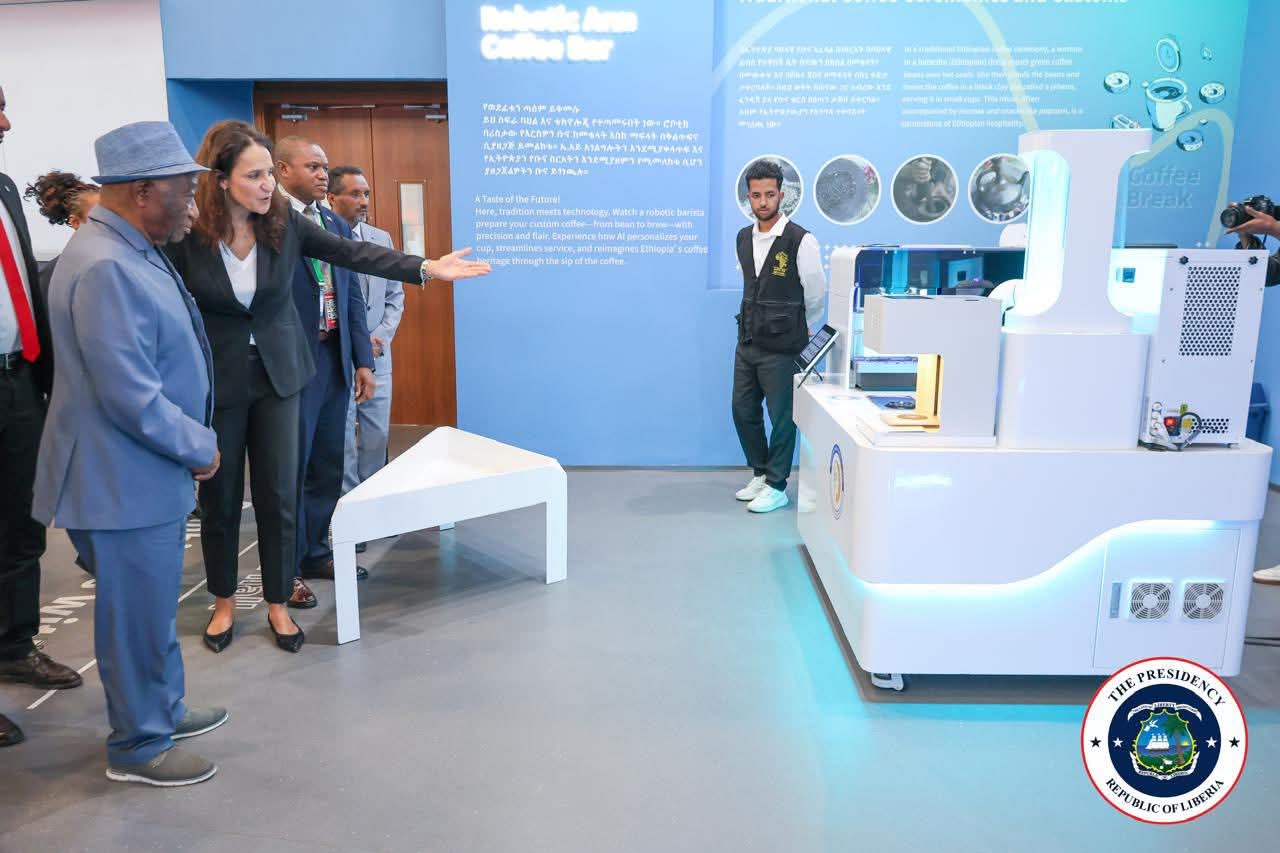
As part of his official engagements in Ethiopia, President Boakai paid a courtesy visit to the Addis Ababa Science Museum, following a formal invitation from the Office of the Ethiopian Prime Minister.
Accompanied by senior members of the Liberian delegation, the President received a guided tour of the state-of-the-art facility, which is widely regarded as one of Africa’s leading centers for public science education and technological exhibition.
The museum showcases advancements in artificial intelligence, space science, renewable energy, biotechnology, and industrial innovation sectors increasingly seen as critical to Africa’s economic transformation.
Africa’s Innovation Drive in Context
According to AU development frameworks, Africa currently accounts for less than 1 percent of global research and development (R&D) expenditure, with average national investment in science and innovation standing at approximately 0.6 percent of GDP, compared to a global average of over 2 percent.
Ethiopia has emerged as one of the countries actively seeking to reverse this trend through infrastructure investment, science education, and innovation hubs such as the Addis Ababa Science Museum.
President Boakai was observed engaging keenly with interactive exhibits demonstrating how African-led research and technology can address pressing continental challenges, including climate change, food security, public health, and industrial productivity.
Liberia’s Development Outlook
The visit underscored Liberia’s growing interest in positioning science, technology, and education as strategic pillars of national development.
Since assuming office, President Boakai has emphasized human capital development as a cornerstone of his governance agenda, particularly in a country where more than 60 percent of the population is under the age of 25.
Observers note that exposure to institutions such as the Addis Ababa Science Museum offers valuable insights for Liberia as it seeks to modernize its education sector, strengthen technical and vocational training, and encourage innovation-driven growth.
A Symbolic Yet Strategic Engagement
While largely symbolic, the museum tour carried strategic significance, highlighting how diplomacy can intersect with knowledge exchange and development planning.
It also reinforced Liberia’s alignment with Africa’s broader aspiration to transition from a resource-dependent economy to one driven by innovation and skills.
President Boakai’s return marks the conclusion of a diplomatic mission that blended continental leadership engagement with forward-looking development inspiration, signaling Liberia’s intent to remain an active participant in shaping Africa’s future.
