
By: Julius Konton
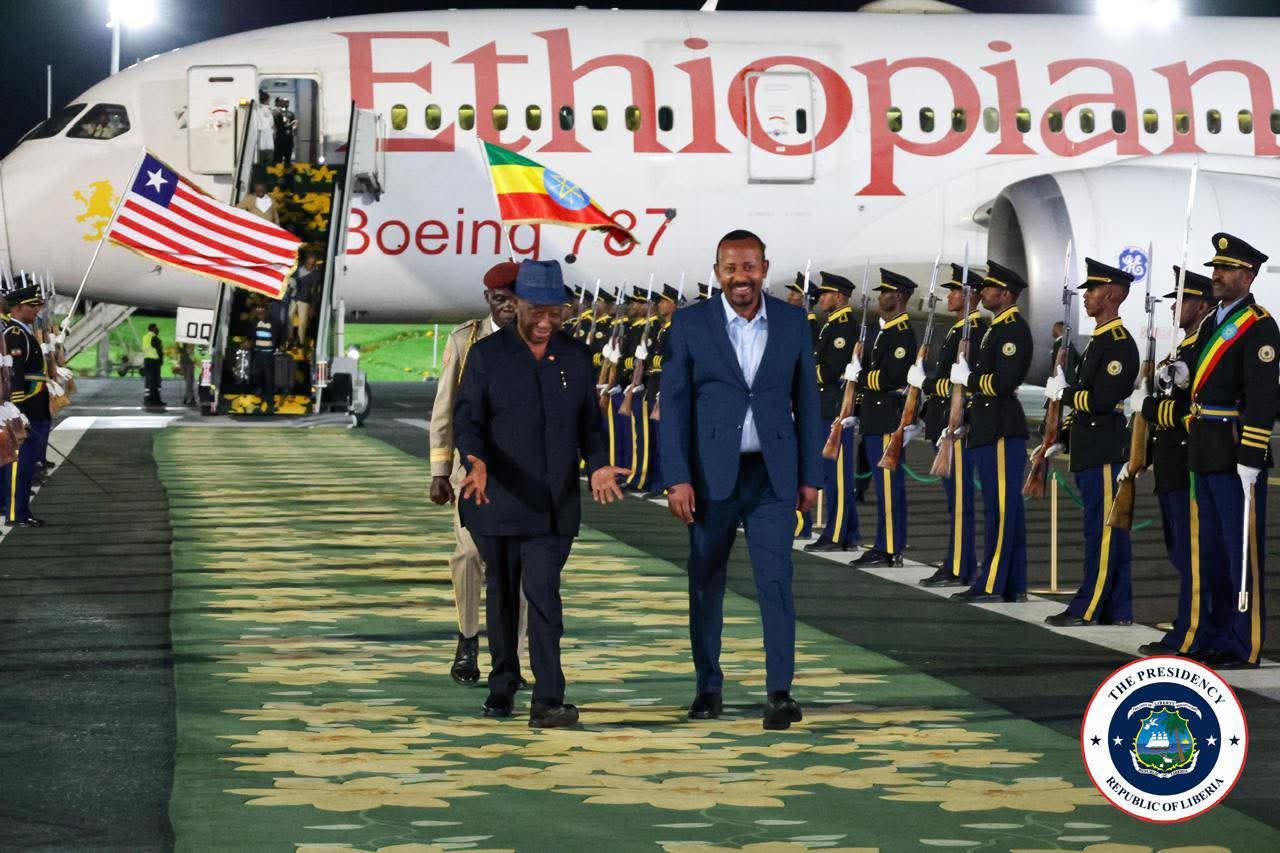
President Joseph Nyuma Boakai has arrived in Addis Ababa for an official state visit aimed at strengthening diplomatic, economic and development ties between the Liberia and Ethiopia.
The Liberian leader, accompanied by a high-level delegation of senior government officials, landed at Bole International Airport at 8:20 p.m. local time, beginning what officials describe as a significant mission to expand bilateral cooperation and reinforce Africa-to-Africa partnerships.
President Boakai’s visit comes at the invitation of Abiy Ahmed, Prime Minister of Ethiopia, and is expected to include high-level discussions on trade, investment, agriculture, infrastructure, education, and regional peace and security.
Historic Ties Between Two African Nations
Liberia and Ethiopia share historic significance as two of Africa’s oldest sovereign states. Liberia, founded in 1847, is Africa’s first modern republic, while Ethiopia remains one of the continent’s oldest civilizations and famously resisted colonial rule during the scramble for Africa.
Both countries were founding members of the United Nations in 1945 and later played key roles in the establishment of the Organization of African Unity in 1963, now the African Union.
Diplomatic analysts say the visit symbolizes renewed cooperation among African nations seeking stronger intra-continental trade and development partnerships under the African Continental Free Trade Area.
Agriculture at the Center of Discussions
A major component of the Liberian President’s visit will focus on agriculture, a sector seen as vital to Liberia’s economic diversification strategy.
President Boakai is scheduled to tour Ethiopian agricultural sites to study modern production systems, mechanized farming, irrigation networks, and value-addition processes for farm produce.
Ethiopia has emerged as one of Africa’s agricultural success stories, with agriculture contributing roughly 34% of GDP and employing more than 65% of the workforce in recent years.
Liberia, by contrast, possesses over 600,000 hectares of arable land, yet imports a substantial share of its food needs, including rice, the nation’s staple food.
Officials believe partnerships with Ethiopia could help Liberia improve food security, reduce import dependency, and create jobs for rural communities.
Economic Opportunities and Trade Expansion
Trade between African nations remains relatively low, accounting for only about 15% of total African exports, according to continental trade estimates.
Leaders across the continent have increasingly called for stronger regional commerce to unlock growth and reduce external dependency.
Liberia’s delegation is expected to engage Ethiopian officials and private-sector actors on possible investment opportunities in:
Agro-processing
Aviation and logistics
Education and skills training
Renewable energy
Manufacturing
Digital governance systems
Ethiopia, with a population exceeding 130 million people, is among Africa’s fastest-growing large economies and presents a potentially valuable market for Liberian goods and services.
Regional Peace and Shared Priorities
The two governments are also expected to consult on regional security matters, governance reforms, climate resilience, and Africa’s collective voice in global institutions.
Liberia currently serves as an advocate for peacebuilding and democratic governance in West Africa, while Ethiopia remains an influential diplomatic center as host of the African Union.
A New Chapter in Liberia’s Foreign Policy
Since assuming office in January 2024, President Boakai has pledged to pursue a pragmatic foreign policy centered on investment, food security, youth employment, and stronger diplomatic partnerships.
Observers say the Ethiopia trip signals Liberia’s desire to deepen strategic ties with emerging African economies and learn from successful development models on the continent.
As talks begin in Addis Ababa, many will be watching whether the visit yields concrete agreements capable of boosting Liberia’s economic transformation agenda.
