




By: Julius Konton
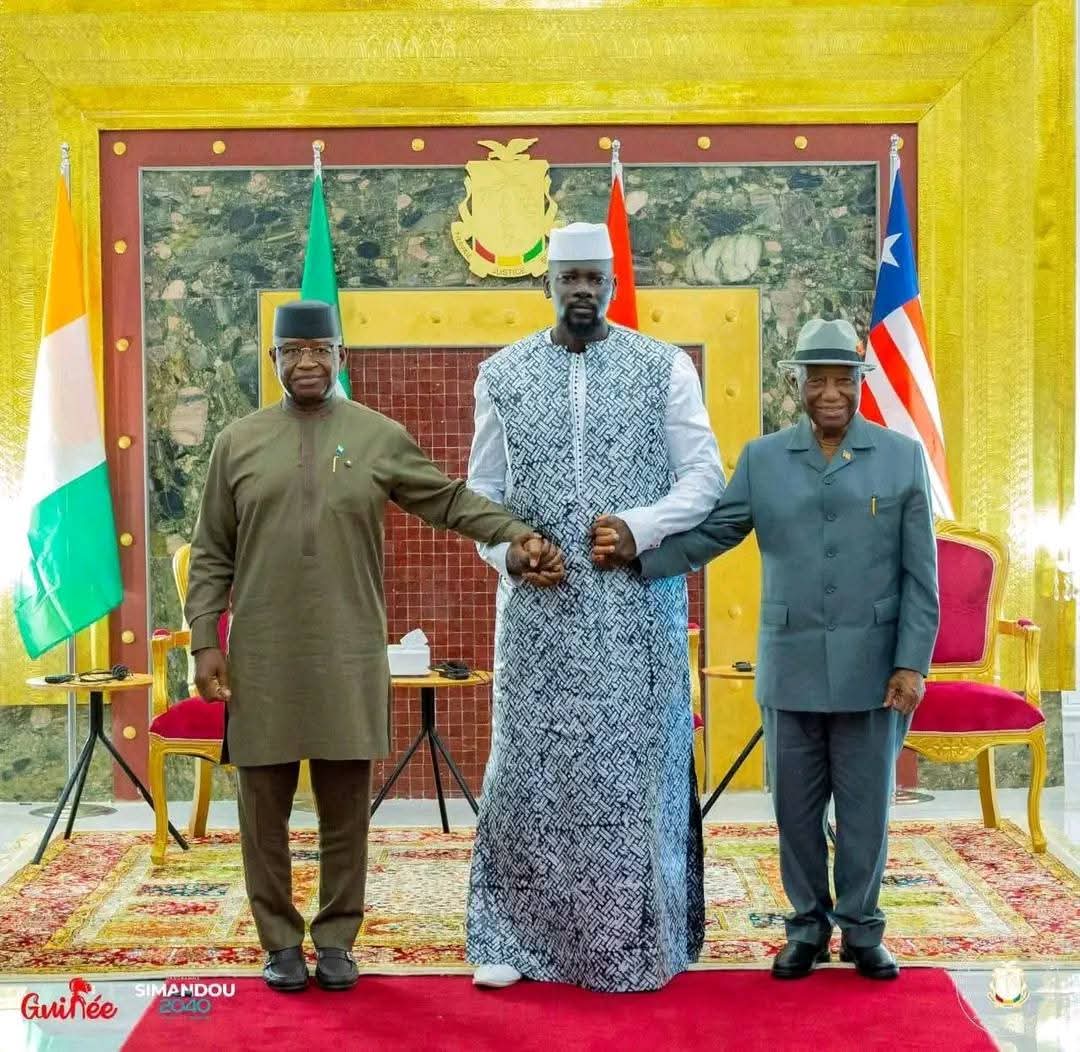
In a move widely seen as both pragmatic and politically calculated, the presidents of Liberia, Joseph Nyuma Boakai, Guinea Mamadi Doumbouya, and Sierra Leone, Julius Maada Bio have agreed to pursue a strictly peaceful and diplomatic path in resolving escalating border tensions within the Mano River Union (MRU).
The high-level consultations, held in Conakry, concluded with a joint communiqué emphasizing restraint, dialogue, and regional cooperation, an outcome that analysts describe as “necessary, but not sufficient” to address the deep-rooted structural issues fueling recurring border disputes.
A Region Marked by History, Fragility, and Interdependence
The MRU comprising Liberia, Sierra Leone, Guinea, and Côte d’Ivoire has long been defined by porous borders, shared ethnic communities, and a history of instability.
Between 1989 and 2002, the region was engulfed in civil wars that resulted in an estimated over 500,000 deaths and millions displaced, with cross-border insurgencies often blurring national boundaries.
Today, while large-scale conflict has subsided, tensions persist.
Border areas remain economically marginalized, with youth unemployment in some districts exceeding 60%, according to regional development estimates.
Informal trade accounts for up to 40% of cross-border economic activity, underscoring both the importance and vulnerability of these frontier zones.
The Conakry Agreement: Peaceful Intentions, Strategic Calculations
At the core of the agreement is a commitment to maintain the status quo ante effectively freezing current border positions while diplomatic negotiations continue.
The leaders also reaffirmed adherence to United Nations principles, particularly peaceful dispute resolution under Article 33 of the UN Charter.
Key outcomes include:
Expanded joint border patrols and intelligence-sharing mechanisms
Renewed efforts toward technical demarcation and clarification of boundaries
Increased community-level engagement to prevent local conflicts
Commitments to boost cross-border trade, infrastructure, and energy cooperation
Plans to convene a full MRU Summit within one month
While these measures signal unity at the top, implementation remains uncertain historically the weakest link in regional agreements.
Rising Tensions: What Prompted the Talks?
Though the communiqué avoided specifics, diplomatic sources point to recent localized clashes, disputed mining zones, and competing security operations as key triggers for the emergency consultations.
The border regions are rich in natural resources including gold and diamonds making them economically strategic but also prone to dispute.
In some contested zones, artisanal mining employs thousands but operates largely outside formal regulation, often leading to tax losses estimated in the tens of millions of dollars annually.
Additionally, the spread of transnational threats ranging from arms trafficking to extremist spillover from the Sahel has heightened security concerns.
West Africa recorded a sharp rise in violent incidents linked to armed groups between 2020 and 2025, increasing pressure on governments to secure peripheral territories.
Analysis: Diplomacy or Delay?
While the leaders’ commitment to peace has been broadly welcomed, critics argue the agreement may reflect a short-term de-escalation strategy rather than a long-term solution.
Key concerns include:
Lack of enforcement mechanisms: Previous MRU agreements have faltered due to weak institutional follow-through.
Ambiguity in border demarcation: Many boundaries date back to colonial-era maps, often imprecise or contested.
Economic neglect of border communities:
Without tangible development, local grievances may persist.
Security gaps: Joint patrols require sustained funding, coordination, trust and elements historically inconsistent in the region.
Political analysts note that the decision to “freeze” positions could prevent immediate conflict but risk entrenching unresolved disputes, especially if negotiations stall.
Voices from Leadership
Speaking upon his return, President Joseph Nyuma Boakai struck a conciliatory tone:
“We all realized that we are the same people,
we have nothing to gain from war,
We need to be friends and help to develop our people.”
His remarks reflect a broader regional narrative, one rooted in shared identity but challenged by competing national interests.
What Comes Next? A Critical Test for the MRU
The planned MRU summit within the next month is expected to serve as a litmus test for the bloc’s relevance in modern West African geopolitics.
Once a cornerstone of regional cooperation, the MRU has struggled in recent decades to assert influence amid the rise of larger bodies like ECOWAS.
If successfully implemented, the Conakry roadmap could:
Stabilize a region of over 50 million people
Boost intra-regional trade, currently estimated at less than 15% of total trade volume
Strengthen collective security against emerging threats
However, failure could reinforce perceptions of the MRU as symbolic rather than functional, with real consequences for regional peace.
A Delicate Balance Between Hope and Reality
The Conakry agreement represents a critical, if cautious, step toward stability in one of West Africa’s most historically volatile corridors.
Yet, as history has shown, declarations of peace must be matched by sustained political will, economic investment, and institutional accountability.
For now, the region stands at a familiar crossroads, choosing dialogue over conflict, while the harder work of lasting resolution still lies ahead.


