
By: Julius Konton
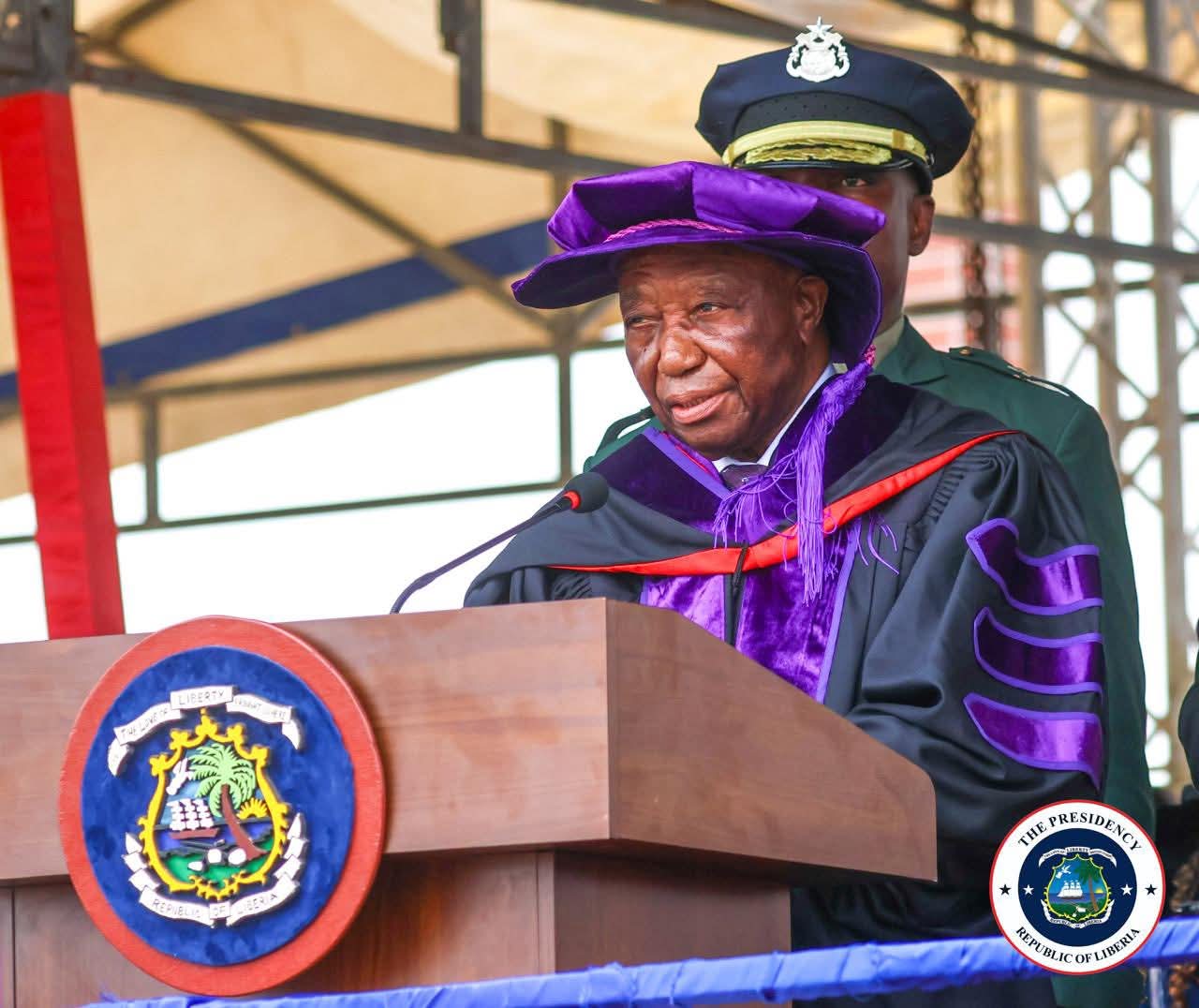
President Joseph Nyuma Boakai, Sr. has reaffirmed his Administration’s commitment to higher-education reform, institutional accountability, and youth-driven innovation, announcing a US$6 million budgetary allocation for the University of Liberia during the institution’s 105th Commencement Convocation for its Graduate and Professional Schools.
Addressing graduates, faculty, administrators, and national stakeholders, President Boakai described the University of Liberia (UL) as the country’s “national flagship institution” and a critical pathway for Liberia’s youth into the middle class, at a time when the nation is seeking to reposition itself within an increasingly competitive global economy.
Founded in 1862, the University of Liberia is one of Africa’s oldest public universities and has produced generations of national leaders, professionals, jurists, diplomats, and academics.
Today, UL enrolls tens of thousands of students across its campuses, playing a central role in Liberia’s human capital development amid a youthful population where over 60 percent are under the age of 25, according to national demographic data.
$6 Million Investment Targets Infrastructure and Modernization
President Boakai disclosed that the Fiscal Year 2026 National Budget includes more than US$6 million earmarked specifically for infrastructure renovation and modernization at UL, one of the largest single-year government investments in the institution in recent history.
“Our students deserve an environment that reflects the dignity of their aspirations and the seriousness of their purpose,” the President said, emphasizing that physical infrastructure must align with academic excellence.
Education sector analysts note that decades of underinvestment have constrained Liberia’s tertiary institutions, even as enrollment demand continues to grow.
The new funding is expected to support classroom rehabilitation, learning facilities, utilities upgrades, and campus modernization, key requirements for meeting regional and international accreditation standards.
Beyond Buildings: Accountability and Systems Reform
While welcoming the infrastructure commitment, President Boakai stressed that bricks and mortar alone will not transform the University.
He called on UL’s leadership to deepen reforms in academic governance, financial management, administration, and student discipline, arguing that institutional credibility depends on transparency and integrity.
“Excellence is never accidental,” he said. “It is the product of discipline, integrity, and the courage to uphold standards.”
The message aligns with the Administration’s broader public-sector reform agenda, which prioritizes accountability as a prerequisite for sustainable development and donor confidence.
Alumni Engagement Seen as Untapped Strategic Asset
Drawing on global best practices, President Boakai urged the revitalization of UL’s Alumni Association, describing it as a potentially powerful partner for fundraising, mentorship, institutional branding, and career development.
In leading universities worldwide, alumni networks contribute millions of dollars annually to research, scholarships, and endowment growth.
Liberia’s higher-education system, by contrast, remains heavily dependent on government subventions.
As an alumnus of UL himself, Boakai called on graduates at home and abroad to “organize, reconnect, and recommit” to their alma mater, pledging presidential engagement to help strengthen alumni-driven initiatives.
Campus Culture: Activism with Responsibility
The President also addressed UL’s long-standing tradition of student activism, acknowledging its historic role in shaping Liberia’s democratic consciousness while cautioning against confrontation and disorder.
“Let this campus remain a marketplace of ideas and a citadel of innovation not a battleground of conflict,” he said, urging peaceful, constructive engagement grounded in respect and discipline.
UL has historically served as a hub for civic debate and reform movements, particularly during pivotal moments in Liberia’s political history.
Observers note that balancing free expression with institutional stability remains a central challenge for universities across West Africa.
Personal Donation Supports Research and Innovation
In a notable personal gesture, President Boakai announced a US$50,000 personal contribution toward the construction of a modern research laboratory, an initiative proposed by the graduating class leadership.
The President revealed that the funds were drawn from savings generated by his voluntary salary reduction, a policy he has used to support targeted development projects since taking office.
“This is the kind of leadership Liberia needs,” Boakai said, praising the graduates’ focus on innovation, applied learning, and national relevance.
Education experts say investment in research infrastructure is critical if Liberia is to reduce dependency on imported expertise and build local solutions in health, agriculture, engineering, and technology.
Graduates as Drivers of National Renewal
Addressing the Class of 2025, President Boakai framed their graduation as both a personal achievement and a national responsibility, urging them to prioritize governance over greed and vision over division.
“Liberia is ready for your expertise,” he said, invoking the University’s historic motto, Lux in Tenebris, Light in Darkness, as a charge to graduates entering public service, the private sector, academia, and civil society.
As Liberia seeks to accelerate economic recovery, expand its skilled workforce, and modernize its institutions, the President’s address positioned the University of Liberia not merely as a degree-granting institution, but as a cornerstone of national transformation.
