




By: Julius Konton
Liberia’s premier state-owned financial institution, the Liberia Bank for Development and Investment (LBDI), on Saturday marked its 60th anniversary, a milestone celebration that doubled as a moment of candid reflection on the country’s banking challenges and a renewed commitment by government to restore financial sector confidence.
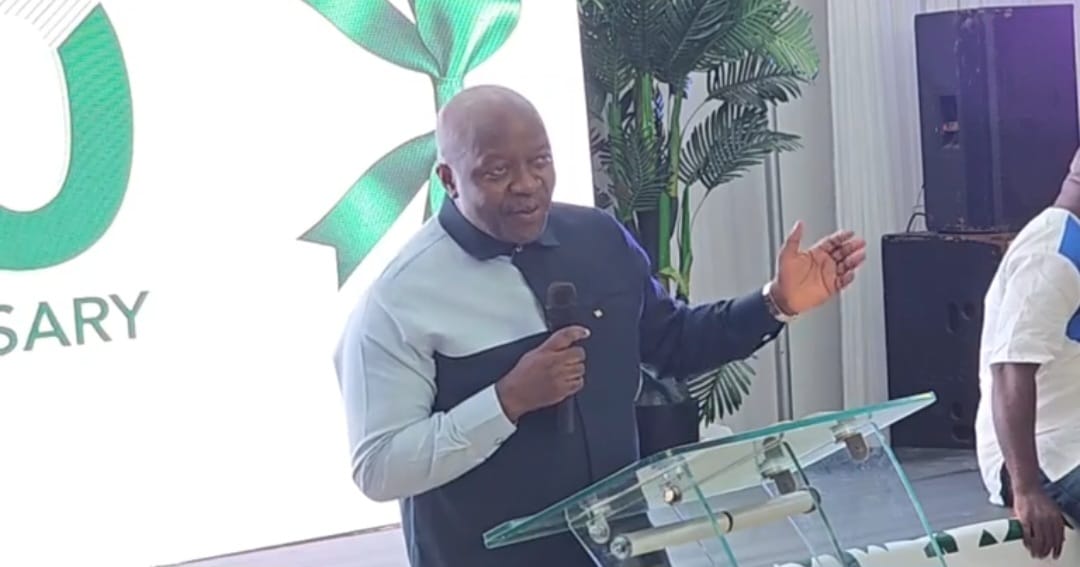
Speaking at the commemorative ceremony, Finance and Development Planning Minister Augustine Kpehe Ngafuan congratulated LBDI on six decades of operation but openly acknowledged that the broader banking sector has not yet reached its full potential.
“We are grateful for this milestone,” Ngafuan said, “but we are not entirely pleased with where the banking sector is today. There is progress, but there is still work to be done”, he said
A Unique Government–Bank Relationship
Founded in 1965, LBDI occupies a distinctive position in Liberia’s financial architecture, operating as a commercial bank with significant government ownership.
According to Ngafuan, that relationship has historically been both a strength and a strain.
“LBDI has a unique relationship with government. In some respects, it is a government bank,” he noted. “That relationship can be a blessing but it can also become a burden”, he re-emphasized.
The minister admitted that some of the challenges facing LBDI and other banks did not originate within the institutions themselves but stemmed from broader fiscal constraints and past government defaults.
“We who wear the government cap must be humble,” Ngafuan said. “Government must not be a problem. Government must be a blessing and that is the commitment we are making.”
Signs of Recovery Under Presidential Resuscitation Plan
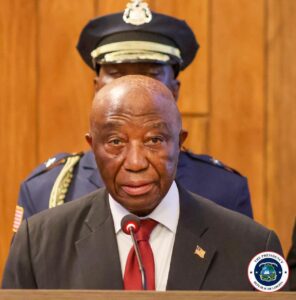
Ngafuan credited President Joseph Nyuma Boakai, Sr. with initiating a financial sector resuscitation program that has begun to yield measurable improvements.
“Mr. President, where you met the bank and where it is today are two very different places,” he said. “The aggregates and indicators are getting better”, he added.
While acknowledging that LBDI is “not yet where it wants to be,” Ngafuan praised the bank’s management and staff for stabilizing operations amid rising competition from regional and international banks.
Liberia’s banking sector currently comprises nine licensed commercial banks, according to the Central Bank of Liberia (CBL), operating in an economy valued at approximately US$4.5 billion, with financial intermediation still below regional averages.
Debt Repayment at the Center of Budget Strategy
One of the most significant announcements came with Ngafuan’s disclosure that the government has allocated over US$90 million in the FY2026 national budget for debt service to commercial banks, a move aimed at reversing years of strained relations.
“We cannot continue to be the defaulter-in-chief,” Ngafuan admitted. “For all those years, we say: LBDI, we are sorry. International Bank, we are sorry. Ecobank, we are sorry”, he apologize to banking institutions.
The minister stressed that the government’s debt repayment plan is deliberate and central to restoring trust in the financial system.
“We want to regain your confidence so you can do what you do best, finance and empower the private sector,” he said.
Strengthening Monetary, Fiscal Coordination
Ngafuan also highlighted improved coordination between the Ministry of Finance and the Central Bank of Liberia, describing the relationship as one of the strongest in recent years.
“The coordination between the fiscal and monetary authorities could not be better,” he said, crediting long-standing professional ties between the leadership of both institutions.
This collaboration, he noted, has helped stabilize inflation, improve liquidity management, and lay the groundwork for digital financial expansion.
Mobile Money Interoperability and Growth Push
Looking ahead, the finance minister announced that Liberia is set to launch mobile money interoperability between the country’s two major mobile network operators, a reform expected to boost financial inclusion and transaction efficiency.
“People may not fully understand what this means,” Ngafuan said, “but it means we are oiling the engine of the economy.”
According to official estimates, mobile money transactions already account for over 40 percent of domestic retail payments, a figure expected to rise sharply once interoperability is fully implemented.
A Call for Innovation and Hard Work
Ngafuan concluded with a stark warning to the banking sector as competition intensifies across West Africa.
“There are many rivers to cross, mountains to climb, and competitors to face. If you don’t innovate, you evaporate.”
He urged banks to embrace digitalization, product diversification, and stronger partnerships with government as Liberia works to unlock growth constraints.
“We have no option,” he said. “We must work hard and work together”, he reechoed.
As LBDI enters its seventh decade, the anniversary celebration underscored both the resilience of Liberia’s oldest development bank and the government’s determination to reset its relationship with the financial sector, an effort widely seen as critical to sustaining economic recovery and private-sector-led growth.
Editor’s Note
This article captures a pivotal moment in Liberia’s ongoing effort to restore confidence in its financial system, using the 60th anniversary of the Liberia Bank for Development and Investment (LBDI) as both a celebration and a mirror for national reflection.
Finance and Development Planning Minister Augustine Kpehe Ngafuan’s remarks go beyond ceremonial praise, offering an unusually candid acknowledgment of past government-induced strains on the banking sector and a clear signal of policy recalibration.
At the heart of the report is a central theme: the evolving relationship between government and state-linked financial institutions.
Ngafuan’s framing of government as either a “blessing or a burden” underscores a broader reform narrative, one that recognizes historical defaults, commits to debt repayment, and emphasizes stronger fiscal and monetary coordination as foundations for recovery.
The article also situates Liberia’s banking challenges within a wider economic context, highlighting modest sector size, rising competition, and the transformative potential of digital finance, particularly mobile money interoperability.
As LBDI enters its seventh decade, the piece presents the anniversary not merely as a milestone, but as a benchmark against which future reforms and accountability will be measured.
Readers are invited to view this development as more than a single bank’s celebration; it is a litmus test for whether government promises of reform, discipline, and partnership with the private sector will translate into sustained economic growth and financial stability.


