


By: Julius Konton
Liberia has presented a confident picture of its economic recovery and national development trajectory before the international community, with Finance and Development Planning Minister Augustine Kpehe Ngafuan declaring that the country is making measurable progress toward achieving the United Nations Sustainable Development Goals (SDGs) despite persistent global economic shocks and domestic challenges.
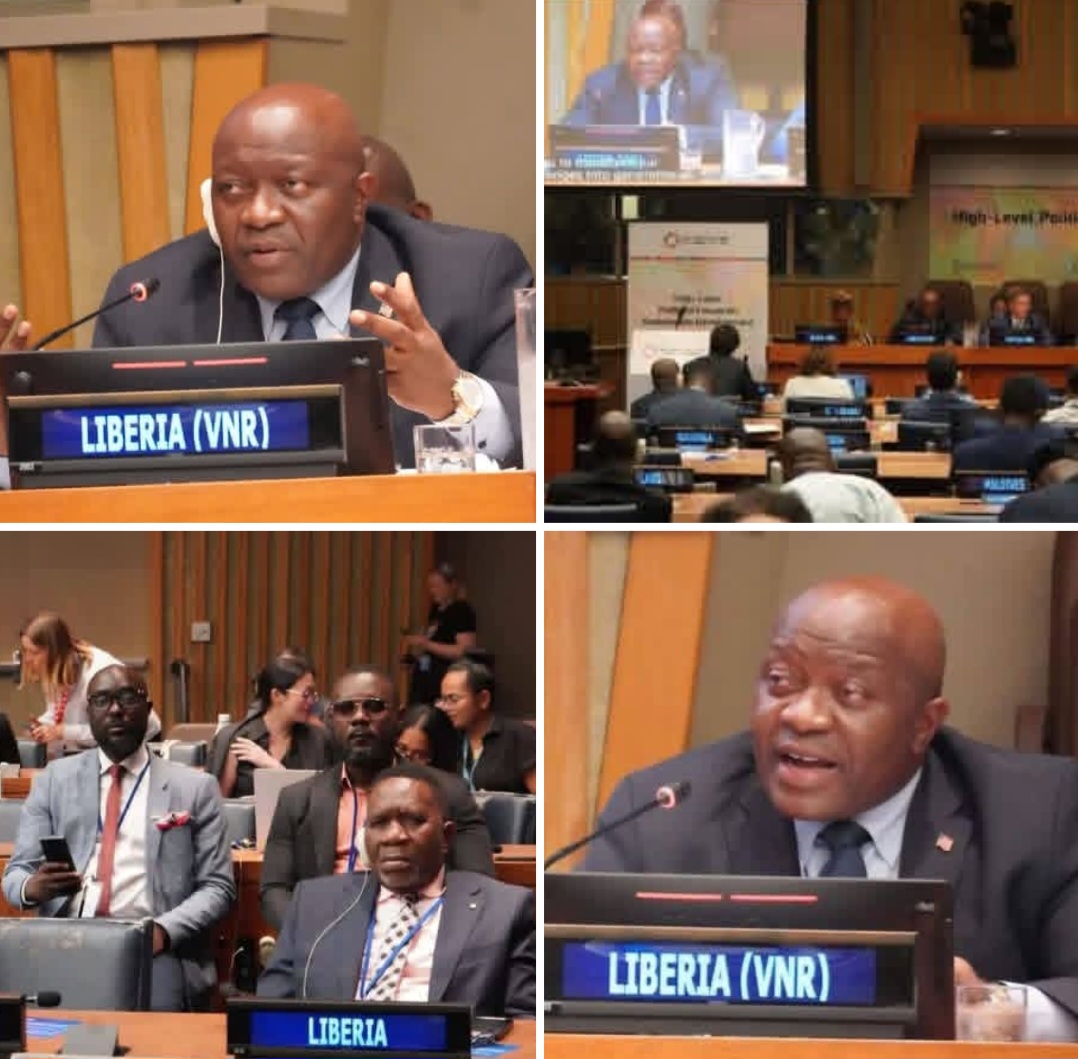
Addressing delegates during Liberia’s Third Voluntary National Review (VNR) at the United Nations High-Level Political Forum (HLPF) on Sustainable Development in New York Minister Ngafuan reaffirmed the Government’s commitment to inclusive growth, economic resilience, and sustainable development under President Joseph Nyuma Boakai Sr.’s ARREST Agenda for Inclusive Development (2025–2029).
Liberia joined 35 other countries presenting Voluntary National Reviews under the 2026 HLPF theme: “Transformative, Equitable, Innovative and Coordinated Actions for the 2030 Agenda,” a global platform established in 2013 to monitor countries’ progress toward the 17 Sustainable Development Goals adopted by all UN member states in 2015.
Minister Ngafuan told the forum that Liberia’s national development blueprint has become the country’s principal instrument for implementing the SDGs.
The ARREST Agenda for Inclusive Development, which serves as Liberia’s five-year National Development Plan, contains 375 priority development interventions, with approximately 83 percent directly aligned to specific Sustainable Development Goal targets, reflecting what he described as a results-oriented and accountable development framework.
He stressed that the Government is increasingly relying on domestic institutions, reforms, and local ownership to drive national transformation.
Economic Recovery Strengthens
Highlighting recent macroeconomic achievements, the Finance Minister reported that Liberia’s economy continues to demonstrate resilience despite global uncertainty.
According to the presentation:
GDP growth is projected at 5.5 percent in 2026, among the stronger growth rates in West Africa.
Inflation has declined to 5.3 percent, a dramatic improvement from the double-digit inflation recorded during 2023.
Liberia’s Human Development Index (HDI) has risen to 0.510, reflecting gradual improvements in education, health, and living standards.
National poverty has declined from 34 percent in 2020 to 29.6 percent in 2024, signaling improving household welfare and expanded economic opportunities.
The Minister attributed much of this progress to prudent macroeconomic management, fiscal reforms, increased domestic revenue mobilization, and continued investments in productive sectors.
Liberia’s report outlined notable gains across health, education, infrastructure, digital connectivity, and financial inclusion.
The Government reported continued reductions in maternal mortality while strengthening disease surveillance systems capable of detecting outbreaks within 24 to 48 hours, a major lesson learned following the devastating 2014–2016 Ebola epidemic.
Education indicators also continue to improve, with rising school enrollment and expanded Technical and Vocational Education and Training (TVET) programs equipping thousands of young Liberians with employable skills.
Financial inclusion has accelerated significantly as mobile money accounts doubled from 1.5 million in 2020 to more than 3.5 million, expanding access to financial services, particularly in rural communities.
Infrastructure development also remains a central pillar of Liberia’s modernization strategy.
Government data presented at the forum showed:
78.8 percent of Liberians now have access to safe drinking water.
Sanitation coverage has increased from 18 percent to 28 percent.
Electricity access has expanded from 32.7 percent to 38 percent, supported by an installed generation capacity of 146 megawatts, much of it from renewable energy investments.
The national paved road network has grown from approximately 1,300 kilometers in 2023 to about 1,450 kilometers by the end of 2025, with Government maintaining its target of 2,000 kilometers by 2029.
Liberia also reported that 4G telecommunications coverage now reaches approximately 80 percent of the country, while construction has commenced on Liberia’s first Special Agro-Industrial Processing Zone, expected to stimulate agricultural value addition, industrialization, and job creation.
Domestic Revenue Reaches Record Levels
One of the strongest indicators presented during the review was Liberia’s improving fiscal performance.
Domestic revenue increased from US$606.3 million in 2023 to more than US$840 million in 2025, raising the country’s revenue-to-GDP ratio to 15.8 percent, a milestone Government officials say reflects improved tax administration, digital reforms, and stronger compliance.
The gains are expected to provide Government with greater fiscal space to finance national development priorities while reducing dependence on external assistance.
Despite the encouraging progress, Minister Ngafuan acknowledged that Liberia continues to face considerable external pressures.
Among the major challenges cited were:
The withdrawal of assistance from one of Liberia’s largest development partners in 2025;
Rising global fuel and food prices linked to continuing geopolitical tensions in the Middle East;
Increasing debt-servicing obligations; and
Growing climate-related vulnerabilities affecting developing countries.
Nevertheless, he assured the international community that Liberia remains committed to building a resilient and self-reliant economy.
“Liberia is not retreating. We are taking ownership.
We are modernizing tax administration, accelerating digital transformation, strengthening climate resilience, and mobilizing more domestic resources to finance our own development priorities.
Our commitment to ensuring that no Liberian is left behind remains steadfast,” Minister Ngafuan declared.
Minister Ngafuan emphasized that Liberia’s Third Voluntary National Review was developed through one of the country’s most inclusive national consultation processes.
According to the report, more than 40 percent of stakeholder consultations were led by civil society organizations, women, youth groups, and persons with disabilities, ensuring that the review reflected the priorities and aspirations of communities across Liberia.
Concluding Liberia’s presentation, the Finance Minister urged the international community to deepen cooperation with developing countries through increased private sector investment, innovative financing mechanisms, technology transfer, climate financing, and stronger multilateral partnerships.
He stressed that achieving the Sustainable Development Goals by 2030 will require sustained collaboration between governments, development partners, financial institutions, and the private sector.
Liberia’s delegation to the High-Level Political Forum also included R. Matenokay Tingban, Minister of Mines and Energy, and Cooper Kruah, Minister of Labor, who joined Minister Ngafuan in presenting the country’s progress and reaffirming Liberia’s commitment to inclusive, sustainable, and people-centered development.


