





By: Julius Konton
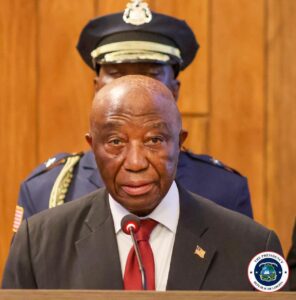
Liberia’s Minister of Finance and Development Planning, Augustine Kpehe Ngafuan, has pledged to lead a national advocacy campaign to combat Hepatitis B, warning that the virus has become one of the country’s deadliest yet most overlooked public health threats.
Speaking during the World AIDS Day commemoration on the grounds of the Capitol Building in Monrovia, Minister Ngafuan revealed that “over the past one and a half years, I have personally known about ten people who died from Hepatitis B.” He described the virus as “one of the biggest silent killers in the country” and emphasized the urgent need for a coordinated national response.
Hepatitis B, transmitted through blood, sexual contact, or from mother to child is significantly more infectious than HIV.
Globally, the World Health Organization (WHO) estimates 296 million people are living with chronic Hepatitis B, causing 820,000 deaths annually.
In West Africa, prevalence rates range between 8–15%, among the highest in the world.
In Liberia, health experts estimate that more than 13% of adults may be living with the virus, although testing gaps make the exact figure uncertain.
Minister Ngafuan urged for increased community awareness, especially in rural and densely populated urban communities where testing and vaccination rates remain low.
“It is time to ramp up massive efforts against Hepatitis B,” he said, assuring the public of his “fullest support.”
The Minister disclosed that the government has already allocated funds in the national budget to strengthen HIV and viral infection control programs, adding that more support will follow as fiscal space allows.
“We will not sit to allow a critical sector to be overly challenged,” Ngafuan said. “From where I sit and see, good news is on the way.”
Ngafuan highlighted the financial strain facing government health programs, noting that debt servicing now rivals national allocations to the health and education sectors, amounting to roughly US$230 million.
“Yes, we are increasing our budget, but our challenges are increasing as well,” he warned. “Debt servicing is competing side by side with two critical sectors, health and education.”
Despite challenges, Minister Ngafuan emphasized that Liberia has made significant progress in its HIV response.
He noted that over 36,000 Liberians are currently living with HIV, a figure that the government aims to push to zero through treatment expansion, testing campaigns, and community partnerships.
“Unlike before, AIDS is no longer a death sentence,” he stressed. “The stigma that once defined the disease has reduced significantly because of years of dedication, resources, and the relentless efforts of health workers.”
The Minister added: “We are not where we want to be, but we are not where we used to be. That is the theme of our progress.”
He praised Liberia’s healthcare workers and international partners for their contributions but cautioned that more work remains.
“We celebrate all those who have made efforts in the fight against AIDS. We celebrate the transition,” he noted, while urging health stakeholders to stay vigilant amid rising co-infections of HIV, Hepatitis B, and other sexually transmitted infections.
Reaffirming President Boakai’s commitment to the health sector, Ngafuan concluded: “We do not claim that every problem can be solved overnight. But today is materially better than yesterday, and tomorrow will be better than today.”


