




By: Julius Konton
The International Monetary Fund (IMF) has intensified negotiations with Liberia on climate-linked financing under its Resilience and Sustainability Facility (RSF), as the Fund’s Third Review Mission held high-level talks with the country’s economic managers and key sector stakeholders in Monrovia on Monday.
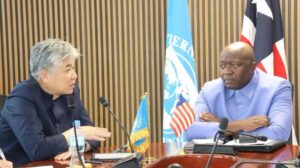
The IMF delegation, led by Mission Chief Daehaeng Kim and Resident Representative Joel Chiedu Okwuokei, met with Liberia’s Minister of Finance and Development Planning, Augustine Kpehe Ngafuan, alongside senior officials from the energy, public works, environment, and water sectors.
The discussions focused on supply-side constraints and policy reforms required to unlock long-term concessional financing under the RSF framework.
The RSF operates under the IMF’s Resilience and Sustainability Trust (RST) and is designed to help vulnerable and low-income countries strengthen resilience to climate change, improve disaster preparedness, and enhance macro-economic stability.
The facility also supports reforms linked to climate adaptation, mitigation, and public health shock preparedness.
Up to $1.4 Billion in Long-Term Concessional Financing
Under the RSF framework, Liberia is eligible to access financing equivalent to 150 percent of its IMF quota, estimated at approximately US$1.4 billion in Special Drawing Rights (SDRs).
The financing comes on highly concessional terms, including a 20-year maturity, a 10-year grace period, and below-market interest rates, making it one of the most affordable long-term funding instruments available to developing economies.
IMF officials emphasized that access to RSF resources is performance-based and tied to credible policy commitments, particularly in areas such as climate-responsive public investment, energy sector reforms, environmental governance, and institutional capacity building.
Focus on Energy, Infrastructure, and Climate Resilience
Liberia remains among the most climate-vulnerable countries in West Africa, facing rising risks from coastal erosion, flooding, erratic rainfall, and infrastructure fragility.
These challenges place increasing pressure on public finances, energy supply, food systems, and water security.
During the meeting, stakeholders from Liberia’s energy, works, environment, and water sectors outlined structural bottlenecks affecting service delivery, investment efficiency, and climate resilience.
IMF officials underscored the importance of aligning sector reforms with macro-economic stability goals and ensuring that climate-related spending delivers measurable development outcomes.
Beyond Financing: Budget Support and Structural Reform
Beyond direct financial inflows, the RSF is expected to provide critical budgetary support, enabling Liberia to advance structural reforms, mobilize climate finance from other development partners, and scale up investments in green public infrastructure.
The facility is also designed to act as a catalyst, helping countries crowd in concessional and private financing by strengthening policy credibility and long-term fiscal planning.
The IMF’s engagement with Liberia under the Third Review Mission comes amid broader efforts by the government to stabilize the economy, improve public financial management, and reposition the country for climate-resilient and inclusive growth.
Further technical discussions are expected in the coming weeks as Liberia works toward meeting the policy benchmarks required for RSF approval.


