




By: Julius Konton
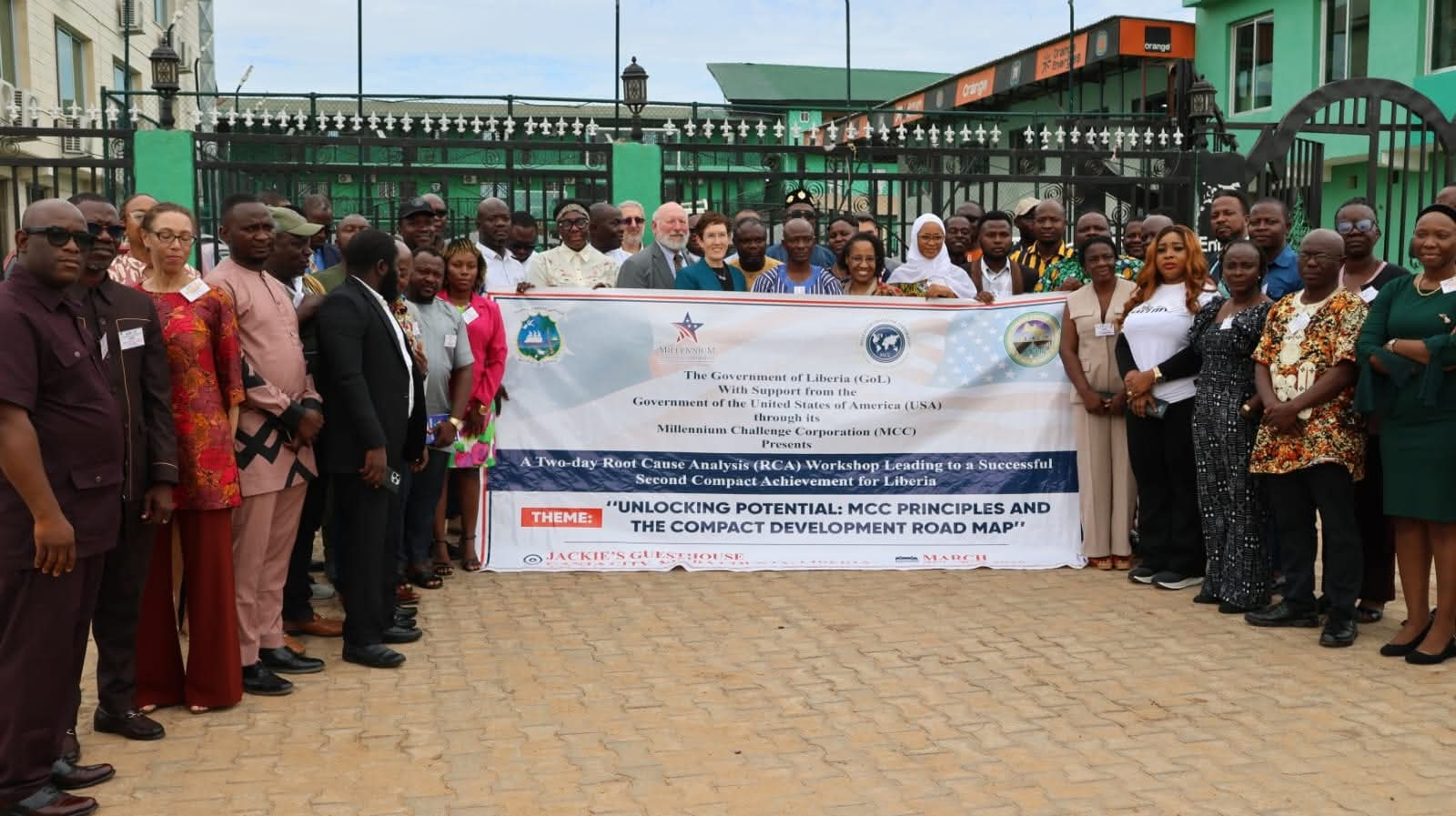
The Millennium Challenge Corporation (MCC), in partnership with the Ministry of Finance and Development Planning, has convened a high-level Root Cause Analysis (RCA) Workshop focused on Liberia’s energy sector, marking a critical step toward shaping the country’s second MCC development compact.
Held in Gompa, Nimba County, the multi-day workshop brings together representatives from key line ministries, the Liberia Electricity Corporation (LEC), energy regulators, private-sector investors, development partners, and civil society organizations.
It is the second RCA workshop under Liberia’s renewed engagement with MCC and is widely viewed as a pivotal moment in addressing what economists describe as one of Liberia’s most binding constraints to economic growth: reliable and affordable electricity.
Energy Poverty as an Economic Brake
Despite vast renewable energy potential, Liberia continues to face one of the lowest electricity access rates in sub-Saharan Africa. National electrification remains below 30 percent, with rural access estimated at less than 10 percent, according to sector data cited by development partners.
High tariffs among the most expensive in the region continue to burden households and businesses, limiting industrial expansion, job creation, and service delivery.
Opening the workshop on Tuesday, Carolyn Wetzel Chen, Acting MCC Liberia Team Lead, emphasized the historic significance of the exercise.
“The evidence we bring into this room, the discussions we will have, and the decisions that will be made to define and prioritize the root causes of this binding constraint will make history,” she said.
Ms. Chen explained that the RCA process goes beyond surface-level challenges such as generation shortfalls and grid instability, probing deeper into institutional weaknesses, financial sustainability, regulatory gaps, and policy implementation failures that have historically undermined the sector.
Roadmap to a New Compact
According to the MCC timeline presented at the workshop, compact development is expected between 2027 and 2028, with formal signing projected for 2028 and implementation spanning 2029 to 2035.
The anticipated compact is expected to focus heavily on energy sector reform, grid expansion, and private-sector participation to unlock inclusive economic growth.
Ms. Chen also referenced high-level diplomatic engagement between Liberia and the United States, noting that in July 2025, President Joseph Nyuma Boakai, Sr. met with U.S. President Donald Trump at the White House, where both leaders reaffirmed their commitment to strengthening bilateral cooperation, including through MCC programs.
Government: Beyond Symptoms to Structural Causes
Representing the Ministry of Finance and Development Planning, Assistant Minister for Economic Policy, Henry D. Z. Yanquoi, underscored the analytical depth of the workshop.
“This process is not merely about identifying constraints,” Yanquoi said. “It is about understanding why these constraints exist, why they persist, and what systemic reforms are required to sustainably remove them.”
He stressed that reliable energy is foundational to Liberia’s Agriculture, Manufacturing, Health, Education, and Digital Economy agendas, all of which are central pillars of the Boakai administration’s national development strategy.
A Record of Impact: Lessons from the First Compact
Liberia’s partnership with MCC dates back to 2015, when the country signed a US$257 million compact one of the largest per-capita MCC investments globally at the time. Implemented between 2016 and 2021, the compact delivered transformative results, most notably through the rehabilitation of the Mount Coffee Hydropower Plant, which restored more than 80 megawatts of domestic generation capacity.
The first compact also supported road maintenance systems, improved institutional governance, and reduced Liberia’s dependence on costly diesel generation, saving the economy millions of dollars annually in fuel imports.
However, experts note that generation gains have not been fully matched by transmission, distribution, and financial reforms, leaving much of the population still without access to power an imbalance the current RCA process aims to correct.
Toward Inclusive Growth and Poverty Reduction
In 2024, Liberia was officially selected to develop a second MCC compact, reflecting renewed confidence in the country’s reform trajectory under President Boakai.
The proposed focus on energy aligns with global evidence showing that each percentage-point increase in electricity access can significantly boost GDP growth, employment, and poverty reduction.
As deliberations continue in Gompa, stakeholders agree that the success of Liberia’s next MCC compact will hinge on data-driven prioritization, political commitment, and coordinated reform implementation.
For Liberia, the workshop represents more than a technical exercise it is a strategic inflection point in the nation’s long struggle to turn energy from a constraint into a catalyst for development.


