


Liberia Bets on Sustainable Sports Financing as Boakai Signs Sogbie-Sponsored Law
By: Julius Konton
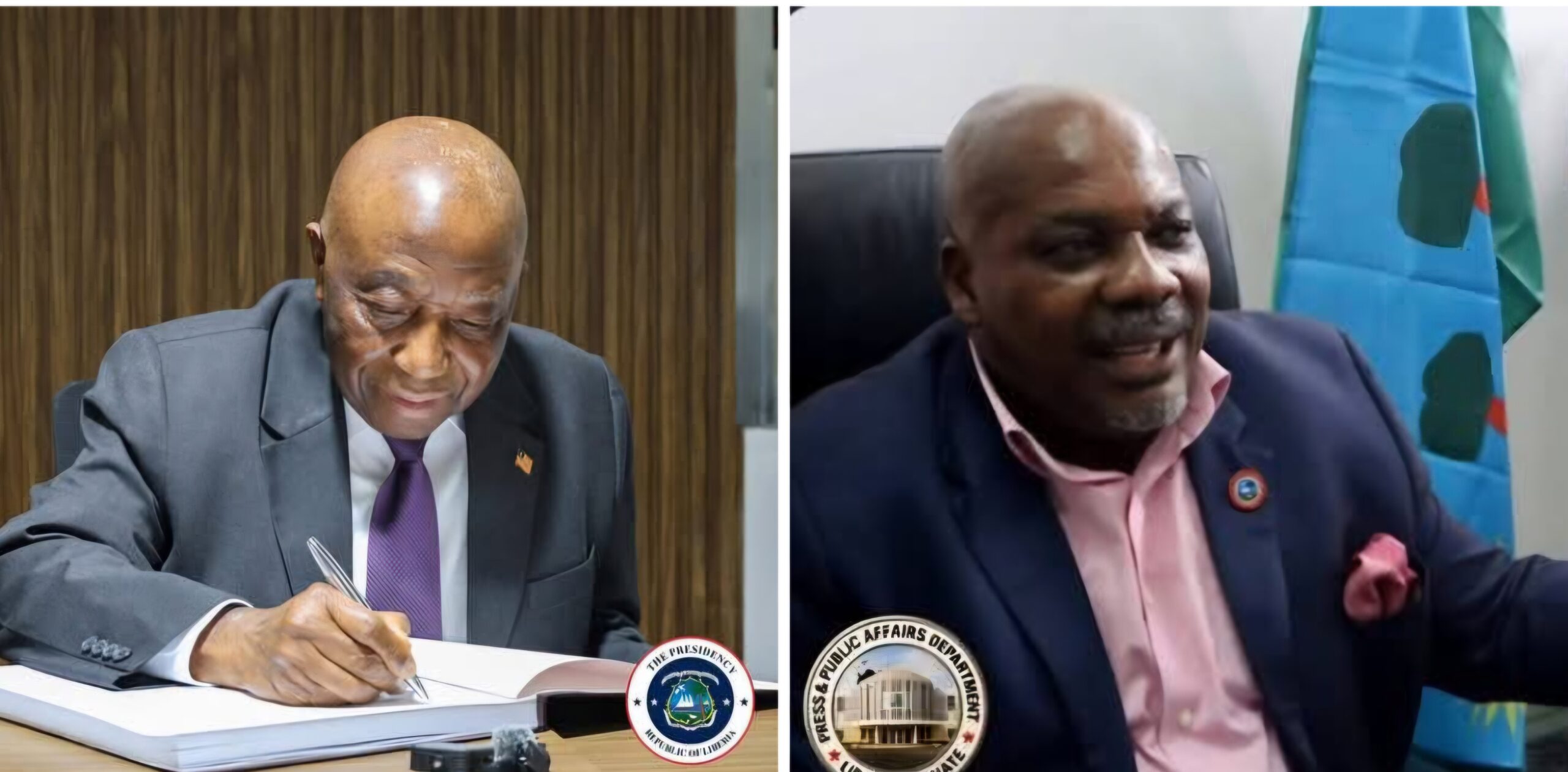
President Joseph Nyuma Boakai has signed into law legislation establishing the Liberia National Sports Fund Authority, creating a dedicated institutional mechanism intended to provide more predictable and sustainable financing for athletes, national teams, sporting federations, grassroots programs and sports infrastructure across the country.
The legislation, formally titled the “Act to Create the National Sports Fund Authority,” represents one of Liberia’s most significant policy interventions in sports financing in decades and could fundamentally change how the country mobilizes, manages and distributes resources for sporting development.
The law was sponsored by River Gee County Senator Jonathan Boye-Charles Sogbie, a former Liberian national-team footballer, and was passed by the Liberian Senate on July 23, 2025, after being introduced earlier that year.
The measure subsequently advanced through the legislative process before receiving presidential assent.
Sogbie, speaking Monday, August 17, 2026, described the legislation as a potential “lifeline” for Liberian athletes, particularly those who have spent years confronting inadequate facilities, irregular financing, delayed allowances, limited training opportunities and uncertainty over national-team participation.
“This law ensures sustainable and transparent financing for sports,” Sogbie said.
The senator’s argument reflects a longstanding concern within Liberia’s sporting community: the country has produced elite athletes capable of competing internationally, but its domestic sports system has often struggled to provide the consistent financial and institutional support required to develop that talent.
A Shift From Emergency Funding to Institutional Financing
At the heart of the new law is the creation of a specialized public authority responsible for mobilizing, administering, monitoring and disbursing funds dedicated to sports.
Earlier versions of the legislation proposed a diversified financing model that included levies on selected imported goods, government budgetary support, grants, donations and other legally approved revenue sources.
The bill specifically identified apparel, footwear, cosmetics and luxury vehicles among the categories that could be subject to levies, with a proposed 2 percent levy on qualifying luxury imports identified as one potential revenue stream.
The underlying objective is straightforward: create a funding stream that is specifically earmarked for sports rather than leaving national teams and federations almost entirely dependent on annual appropriations, sponsorship appeals or emergency government interventions.
The authority is expected to support:
Construction, rehabilitation and modernization of sporting facilities;
National teams participating in regional, continental and international competitions;
Grassroots and youth sports programs;
Athlete training, talent identification and development;
Coaching and technical education;
National sporting federations;
County-level sporting programs;
Equipment and sports development initiatives; and
Other programs deemed essential to the advancement of Liberian sports.
The legislation also establishes a governance and accountability framework. Earlier provisions called for a Board of Directors, legislative oversight and annual independent audits, with audit findings expected to be made public.
The day-to-day operations would be managed by a Director General and supporting administrative structures.
Why the Law Matters
For decades, Liberia’s sports sector has operated under a financing model characterized by limited public resources, inconsistent sponsorship and periodic emergency interventions.
That challenge remains evident today.
In February 2026, Youth and Sports Minister Cornelia W. Kruah disclosed that her ministry’s budget stood at approximately US$9.1 million, with about US$2.1 million allocated as grants for various sporting federations.
At the same time, officials of the Liberia Football Association and Liberia Basketball Federation cited significant debts, delayed reimbursements, high accommodation costs, international competition expenses and logistical shortages as continuing obstacles to development.
The figures illustrate the pressure facing a ministry expected to support multiple sporting disciplines while also financing youth programs, national competitions, infrastructure and international commitments.
The new authority is therefore designed to create a financing mechanism that can operate beyond the limitations of the annual national budget.
2026 Budget Reveals Growing Government Investment
The Sports Fund law comes as the Boakai administration has already increased financial attention toward several sporting disciplines.
The 2026 draft national budget proposed approximately US$1.07 million for football, compared with about US$550,000 previously allocated, according to budget reporting.
Other disciplines also recorded proposed increases: chess was listed at approximately US$50,000, up from US$5,000; basketball at about US$22,720; and kickball at approximately US$13,915, compared with roughly US$5,000 previously.
While those allocations represent increased government support, the broader question remains whether annual budgetary increases alone can adequately finance Liberia’s sporting ambitions.
The National Sports Fund Authority is intended to provide an additional answer.
A Country With World-Class Sporting Potential
Liberia’s sports history provides perhaps the strongest argument for greater investment.
The country has repeatedly produced athletes who have succeeded far beyond the limitations of the domestic sporting environment.
The most powerful example remains George Manneh Weah, Liberia’s legendary footballer who in 1995 became the first African and first non-European player to win the Ballon d’Or after the award’s eligibility was expanded to players from outside Europe.
Weah won the Ballon d’Or with 144 points, finishing ahead of Germany’s Jürgen Klinsmann, who received 108 points.
That same year, Weah also became the first African winner of the FIFA World Player of the Year award.
The BBC notes that he remains the only African to have won FIFA’s prestigious global player award.
His achievement demonstrated that Liberia possesses sporting talent capable of reaching the highest levels of world competition.
But Weah’s story also highlights the central challenge confronting Liberia: extraordinary individual talent has frequently emerged without a comparably strong domestic development system.
From Weah to the Next Generation
The new Sports Fund Authority is therefore being viewed not simply as a mechanism for paying national-team bills, but as a possible investment in an entire sporting ecosystem.
A successful system would allow young athletes to be identified earlier, trained more professionally and provided with access to facilities, qualified coaches, competitions, equipment and international exposure.
It could also strengthen the connection between schools, county sports programs, clubs, federations and national teams.
That issue has become increasingly important as the government pushes decentralization.
In February 2026, the Ministry of Youth and Sports said it was working with national federations to improve talent identification and expand sports development beyond Monrovia.
The ministry also said a National Sports Strategy was being prepared, with federations expected to contribute to the process.
Such initiatives could complement the new financing authority if properly coordinated.
The County Dimension
Liberia has 15 counties, yet sporting opportunities and infrastructure remain heavily concentrated around the capital and a limited number of urban centers.
For many young athletes outside Monrovia, the pathway from school competition to professional or national-team football, basketball, athletics, volleyball, kickball and other disciplines remains fragmented.
A properly financed National Sports Fund could change that equation by directing resources toward county-level playing fields, training centers, competitions, scouting programs and equipment.
The result could be a broader national talent pool rather than a system that depends disproportionately on athletes discovered in Monrovia.
The Accountability Test
Despite the optimism surrounding the legislation, the signing of the law is only the beginning.
The creation of an authority does not automatically produce money.
The government must now establish the institution, appoint competent leadership, develop effective revenue-collection systems, define clear disbursement procedures and ensure that the fund remains protected from political interference and financial mismanagement.
The credibility of the authority will ultimately depend on whether athletes and sporting organizations can see measurable improvements.
That means transparent budgets, independent audits, published financial reports and clear eligibility criteria for beneficiaries will be critical.
The issue is particularly important because the law is designed to manage potentially significant public and privately generated resources.
Sports federations, in turn, will face increased expectations to submit credible development plans, properly account for public funds and demonstrate measurable results.
The Ministry of Youth and Sports has already begun moving in that direction. Minister Kruah said in February that federations benefiting from government funding would be required to submit annual work plans detailing activities and projected expenditures, with periodic reviews intended to improve accountability.
A Potential Turning Point for Liberian Sports
The significance of the legislation extends beyond football.
Although football remains Liberia’s most popular sport, the country has competitive traditions in basketball, athletics, kickball, volleyball, table tennis, handball, chess and other disciplines.
A national sports financing mechanism could give these sports greater opportunities to develop structured youth programs, organize domestic competitions and participate more consistently in international events.
For Liberia’s national teams, the impact could be equally important.
Instead of repeatedly searching for emergency financing for airfare, accommodation, training camps, equipment and technical expenses, federations could potentially operate under a more predictable financial framework.
That would allow administrators to plan seasons rather than simply respond to crises.
Sogbie’s Personal Connection
For Senator Sogbie, the legislation carries an additional significance.
His experience as a former national-team footballer gives him first-hand knowledge of the difficulties that athletes face when resources are scarce.
The bill therefore represents an attempt by a former player turned lawmaker to translate sporting experience into public policy.
When the Senate passed the legislation in July 2025, Sogbie argued that Liberia could no longer depend exclusively on unpredictable government allocations to finance national teams and sporting development.
Sports Writers Association of Liberia also welcomed the initiative, describing it as a potentially transformative step while stressing that the authority must combine financing with strong governance, athlete development and infrastructure investment.
The Bigger Question: Will the Money Reach the Athlete?
That may ultimately become the defining test of the new law.
Liberia has never lacked sporting talent. What it has lacked is a sufficiently consistent system for identifying, financing and developing that talent.
The National Sports Fund Authority provides an opportunity to address that gap.
But its success will not be measured by the establishment of an office in Monrovia or the appointment of a board.
It will be measured by whether a young athlete in Nimba, River Gee, Grand Gedeh, Lofa, Maryland, Grand Cape Mount or another county can find a proper playing field, access qualified coaching, receive equipment, compete regularly and receive a genuine pathway toward national and international competition.
It will be measured by whether Liberia’s national teams arrive at international tournaments properly prepared rather than battling financial uncertainty.
And it will be measured by whether the country can turn its remarkable history of producing exceptional individual athletes into a sustainable national sports system.
A New Chapter Begins
President Boakai’s signing of the National Sports Fund Authority legislation therefore marks more than the creation of another government institution.
It represents a policy bet on the proposition that sports can be treated as a long-term national investment rather than an occasional budgetary obligation.
For a country that produced the first African Ballon d’Or winner, the challenge is no longer proving that Liberians can compete at the highest level.
The challenge is building the domestic system capable of producing many more George Weahs across football and every other sporting discipline.
The new authority now carries that responsibility.
If the promised revenue mechanisms are implemented, if the governance safeguards are enforced and if funding reaches athletes, coaches, federations and communities transparently, Liberia could be entering a new era in which sporting development is financed with greater predictability and strategic purpose.
But if implementation falters, the law could become another ambitious reform trapped between legislation and reality.
For Liberian athletes who have spent generations competing against better-funded sporting nations, the hope is that this time the promise will translate into fields, facilities, equipment, training, competitions, international exposure and, ultimately, opportunity.
The law has been signed. The real test now begins with implementation.


