



By: Julius Konton
Civil Service Agency (CSA) Director-General Dr. Josiah F. Joekai Jr. has challenged Liberian university students to view education not simply as a pathway to graduation, but as preparation for leadership, innovation and national transformation.
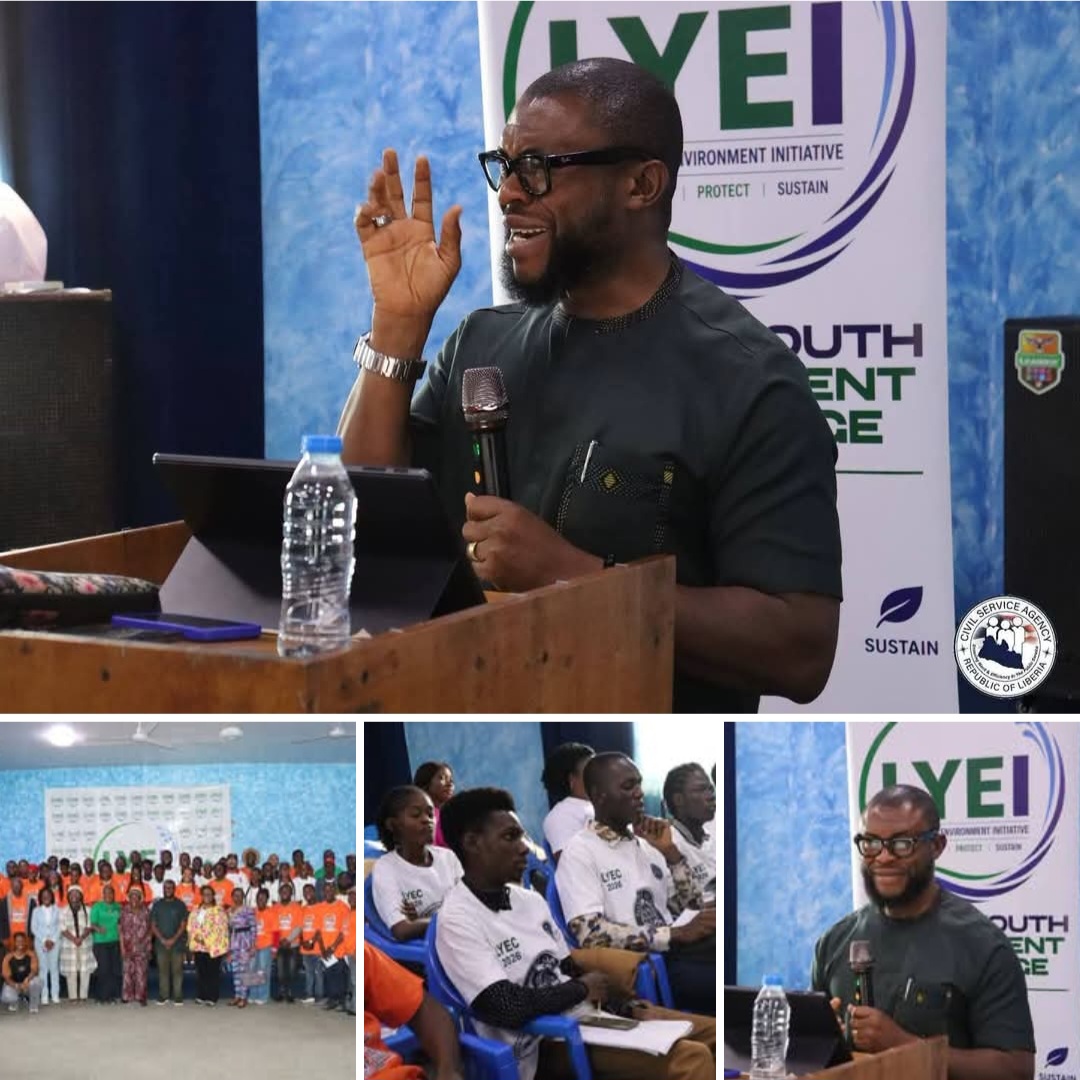
Speaking at the inaugural National Inter-University Environmental Debate Championship and Career Mentorship Forum at Stella Maris Polytechnic University in Monrovia on Friday, Dr. Joekai urged young Liberians to make deliberate choices about their education, careers and contribution to society.
He said Liberia’s future would not be determined solely by its mineral resources, forests, rivers or coastline, but increasingly by the knowledge, skills, creativity and judgment of its young people.
“What is between your ears, what you know, what you can do, and the choices you make” will help determine Liberia’s future, Dr. Joekai told participants.
The event was organized by the Liberia Youth Environment Initiative, a youth-led organization focused on environmental education, leadership development and climate action.
Its Executive Director, Elizabeth D. Kamara, invited the CSA Director-General to deliver the keynote address and formally open the competition.
Dr. Joekai’s message comes against the backdrop of significant human-capital and employment challenges in Liberia.
World Bank data indicate that 14% of Liberian youth aged 15–24 were not in employment, education or training in 2024, highlighting the importance of creating stronger connections between education, skills development and employment opportunities.
Another World Bank analysis published in 2026 estimated the youth NEET rate at approximately 14.8% and noted that Liberia’s employment structure remains overwhelmingly informal.
The World Bank also reports that Liberia’s primary-school completion rate stood at 58% in 2022, while about 21% of children aged 5–17 were engaged in economic activities, underscoring the long-term challenges surrounding education, skills formation and human-capital development.
Against this backdrop, Dr. Joekai argued that career preparation should begin long before young people receive university diplomas.
He encouraged schools and universities to help students understand their interests, strengths and abilities while also exposing them to the realities of Liberia’s labor market and emerging professions.
‘Career guidance must start early’
According to Dr. Joekai, career guidance should not be treated as an intervention that begins after graduation.
Rather, students should receive information and mentorship early enough to help them make informed decisions about academic programs and future professions.
He called for stronger links between Liberia’s educational institutions, government agencies, private businesses and professional organizations so that students can understand how classroom knowledge translates into real-world opportunities.
“If you are interested in environmental governance, learn what the Environmental Protection Agency actually does,” he advised.
Students interested in fisheries and the blue economy, he added, should engage with the National Fisheries and Aquaculture Authority, while those interested in forestry and conservation should seek knowledge from institutions and professionals working in those areas.
Those pursuing public policy, meanwhile, should understand how ministries and government agencies transform policies and ideas into programs and services.
The message, he said, is simple: students must take ownership of their professional development before entering the job market.
Environment and the future of Liberia
The focus on environmental leadership also reflects the growing importance of Liberia’s natural-resource economy.
With extensive forest resources, a long Atlantic coastline, substantial freshwater systems and significant agricultural and mineral potential, Liberia faces the dual challenge of exploiting natural resources for economic growth while protecting ecosystems for future generations.
For young people, Dr. Joekai suggested, this creates opportunities in fields ranging from environmental governance and conservation to fisheries, agriculture, climate resilience, renewable energy, natural-resource management and public policy.
The environmental debate therefore served not only as an academic competition but also as a platform for students to examine how Liberia can balance development with environmental sustainability.
The one-day program brought together students from four Liberian universities: Cuttington University, Notre Dame University, African Methodist Episcopal University and the University of Liberia.
The participating students were encouraged to use debate, research and public speaking as tools for developing the confidence and analytical abilities required for leadership.
Dr. Joekai urged them to remain curious and continuously seek opportunities beyond the classroom through volunteerism, internships, apprenticeships, mentorship and professional engagement.
Such experiences, he said, can help students develop practical competencies and professional networks that complement their academic qualifications.
Civil service reform and the skills agenda
Dr. Joekai’s call for a more skilled and career-ready generation also aligns with the broader reform mandate of the Civil Service Agency.
Established by an Act of the Liberian Legislature in 1973, the CSA serves as the central human-resource institution for Liberia’s government, with responsibilities including workforce planning, recruitment, training and development, performance management and career development.
Under Dr. Joekai’s leadership, the agency launched a 2025–2029 Strategic Plan focused on institutional effectiveness, research and innovation, sustainability and resilience, capacity building, and stakeholder engagement.
The strategy is aligned with the government’s ARREST Agenda for Inclusive Development and places human-capital development at the center of public-sector transformation.
The agency has also pursued modernization initiatives, including personnel and credential verification and the digitalization of human-resource processes.
These reforms reflect a wider recognition that Liberia’s development ambitions require not only infrastructure and financial investment but also a professional workforce capable of designing, implementing and sustaining national programs.
Dr. Joekai told the students that leadership should not be postponed until they occupy senior government, corporate or institutional positions.
Instead, leadership begins with everyday decisions: how students learn, how they use their time, the skills they develop, the people they associate with and the causes they choose to serve.
He encouraged participants to be intentional about their career choices and to identify opportunities that allow them to contribute to Liberia’s development while building their own professional futures.
The CSA chief commended the Liberia Youth Environment Initiative and Kamara for creating a platform that combines education, environmental awareness, debate, mentorship and leadership development.
He described the initiative as an important contribution to cultivating a new generation of Liberian environmental and civic leaders.
For Liberia, the challenge extends beyond producing university graduates. The country must increasingly ensure that education produces young people equipped with the technical, entrepreneurial, analytical and leadership skills demanded by a changing economy.
With a large share of employment remaining informal and thousands of young people facing barriers to education, training and formal employment, the transition from classroom to career remains one of Liberia’s most pressing development challenges.
Dr. Joekai’s message at the Monrovia forum therefore carried a broader national significance: Liberia’s natural resources may provide opportunities, but it will be the quality of its people and particularly the preparation of its young generation that determines how effectively those opportunities are converted into sustainable national development.
For the students gathered at Stella Maris Polytechnic University, the challenge was clear: learn boldly, choose wisely, gain practical experience and prepare to lead courageously.


