



By: Julius Konton
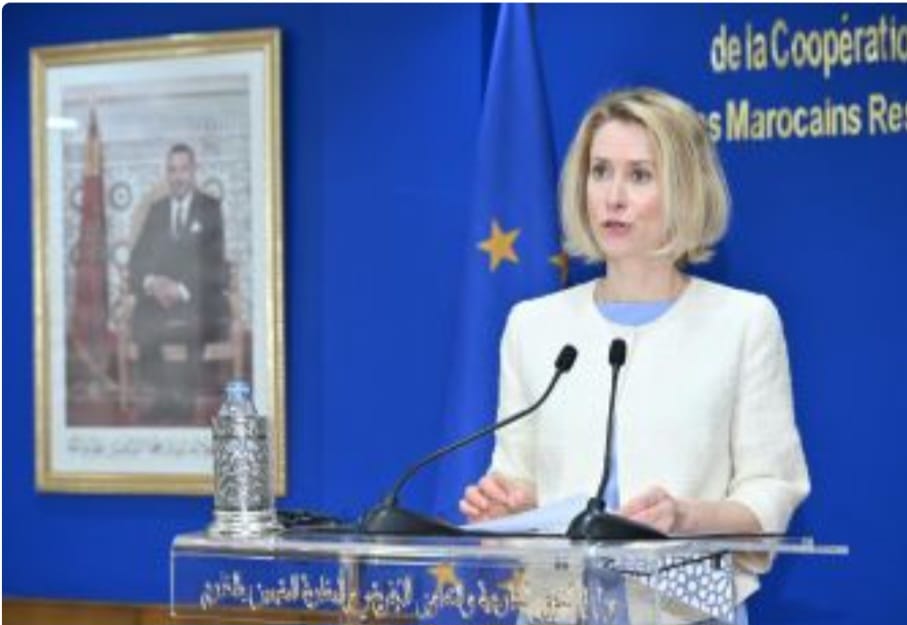
In a major diplomatic development with implications for North Africa and Europe, the European Union’s High Representative for Foreign Affairs and Security Policy, Kaja Kallas, on Thursday endorsed a new European position on the Moroccan Sahara issue, stating that “genuine autonomy could represent the most feasible outcome” for resolving one of Africa’s longest-running territorial disputes.
Kallas, who also serves as Vice-President of the European Commission, made the remarks during an official working visit to Rabat, where she held talks with Morocco’s Minister of Foreign Affairs, African Cooperation and Moroccan Expatriates, Nasser Bourita.
The statement marks one of the clearest signals yet from the 27-member European Union supporting a political settlement centered on Morocco’s autonomy proposal for the Sahara region, an issue that has remained unresolved for nearly five decades.
EU Calls for Negotiations Without Preconditions
According to a joint communiqué issued after the meeting, the European Union reaffirmed its support for a negotiated political process under United Nations auspices and urged all parties to engage in talks without preconditions.
The communiqué stated that discussions should proceed on the basis of Morocco’s Autonomy Proposal, with the objective of reaching a lasting and mutually acceptable political solution.
The EU further welcomed Morocco’s readiness to clarify how autonomy under Moroccan sovereignty would function institutionally, administratively, and economically.
Strategic Timing Ahead of UN Security Council Meeting
The announcement comes just days before a scheduled meeting of the United Nations Security Council, where members are expected to review progress on the Sahara dossier and the mandate of the UN Mission for the Referendum in Western Sahara (MINURSO).
Diplomatic analysts say the EU’s unified language could influence broader international discussions, particularly as several permanent and non-permanent Security Council members continue to support a pragmatic settlement model.
The communiqué also welcomed the adoption of UN Security Council Resolution 2797 (2025), which reaffirmed support for the UN Secretary-General and his Personal Envoy in facilitating negotiations, while referencing Morocco’s autonomy initiative as the basis for renewed engagement.
Growing International Support for Morocco’s Position
The latest EU statement reflects a wider international trend in favor of Morocco’s proposal, first presented to the United Nations in 2007.
The plan offers self-governance to the Sahara territory while maintaining Moroccan sovereignty.
Over the past several years, a number of countries have publicly backed Morocco’s position, including the United States, Spain, France, Germany, and several Arab and African nations.
More than 30 countries have also opened consulates in the cities of Laayoune and Dakhla, which Morocco cites as evidence of growing international recognition of its sovereignty claims.
Economic and Geopolitical Stakes
The Sahara region carries growing strategic significance due to:
Rich phosphate reserves
Expanding renewable energy investments
Atlantic trade access
Fisheries resources
Increasing links to West African markets
Morocco has invested billions of dollars in infrastructure, ports, roads, solar power, and social services in the territory over the last two decades.
The Dakhla Atlantic Port, currently under development, is expected to become a major logistics hub connecting Europe, Africa, and the Americas.
Historical Context of the Dispute
The Western Sahara conflict dates back to 1975, following Spain’s withdrawal from the territory. Morocco subsequently asserted sovereignty, while the Polisario Front, backed by Algeria, sought independence.
A UN-brokered ceasefire was reached in 1991, but a final political settlement has remained elusive despite repeated mediation efforts.
The EU’s latest position appears to strengthen momentum toward a compromise solution emphasizing autonomy rather than full independence.
A Diplomatic Victory for Rabat
For Morocco, Thursday’s statement represents a significant diplomatic gain, especially because it reflects consensus among all 27 EU member states, many of whom are key economic and political partners.
Morocco is already one of the EU’s closest southern neighbors, with bilateral trade exceeding €60 billion annually, alongside deep cooperation in migration management, agriculture, renewable energy, and counterterrorism.
Analysts say stronger European backing may reinforce Morocco’s international standing while increasing pressure for renewed negotiations under UN leadership.
Attention now turns to New York, where the UN Security Council is expected to discuss next steps in the peace process.
Whether the renewed European stance can translate into concrete diplomatic progress remains uncertain, but Thursday’s announcement signals that momentum is increasingly moving toward an autonomy-based solution under Moroccan sovereignty.
For Rabat, the message from Europe was unmistakable: the search for a final settlement must now focus on practicality, realism, and political compromise.


