



By : Julius Konton
Former Liberian President George Manneh Weah has issued a forceful warning to Africa’s political class, arguing that democracy cannot be reduced to the casting of ballots and the inauguration of elected governments.
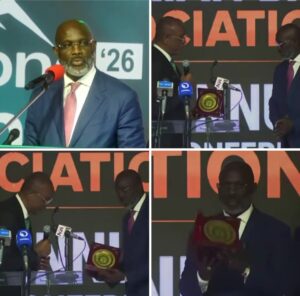
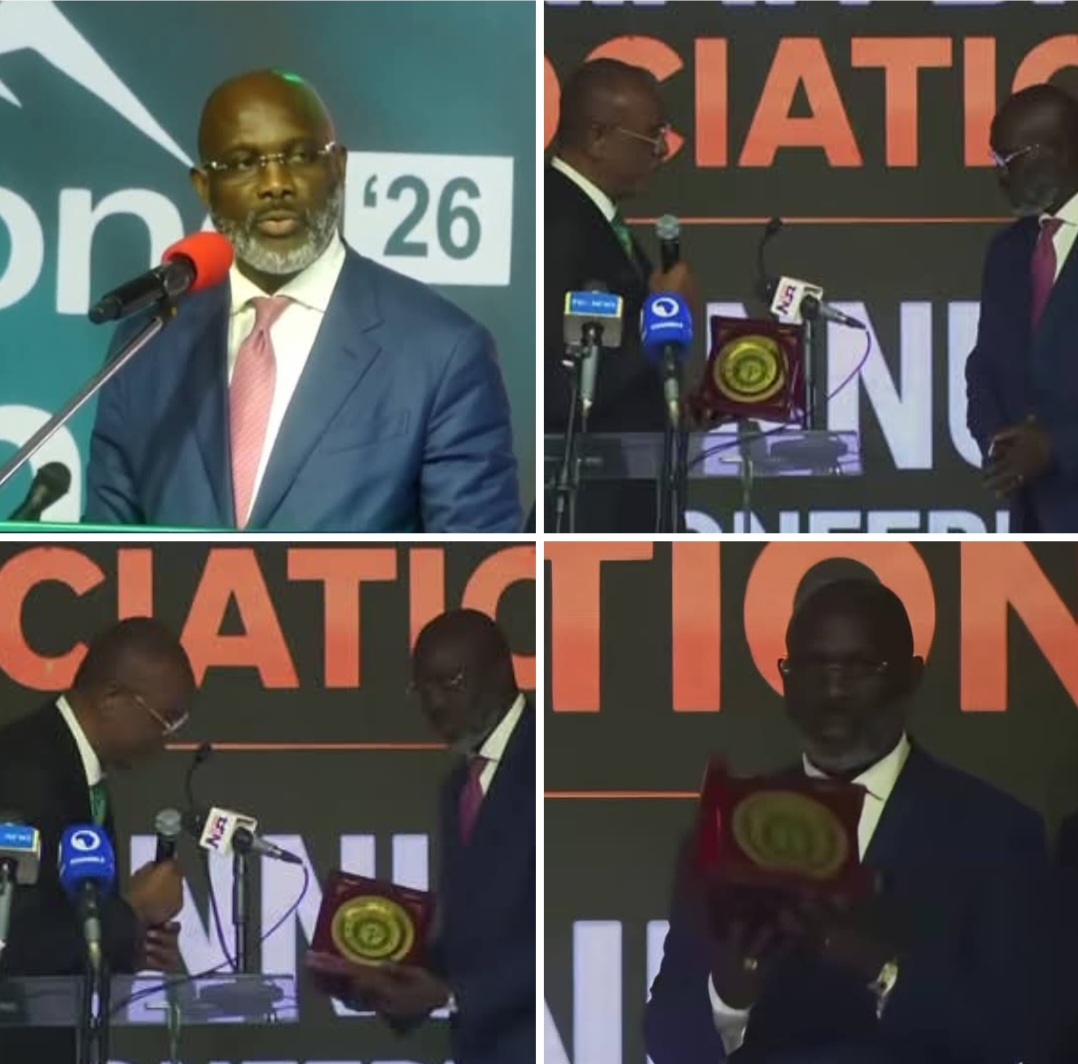
Speaking as keynote guest at the Nigerian Bar Association’s 66th Annual General Conference in Port Harcourt, Rivers State, Weah called on African countries to strengthen peaceful coexistence, uphold the rule of law and protect independent institutions capable of restraining executive power.
The conference, being held from August 21–28 under the theme “Beyond Limits,” has brought together lawyers, judges, policymakers and other stakeholders for discussions on the future of the legal profession and governance.
But Weah’s address went beyond legal practice.
It amounted to a broader political argument about one of Africa’s most persistent dilemmas: what happens to democracy after voters have gone home?
“Democracy does not survive on the strength of elections alone. Elections are the doorway into democracy, not the house itself,” Weah said.
The former Liberian leader warned that Africa must confront two sides of the same democratic crisis: military officers who overthrow elected governments and civilian leaders who use electoral victories to weaken the institutions designed to restrain them.
“A tyrant with a certificate of return is still a tyrant,” he declared.
That formulation places elected authoritarianism alongside military coups as competing threats to constitutional government, a controversial comparison, but one increasingly reflected in debates about Africa’s democratic trajectory.
Weah’s intervention comes at a particularly difficult moment for African democracy.
According to Freedom House’s Freedom in the World 2026, nine African countries have experienced coups since 2019.
The Institute for Security Studies puts the number of successful military coups at 11 across nine countries over roughly five years, including multiple takeovers in Mali and Burkina Faso.
The pattern stretches across West and Central Africa from Mali, Guinea, Burkina Faso and Niger to Gabon, Chad, Sudan, Madagascar and Guinea-Bissau.
Yet the coup phenomenon is only part of the story.
Freedom House says global freedom declined for the 20th consecutive year in 2025, with 54 countries suffering deterioration in political rights and civil liberties compared with 35 that improved.
The organization identifies military coups, institutional erosion and attempts by incumbent leaders to weaken democratic checks as major drivers of the decline.
That distinction matters.
A government does not necessarily cease being democratic the moment soldiers seize power.
Nor does a country remain genuinely democratic simply because its president won an election.
The deeper test is whether courts remain independent, legislatures retain oversight powers, journalists can investigate those in authority, opposition parties can operate freely and citizens can challenge government decisions without fear.
It was against this backdrop that Weah placed lawyers at the center of Africa’s democratic struggle.
He urged members of the Nigerian Bar Association to defend judicial independence and insist that the law apply equally to political leaders, ordinary citizens and powerful interests.
“The rule of law is not an abstract phrase for law school lecture halls.
It is the practical guarantee that a citizen’s rights do not depend on who is in office,” he said.
The argument carries particular resonance in Nigeria, Africa’s most populous country and one of the continent’s most influential democracies.
Nigeria has maintained civilian constitutional rule since 1999, but its democratic institutions continue to face serious challenges.
Freedom House currently rates Nigeria “Partly Free,” with a score of 44 out of 100, citing concerns involving electoral irregularities, corruption, security challenges, judicial independence and due process.
The organization says Nigeria’s judiciary is constitutionally protected and has demonstrated a degree of independence, while also identifying political interference, corruption, insufficient resources and a lack of transparency in judicial appointments as continuing concerns.
For Weah, therefore, the legal profession cannot afford to remain politically neutral when fundamental constitutional principles are under pressure.
He described the Nigerian Bar Association as a “standing sentinel” of democracy and challenged lawyers to speak when judicial independence, civil liberties and citizens’ rights are threatened.
Perhaps the most politically significant element of Weah’s speech was that he delivered his democratic warning from the perspective of a country whose modern history demonstrates the catastrophic consequences of institutional collapse.
Liberia’s experience is a powerful case study.
The April 1980 military coup marked the beginning of a prolonged period of political instability.
Civil war erupted in 1989, followed by another conflict from 1999 to 2003.
The combined wars killed or displaced hundreds of thousands of people and devastated state institutions and infrastructure.
The economic consequences were staggering.
IMF historical analysis found that Liberia’s GDP fell by approximately 90 percent between 1987 and 1995, while average income by the time of the 2005 elections was only about one-quarter of its 1987 level.
The country’s eventual democratic recovery began with the 2003 peace agreement, the deployment of UN peacekeepers and the 2005 elections, which marked a major step toward consolidating Liberia’s transition from conflict toward constitutional government.
That history gives Weah’s warning an unusual weight.
For Liberia, democracy is not merely a political slogan. It is closely connected to the country’s survival.
Weah also invoked his own political history, recalling his journey from the Gibraltar community in Monrovia to Liberia’s presidency.
His most pointed reference was the 2023 presidential runoff, when he conceded defeat to Joseph Boakai.
The election was exceptionally close. Boakai defeated Weah by just over one percentage point, making it one of the tightest presidential contests in Liberia’s history.
Weah ultimately accepted the result peacefully.
Weah presented that decision as evidence that national stability should outweigh personal political ambition.
“I chose to concede while the counting was still underway, because I have always believed, and still believe, that the will of the people must stand above the ambition of any one man in a democratic setting,” he said.
That statement is likely to become one of the most politically discussed portions of his address.
Supporters can point to the 2023 concession as an important contribution to Liberia’s post-war democratic culture.
Critics, however, may reasonably argue that conceding an election is only one part of democratic leadership; the harder test is whether leaders consistently respect institutions, dissent, accountability and independent oversight while in office.
That distinction is crucial.
Democracy cannot depend entirely on the personal character of one president. It must be strong enough to survive presidents with different personalities, ambitions and political interests.
Weah’s argument also challenges a familiar narrative in African politics that the principal enemy of democracy is the military.
There is little doubt that military intervention has inflicted enormous damage on African constitutional order.
But history shows that democratic erosion can also occur gradually, through constitutional manipulation, weakened courts, restrictions on the media, attacks on opposition parties, politicization of public institutions and executive dominance.
Freedom House’s latest global assessment specifically identifies both military coups and efforts by elected leaders to undermine democratic institutions as major sources of democratic decline.
This is why Weah’s statement that “a tyrant with a certificate of return is still a tyrant” may be more consequential than his criticism of coups.
It places an uncomfortable question before African electorates:
If a government wins an election but subsequently weakens the courts, intimidates critics and dismantles institutional checks, at what point does electoral legitimacy cease to be sufficient?
There is no simple answer.
But the question is increasingly unavoidable.
Weah’s remarks also arrive as Nigeria continues to balance democratic progress against institutional weaknesses.
Nigeria’s post-1999 civilian era is its longest uninterrupted period of constitutional government since independence, a major achievement in a country that experienced multiple military coups and long periods of military rule after independence.
Yet democratic continuity has not eliminated concerns about governance.
Freedom House’s assessment points to electoral irregularities, corruption, security threats and weaknesses in judicial independence and due process.
The implication is clear: democratic longevity and democratic quality are not necessarily the same thing.
A country can hold elections regularly while citizens remain concerned about accountability, institutional independence and the equal application of the law.
The Nigerian Bar Association chose “Beyond Limits” as the theme for its 66th conference, calling on the legal profession to challenge conventional boundaries and contribute to justice, governance and national development.
Weah effectively expanded that theme into a continental challenge.
Going “beyond limits,” in his formulation, means going beyond political loyalty.
It means lawyers must be prepared to defend constitutional principles even when the accused government belongs to their preferred political party.
It means judges must be able to rule against governments without fear.
It means legislatures must be able to scrutinize presidents.
It means journalists must be able to investigate public officials.
And it means citizens must retain the right to criticize governments without being treated as enemies of the state.
Weah also called for greater use of Africa’s human capital, including professionals in the diaspora, to strengthen legal systems, judicial modernization and development.
His appeal reflects a broader continental challenge: Africa possesses an enormous pool of lawyers, academics, economists, judges, journalists and other professionals, yet many countries continue to struggle with institutional capacity.
The question is therefore not simply whether Africa has enough educated professionals.
It is whether those professionals are free, independent and courageous enough to challenge power when necessary.
As Weah concluded his address, he called for peaceful coexistence, fairness, impartiality, gender equality, accountability, humanity and democracy.
The message was broad, but the warning was sharp.
Africa cannot protect democracy merely by condemning coups after soldiers have seized power.
Nor can it protect democracy simply by celebrating election victories.
The real battle begins after the votes are counted when institutions must confront power, courts must restrain authority and citizens must be protected from the very governments they elected.
For a former African president whose own country travelled from coup to civil war, international isolation and economic collapse before returning to constitutional government, that is not merely a legal argument.
It is a lesson written in Liberia’s history.
Meanwhile, at the end of the program, the Nigerian Bar Association honored, the former Liberian President for his eloquent speech.


