


By: Julius Konton
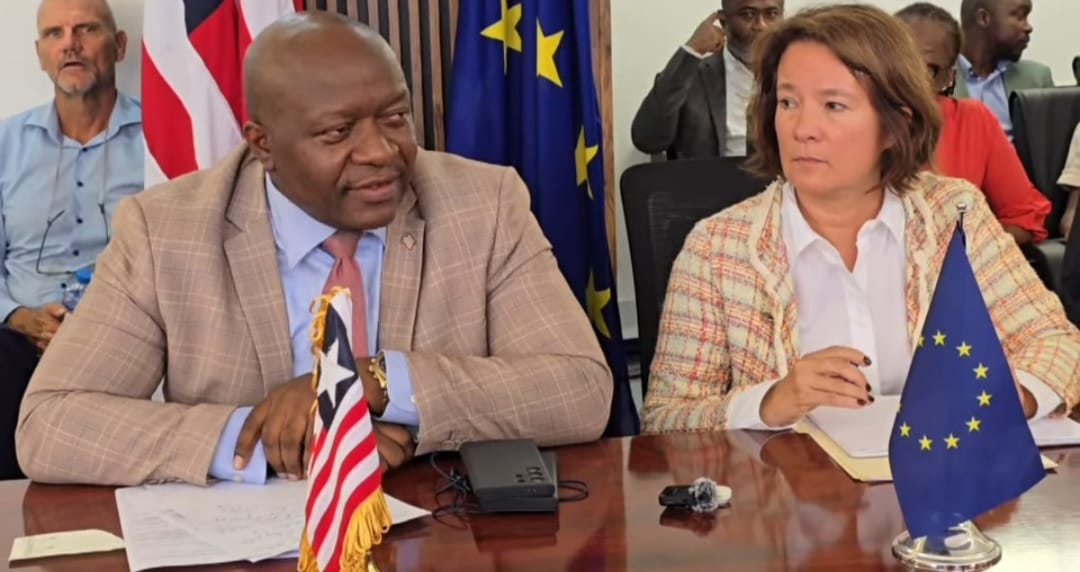
The European Union (EU) has released €21 million (approximately US$24.6 million) in direct budget support to Liberia, marking the first disbursement under a three-year €56 million grant-based budget support program, EU Ambassador and Head of Delegation Nona Deprez announced on Friday.
Speaking at a joint press conference in Monrovia, Ambassador Deprez described the disbursement as a clear vote of confidence in Liberia’s ongoing reforms, particularly in public financial management, fiscal oversight, and natural resource governance.
“This first disbursement demonstrates Liberia’s strong performance and commitment to reform,” Deprez said. “It is evidence that agreed results have been achieved.”
Performance-Based Support
The EU budget support program, which runs from 2025 to 2027, is strictly performance- and results-based, meaning funds are released only after measurable policy actions and reforms are completed.
Under the program:
€21 million was disbursed in 2025
Up to €18 million could be released in 2026
A further €17 million is projected for 2027
If all benchmarks are met, Liberia will receive the full €56 million directly into its national treasury.
“Budget support is not aid in the traditional sense,” Deprez emphasized. “It is a dialogue with a partner country. Once agreed reforms and development results are achieved, we provide direct financial transfers through national systems.”
Why Budget Support Matters
According to the EU, budget support strengthens national ownership, improves policy coherence, and reinforces local institutions by channeling funds directly through a country’s public finance systems rather than parallel donor structures.
Deprez said Liberia met all general eligibility conditions, including:
A credible national development plan
Robust public finance management reforms
Government commitment to macroeconomic stability
Transparent and accountable budget processes
She added that Liberia’s ability to secure the full 2025 disbursement reflects high compliance with both policy measures and agreed reform indicators.
Key Reform Achievements Highlighted
The EU identified several concrete achievements that triggered the disbursement, notably:
Improved budget preparation, with the majority of ministries, agencies, and commissions submitting work plans and budget proposals on time allowing for more responsive and credible national budgeting.
Increased transparency in the forestry sector, including the publication of critical forest and concession data on the Forestry Development Authority’s website, expanding public access to information.
Additional reform indicators focus on:
Strengthening public financial management and oversight
Enhancing domestic revenue mobilization, especially from natural resources
Improving accountability and transparency
Supporting the local rice value chain to improve food security
Reinforcing Liberia’s network of protected areas
A Longstanding Partnership
Ambassador Deprez described the budget support as part of a broader and historic EU–Liberia partnership, spanning post-war recovery, democratic governance, energy access, and climate resilience.
“For us, budget support reflects confidence in Liberia’s commitment to ambitious reform and good governance,” she said. “It also illustrates the strength of our partnership and our shared goal of sustainable development for the Liberian people”, she re-emphasized.
Liberia’s Finance Minister: ‘Promises Have Become Performance’
Also addressing the press conference, Finance and Development Planning Minister Augustine Kpehe Ngafuan welcomed the disbursement, calling it a critical lifeline at a time when global development financing is under pressure.
“Beginning in 2025, the global aid architecture grew darker,” Ngafuan said, referencing reductions and restructuring in overseas development assistance by several major donors. “But when the weather turns dark, you discover who your true friends are. The European Union stood with Liberia”, he added.
EU’s Impact Beyond Budget Support
Ngafuan highlighted the EU’s long-standing investments, including the EU-supported ‘LUCY’ electricity project, which is expanding rural electrification in Sinoe, Grand Kru, and Grand Bassa counties, among others.
“The EU is lighting up the southeast and doing much more,” he said. “Its support is bringing real hope to Liberians”, Minister Ngafuan told reporters.
He also recalled the EU’s intervention in funding Liberia’s Nimba County by-election when other partners withdrew, underscoring the bloc’s reliability during critical moments.
Budget Stability and Avoiding Shortfalls
Ngafuan revealed that the government had projected EU budget support in both the 2024 and 2025 national budgets, meaning failure to secure the disbursement could have resulted in fiscal gaps.
“Had this support not come, we would be talking about a budget shortfall,” he said. “But that is not the case.”
Liberia’s 2025 National Budget, recently passed by the Legislature, includes EU budget support under its external financing component, helping stabilize cash flow and accelerate allotments to ministries and agencies.
“This is not a promise, it is a disbursement,” Ngafuan stressed. “The money has hit the Central Bank of Liberia”, he disclosed.
Meeting Tough Conditions
The finance minister admitted the reform benchmarks were demanding.
“When I first saw the mountain of triggers, I almost gave up,” he said candidly. “But we assembled our troops. People worked overtime. And today, the EU has fulfilled its promise, just as we fulfilled ours.”
As a result, Ngafuan said December cash flows will improve, easing pressure on government operations and service delivery.
The Liberian government has already budgeted for future EU disbursements, and Ngafuan expressed confidence that all remaining reform targets will be met to unlock funding in 2026 and 2027.
“You are not giving us this money because you like the President or the government,” he told the EU delegation. “You are giving it because you like what we are doing for our people and we will continue to do more”, he assured the EU.
With reforms ongoing and donor confidence holding firm, the EU’s budget support is expected to play a pivotal role in strengthening Liberia’s fiscal governance, economic resilience, and development trajectory in the years ahead.
Editor’s Note
This article examines a significant milestone in Liberia’s evolving relationship with international development partners, highlighting the European Union’s €21 million direct budget support disbursement as both a financial boost and a political signal.
Beyond the headline figure, the story underscores a deeper narrative: the growing shift from traditional project-based aid toward performance driven budget support tied to measurable reforms in governance, transparency, and fiscal management.
The report places particular emphasis on accountability detailing the strict conditions attached to the EU’s three-year €56 million program and the concrete reforms that unlocked the first tranche.
It also situates the disbursement within a broader global context marked by shrinking aid flows, making the EU’s continued engagement with Liberia especially noteworthy.
Readers should note that while the disbursement reflects donor confidence and reform momentum, it also raises expectations.
Sustaining this support will depend on Liberia’s ability to maintain reform discipline, strengthen institutions, and translate fiscal stability into tangible improvements in public services and livelihoods.
As Liberia navigates economic pressures and reform demands, this development serves as a reminder that international confidence is earned through performance can be lost just as quickly if progress stalls.


