
By: Julius Konton
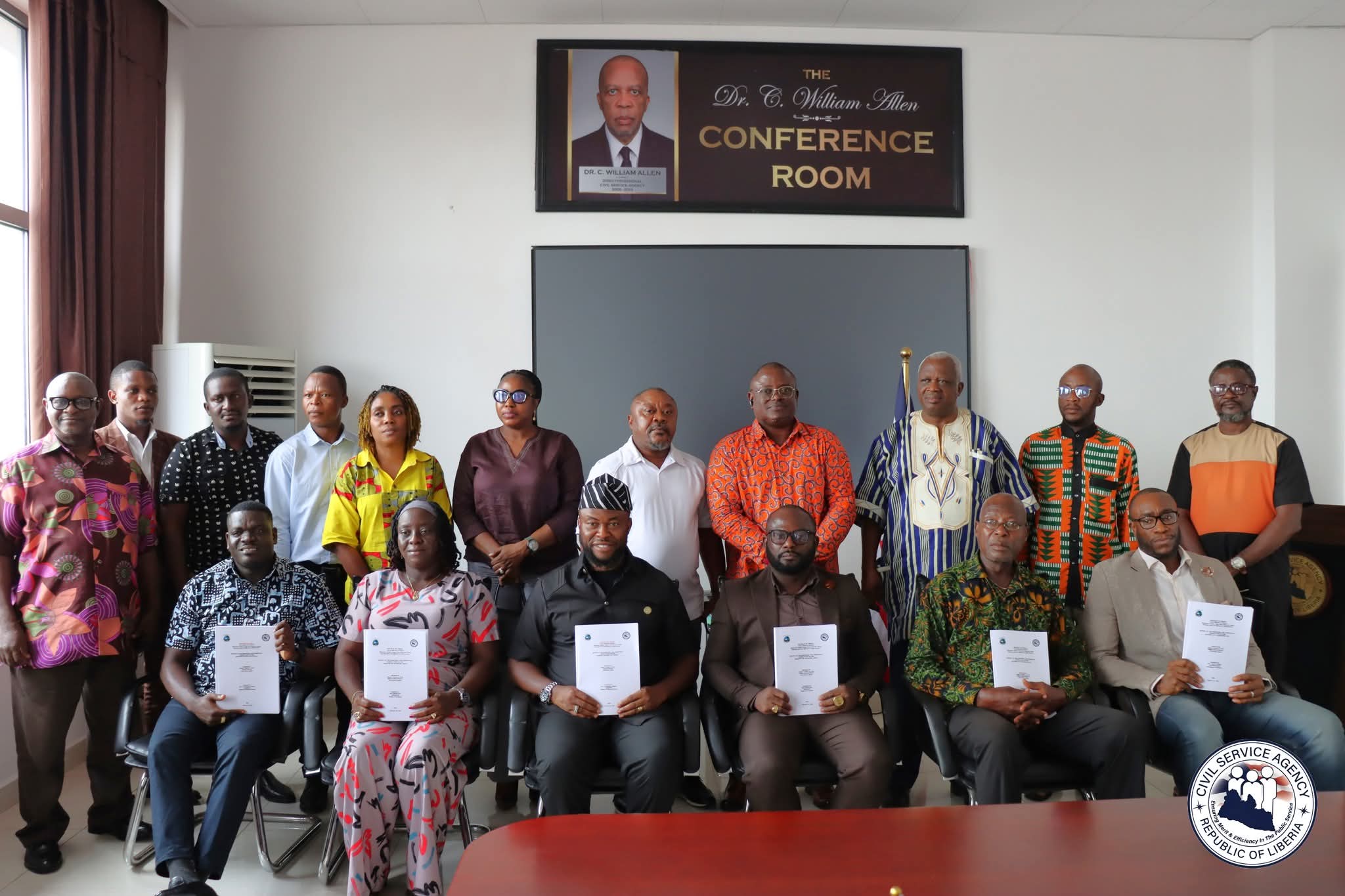
Liberia has taken a decisive step toward strengthening public sector accountability and institutional efficiency as the Civil Service Agency (CSA) formally presented Personnel and Credential Verification Reports to three key government institutions, the Governance Commission, the Ministry of Mines and Energy, and the Ministry of Transport.
The handover ceremony, marks a significant milestone in Liberia’s ongoing public service reform agenda, aimed at improving payroll integrity, eliminating systemic inefficiencies, and ensuring that government institutions are staffed by qualified and verifiable personnel.
A Strategic Reform with National Implications
Personnel and credential verification has emerged as a cornerstone of governance reform in Liberia, where successive audits over the past decade have revealed challenges such as payroll irregularities, unverified credentials, and the persistence of “ghost workers”, issues that have historically drained public resources and undermined service delivery.
According to government reform benchmarks, public sector wages account for over 40 percent of Liberia’s recurrent expenditure, making workforce accuracy critical to fiscal sustainability.
Verification exercises such as this are designed not only to improve data reliability but also to enhance productivity, accountability, and public trust in state institutions.
CSA Reaffirms Its Mandate
Speaking at the ceremony, CSA Director-General Josiah F. Joekai Jr. reaffirmed the Agency’s statutory responsibility to support not override the operational mandates of ministries and autonomous agencies.
“We know our limits. We remain within the parameters of human resource management support, in keeping with established regulations, and we have just demonstrated that,” Dr. Joekai said.
He emphasized that the verification process reflects the CSA’s commitment to building a professional, merit-based civil service aligned with international best practices, adding that credible personnel data is fundamental to effective policy implementation and national development.
Inter-Agency Collaboration Praised
Dr. Joekai commended the leadership of the three recipient institutions for their cooperation, describing the exercise as a strong example of coordinated governance.
He noted that such collaboration is essential to ensuring that Liberia’s public servants are efficient, effective, and responsive to the needs of citizens.
The Governance Commission was represented by its Acting Chairman, Alaric Togba, while the Ministry of Mines and Energy received its report through Assistant Minister for Administration Cooper Passawe.
The Ministry of Transport was represented by Deputy Minister for Administration and Insurance Archibald S. Abban.
Institutions Pledge Continued Cooperation
Accepting the reports, the officials expressed appreciation for the CSA’s technical leadership and pledged continued collaboration to ensure that the findings translate into measurable improvements.
They described the verification exercise as a critical enabler of the President’s governance vision, reinforcing accountability, strengthening institutional performance, and restoring confidence in the public service.
Collectively, the officials noted that accurate personnel data is indispensable to effective planning, performance management, and the delivery of essential public services.
A Broader Reform Trajectory
The CSA-led verification initiative aligns with Liberia’s broader public sector modernization efforts, which include digitizing personnel records, harmonizing payroll systems, and enforcing compliance with recruitment and promotion standards.
Governance experts note that sustained implementation of such reforms could save the government millions of dollars annually, while significantly improving service delivery outcomes.
As Liberia continues to pursue governance and civil service reforms, the presentation of these verification reports signals a renewed commitment to transparency, fiscal discipline, and institutional credibility, key pillars for long-term national development and democratic consolidation.
