
By: Julius Konton
President Joseph Nyuma Boakai has unveiled a major governance reform initiative aimed at strengthening transparency, accountability, and efficiency across Liberia’s public institutions by introducing a performance-based covenant with government ministries, agencies, and commissions.
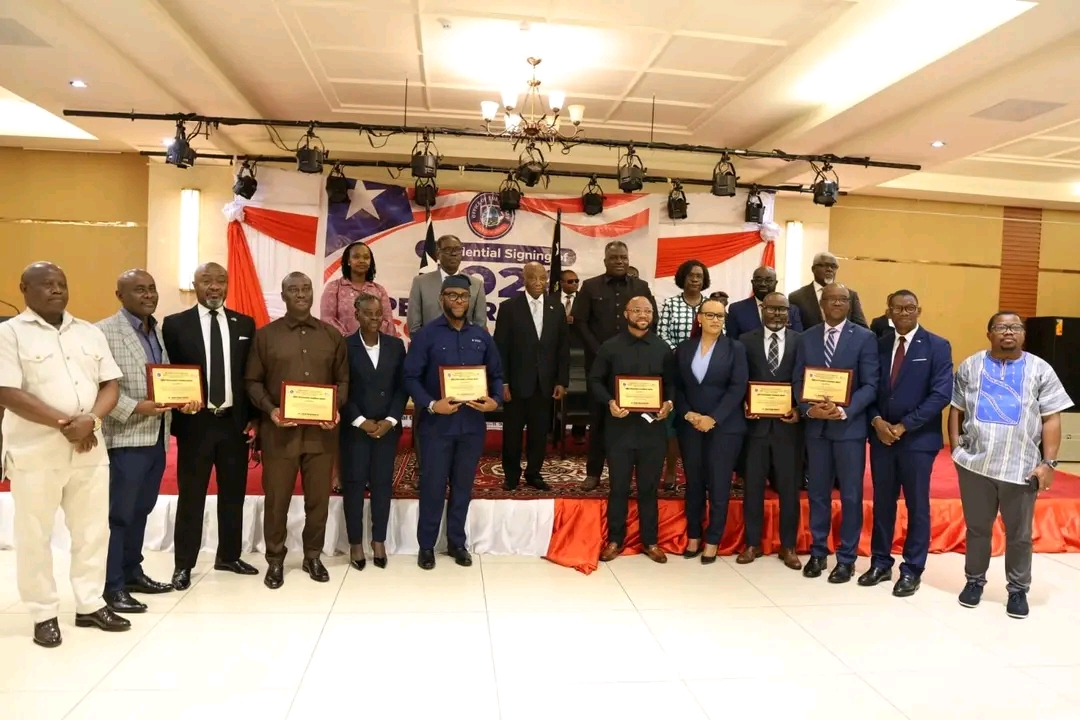
Speaking during an official signing ceremony in Monrovia, President Boakai declared that the documents signed by public officials were far more than ceremonial papers or financial instruments.
“What you signed today is not a check, but a bureaucratic commodity.
It is a covenant with the Liberian people intended to track your progress every quarter, and the results will be published so Liberians will know,” the President stated.
The move signals one of the strongest pushes in recent Liberian history toward measurable governance, where institutions will now be assessed on quarterly targets, delivery benchmarks, and public service outcomes.
A New Era of Results-Based Leadership
President Boakai emphasized that public-sector performance should not be hindered by lack of resources, weak institutional capacity, or funding limitations.
Instead, he pledged full executive support to help institutions meet their targets.
“As your President, I cannot be creating conditions for your performance to fail.
Where institutions need technical support, the Cabinet will ensure it is provided. Where capacity gaps persist, we will invest in training. Where funding constraints exist, we will work to close those gaps.”
He described governance performance as a shared partnership in leadership, where ministries and agencies must deliver while government creates the enabling environment for success.
From Planning to Performance
The President said Liberia is entering a transformative stage of public administration.
“Today marks a moment to strengthen Liberia’s commitment to accountable governance, from a government that plans to a government that performs; from a government that reports to a government that is held accountable; and from a government that manages to a government that improves.”
Political analysts say the initiative mirrors successful reforms adopted in countries such as Rwanda, Ghana, and Singapore, where measurable performance contracts have significantly improved public service delivery.
According to global governance studies, countries that adopt performance management systems can improve institutional efficiency by 20% to 40% over time when backed by political will and transparent reporting.
Top Performing Government Institutions Honored
As part of the ceremony, the Liberian Government recognized high-performing public entities for their achievements during the 2025 performance cycle.
Top Three Best Performing Institutions
Internal Audit Agency
National Road Fund of Liberia
Liberia Maritime Authority
These institutions reportedly excelled in financial management, service delivery, project execution, and compliance standards.
Other Institutions Honored for Outstanding Performance
Several ministries and agencies also received honors for notable service delivery and operational achievements, including:
Central Bank of Liberia
Civil Service Agency
Liberia Petroleum Refining Company
Liberia Extractive Industries Transparency Initiative
Ministry of National Defense
Dozens More Agencies Receive Certificates
Certificates of recognition were also awarded to numerous institutions, including:
Ministry of Public Works
National Oil Company of Liberia
Jackson Fiah Doe Memorial Regional Referral Hospital
Independent Information Commission
Governance Commission
Monrovia City Corporation
Liberia Revenue Authority
Liberia Water and Sewer Corporation
Ministry of Local Government
National Port Authority
Liberia National Commission on Arms
Liberia Standards Authority
Ministry of Youth and Sports
Liberia Telecommunications Authority
Ministry of Labor
John F. Kennedy Medical Center
Ministry of Posts and Telecommunications
Center for National Documents and Records Agency
Liberia Anti-Corruption Commission
Liberia Land Authority
National Public Health Institute of Liberia
Public Procurement and Concessions Commission
Why This Matters for Liberia
Liberia, founded in 1847, has long struggled with governance inefficiencies, weak public institutions, and limited accountability systems.
Following years of civil conflict and economic setbacks, reforms that improve state capacity remain critical.
Economists note that improved institutional performance can directly influence:
Faster infrastructure delivery
Better healthcare outcomes
Increased foreign investment confidence
Stronger anti-corruption systems
Improved tax collection and revenue generation
With Liberia’s GDP estimated at over US$4 billion, effective management of public institutions could significantly accelerate national development.
President Boakai concluded by urging officials to honor the trust placed in them through concrete action rather than rhetoric.
“Together, institution by institution, target by target, year by year, we will deliver the Liberia our people deserve.”
The performance covenant may become one of the defining governance reforms of the Boakai administration if quarterly scorecards are transparently published and underperforming institutions are held accountable.
For many Liberians, the true test will not be speeches but results.
