



By: Julius Konton
Liberian President Joseph Nyuma Boakai Sr. has called on leaders of the Economic Community of West African States (ECOWAS) to transform regional commitments into tangible benefits for more than 450 million West Africans, urging accelerated economic integration, enhanced peace and security, expanded intra-African trade, and greater investments in infrastructure as the region confronts rising geopolitical and economic challenges.
Addressing the Summit on the Future of Regional Integration in West Africa and the 69th Ordinary Session of the ECOWAS Authority of Heads of State and Government in Lungi, Sierra Leone, President Boakai said West Africa stands at a historic turning point where unity, collective leadership and decisive action are essential to safeguarding regional stability and unlocking sustainable economic growth.
Established on May 28, 1975, ECOWAS comprises 12 active member states following the withdrawal of Burkina Faso, Mali and Niger in 2025.
The regional bloc remains one of Africa’s largest economic communities, with a combined Gross Domestic Product (GDP) exceeding US$800 billion and serving as a cornerstone for regional peacekeeping, economic integration and the implementation of the African Continental Free Trade Area (AfCFTA).
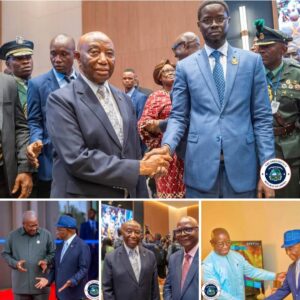
President Boakai congratulated Sierra Leone’s President Julius Maada Bio, the Government and people of Sierra Leone for successfully hosting the twin regional summits and thanked them for the warm hospitality extended to the Liberian delegation.
He also praised President Bio’s tenure as outgoing Chairman of the ECOWAS Authority, describing his leadership as one characterized by steadfast commitment to regional dialogue, peacebuilding, democratic governance and cooperation during one of the organization’s most challenging periods.
The Liberian leader paid tribute to outgoing ECOWAS Commission President Dr. Omar Alieu Touray and the outgoing Vice President of the Commission for steering the regional institution through political transitions, security crises and diplomatic engagements.
He particularly commended Dr. Touray’s efforts to sustain dialogue with Burkina Faso, Mali and Niger following their departure from ECOWAS, while expressing Liberia’s hope that the three Sahel nations would eventually return to the regional family.
President Boakai welcomed the election of Senegal to the Presidency of the ECOWAS Commission and Nigeria to the Commission’s Vice Presidency, assuring both countries of Liberia’s unwavering support in advancing the Community’s vision of regional peace, democracy and shared prosperity.
Speaking on the future of regional integration, President Boakai stressed that ECOWAS must move beyond policy declarations to measurable outcomes that directly improve citizens’ lives.
“The true measure of our success,” he emphasized, “must be reflected in stronger peace, expanded commerce, better roads and infrastructure, increased employment opportunities, and greater economic resilience across our region.”
Liberia, he reaffirmed, fully supports the Compact for the Future of Regional Integration, describing it as a roadmap for building a more connected, competitive and prosperous West Africa.
President Boakai also welcomed the signing of the Inter-Governmental Agreement establishing the African Atlantic Gas Pipeline, describing the transnational energy project as a transformative investment capable of strengthening regional energy security, boosting industrialization and expanding economic cooperation across the continent.
The proposed Nigeria-Morocco Atlantic Gas Pipeline is expected to span approximately 7,000 kilometers, traverse 13 African countries, and eventually supply natural gas to Europe while providing electricity access and industrial opportunities to millions of Africans.
To accelerate regional commerce, the Liberian President urged ECOWAS member states to dismantle long-standing barriers to trade by eliminating unnecessary levies, reducing non-tariff barriers, simplifying customs procedures and ensuring the effective implementation of the ECOWAS Protocol on the Free Movement of Persons, Goods and Services.
According to ECOWAS data, intra-regional trade currently represents only about 10–15 percent of the region’s total trade significantly below levels recorded in Europe and Asia highlighting the enormous untapped potential for economic integration and industrial development.
Reflecting on Liberia’s recent election as a non-permanent member of the United Nations Security Council, President Boakai reaffirmed his country’s commitment to championing the priorities of ECOWAS and Africa within the international community.
He pledged Liberia’s continued support for preventive diplomacy, peacebuilding, constitutional governance, conflict resolution and sustainable development as essential foundations for regional peace.
The President also welcomed progress in resolving the longstanding border issues between Liberia and Guinea, expressing confidence that ongoing diplomatic dialogue, facilitated by the ECOWAS Commission, would produce a peaceful and mutually beneficial settlement.
President Boakai thanked ECOWAS member states for their continued confidence in Liberia through the appointment of qualified Liberians to key positions within regional institutions, pledging that Liberia would continue serving the Community with professionalism, integrity and dedication.
On continental solidarity, he joined fellow African leaders in condemning recent xenophobic attacks in South Africa, emphasizing that unity, mutual respect and African solidarity remain indispensable for achieving the African Union’s Agenda 2063 vision of an integrated, peaceful and prosperous continent.
Concluding his address, President Boakai called on West African leaders to uphold the vision of the founding fathers of ECOWAS by strengthening solidarity, promoting inclusive economic development and safeguarding regional peace and collective security.
“The future of West Africa will not be determined by the challenges we face, but by the courage with which we respond to them,” President Boakai declared.
“Let us seize this moment to strengthen our Community, deepen our unity, and build an ECOWAS that is more resilient, more prosperous, and more responsive to the aspirations of our people.”
His remarks underscored Liberia’s growing diplomatic profile in regional and global affairs and reinforced the country’s commitment to helping shape a more peaceful, economically integrated and resilient West Africa amid evolving security, governance and development challenges.


