



By: Julius Konton
Liberia’s Ministry of Finance and Development Planning continue another phase of executive budget hearings, bringing together scores of spending entities from across the Executive Branch as the government begins assessing competing financial demands and priorities for the upcoming fiscal period.
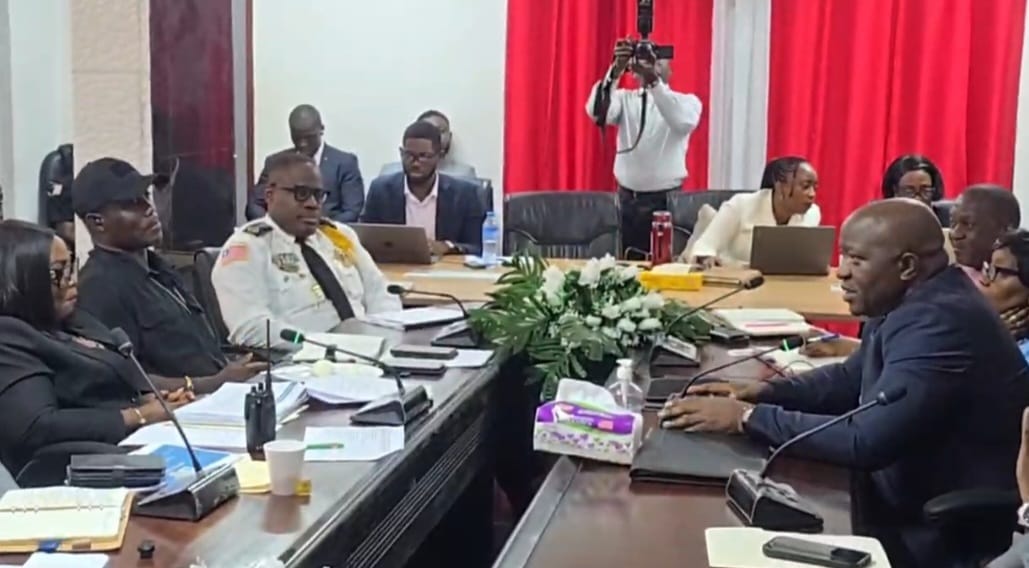
The hearings, which continued Monday with a focus on the justice and security sector, brought together senior officials from the Ministry of Justice, Liberia National Police, Liberia Drug Enforcement Agency (LDEA), Liberia National Fire Service Agency (LNFSA), Liberia Immigration Service, as well as representatives of other government institutions, including the Civil Service Agency and Ministry of Transport.
The process is intended to examine institutional performance, identify critical needs and determine how limited public resources can be allocated to areas with the greatest national impact.
Opening the session, Finance and Development Planning Minister Augustine Kpehe Ngafuan acknowledged the growing demands being placed on the national budget, saying government must balance legitimate institutional needs against available resources.
He said the Ministry’s responsibility is not simply to receive requests, but to carefully evaluate them and allocate public funds according to national priorities.
“We’ve taken notes on key achievements and issues at your various institutions. We are now in the billions, but even US$5 billion won’t be enough to solve all the needs and implement the plans of spending entities,” Minister Ngafuan said. “We will continue to prioritize the priorities.”
Ngafuan said the budget hearings provide an opportunity for spending entities to present their achievements, challenges and funding requirements while allowing the Finance Ministry to determine where limited resources can produce the greatest development outcomes.
He cautioned government institutions, however, that strong justifications and compelling needs would not automatically translate into full funding, stressing that government cannot meet every demand simultaneously.
The Finance Minister emphasized that every government institution has a role to play in Liberia’s development, but acknowledged that some sectors require greater attention because of their strategic importance.
He singled out security as a fundamental pillar of national development, arguing that economic growth, investment and the delivery of public services cannot be sustained without peace and security.
Ngafuan also stressed that security cannot be treated in isolation from other essential sectors, particularly healthcare and electricity. Using a football analogy, he explained that national development functions as a team effort in which every sector has a critical role.
“How can you focus on security alone when you are not healthy? How can you focus on security alone without electricity? This is like a team,” he said, stressing that even the weakest link can affect the performance of the entire system.
The minister’s remarks come as Liberia continues to confront the longstanding challenge of matching ambitious national development objectives with limited fiscal space.
For a country rebuilding institutions and infrastructure after years of civil conflict and economic difficulties, public spending decisions remain closely tied to the government’s ability to finance security, healthcare, energy, infrastructure, education and other essential services simultaneously.
Delivering introductory remarks for the justice sector, Acting Justice Minister Betty Lamin Blamo said the effective discharge of the Ministry of Justice’s mandate is closely linked to the availability of adequate financial resources.
Blamo’s comments underscored the broader challenge confronting justice and security institutions, many of which require sustained investment in personnel, infrastructure, logistics, equipment, training and institutional capacity to effectively perform their statutory responsibilities.
The Liberia Drug Enforcement Agency, meanwhile, reported progress in personnel development and operational preparedness.
Acting LDEA Director General Daniel K. Ziankahn, a retired Major General, disclosed that the agency trained 131 personnel during 2026, an effort he said forms part of ongoing measures to strengthen Liberia’s capacity to combat illicit drugs and related criminal activities.
Ziankahn also announced that the agency had concluded a contract for the procurement of specialized equipment intended to enhance its operational capabilities.
“We have concluded the contract to procure specialized equipment that will enhance our work,” Ziankahn said.
The disclosure comes amid continued concerns across West Africa over drug trafficking and substance abuse, making institutional capacity, specialized training and modern operational equipment increasingly important for law enforcement agencies.
The Liberia Immigration Service also highlighted improvements made during the year.
Commissioer General, Elijah Rufus, told the budget hearing that the Service had supplied uniforms to all immigration officers in 2026, while also procuring 12 vehicles to strengthen its mobility and field operations.
The investments are expected to support immigration officers responsible for border management, migration control and enforcement of Liberia’s immigration laws at entry points and within the country.
The Liberia National Fire Service Agency reported progress in both personnel training and geographic coverage.
According to Fire Service boss Warsuah Barvoul, 79 fire service officers were trained in 2026, while the agency also expanded its operations beyond Monrovia into rural Liberia, including Gbarnga in Bong County.
The expansion represents an effort to improve Liberia’s emergency response capacity outside the capital, where fire and other emergency services have historically faced significant logistical and infrastructure constraints.
The ongoing executive budget hearings are expected to provide the Finance and Development Planning Ministry with detailed information from spending entities as it weighs competing demands and prepares the government’s spending framework.
Minister Ngafuan maintained that the objective is not to favor one institution at the expense of another, but to establish a hierarchy of national priorities based on urgency, impact and available resources.
For Liberia’s justice and security institutions, Monday’s hearing offered an opportunity to demonstrate progress while making the case for additional investments in personnel, equipment, mobility and institutional infrastructure.
As the budget process advances, the central challenge for policymakers will remain how to transform limited public resources into measurable improvements in security, public services and economic development while ensuring that no critical sector is left behind.


