
By: Julius Konton
In a significant diplomatic and economic development, the Republic of Türkiye has announced plans to establish a resident embassy in Liberia, signaling a major step toward strengthening bilateral relations and expanding its footprint in West Africa.
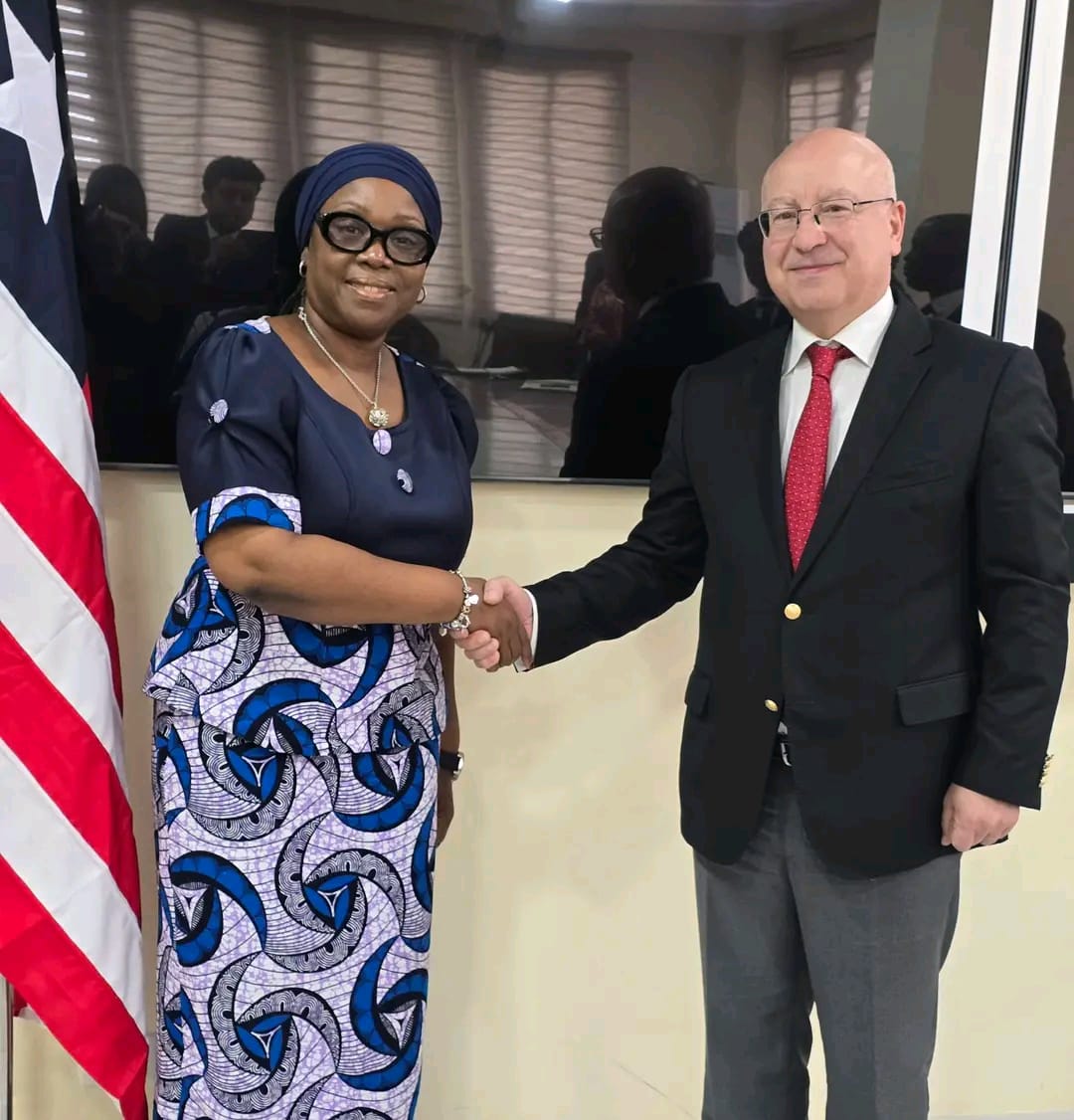
The announcement came during a high-level meeting at Liberia’s Ministry of Foreign Affairs, where Foreign Minister Sara Beysolow Nyanti hosted a Turkish delegation led by Mustafa Kemel Basa, Deputy Director General for Administrative and Financial Affairs.
Welcoming the delegation on behalf of President Joseph Nyuma Boakai, Minister Nyanti described the planned embassy as a “strategic milestone” that will deepen cooperation in trade, infrastructure, aviation, and human capacity development.
ACCELERATED DIPLOMACY AND STRATEGIC INTERESTS
According to Turkish officials, the decision to fast-track the embassy’s establishment deviates from Ankara’s traditional diplomatic model, where embassies typically precede commercial engagement.
Instead, Türkiye is pursuing a dual-track approach simultaneously launching diplomatic and economic initiatives.
This shift, officials say, follows direct engagements between Minister Nyanti and Turkish President Recep Tayyip Erdoğan in 2025, during which both sides agreed to elevate cooperation.
“Türkiye is committed to creating a conducive environment for its private sector to invest and operate in Liberia,” Basa noted, emphasizing that the embassy will serve as a gateway for Turkish businesses entering the Liberian and broader Mano River Union markets.
AVIATION AND INFRASTRUCTURE: KEY PILLARS
A central component of the partnership is aviation connectivity.
Türkiye has confirmed plans for Turkish Airlines to commence flights to Monrovia , an initiative expected to significantly enhance Liberia’s global accessibility.
Currently, Africa accounts for over 60 destinations served by Turkish Airlines, making it one of the continent’s most expansive foreign carriers.
Analysts suggest that Liberia’s inclusion could boost tourism, trade logistics, and foreign direct investment (FDI).
Minister Nyanti highlighted President Erdoğan’s interest in supporting the modernization and efficient management of Roberts International Airport (RIA), Liberia’s primary international gateway, which handles approximately 200,000–300,000 passengers annually.
Infrastructure experts say improvements at RIA could increase passenger traffic by up to 40% within five years, particularly if new international routes are sustained.
HISTORICAL CONTEXT: TÜRKİYE’S AFRICA EXPANSION
Türkiye’s engagement with Africa has expanded dramatically over the past two decades.
In 2002, Ankara had only 12 embassies across Africa. As of 2025, that number has surged to over 40 embassies, reflecting a deliberate geopolitical and economic pivot.
Trade between Türkiye and Africa has also grown exponentially from approximately $5.4 billion in 2003 to over $40 billion in 2024, according to Turkish government data.
Liberia, while a smaller economy with a GDP of roughly $4 billion, is strategically positioned along the West African coast and serves as a potential trade corridor within the Mano River Union, which includes Sierra Leone, Guinea, and Côte d’Ivoire collectively representing a regional market of over 50 million people.
LIBERIA AS A REGIONAL HUB
Minister Nyanti urged Turkish investors to view Liberia beyond its population of about 5.3 million, positioning the country instead as a gateway to regional markets.
“Liberia offers connectivity, stability, and access to cross-border trade opportunities,” she stated, emphasizing the government’s push for economic diplomacy as a cornerstone of its foreign policy.
Key sectors identified for potential Turkish investment include:
Infrastructure and construction
Aviation and airport management
Energy and mining
Agriculture and agro-processing
RECIPROCITY AND DIPLOMATIC EXPANSION
As part of diplomatic reciprocity, the Turkish delegation formally requested land in Monrovia for the embassy compound, a request Liberia has pledged to expedite.
In return, Türkiye encouraged Liberia to establish its own diplomatic presence in Ankara, with proposals for:
A full embassy in Ankara
A consulate in Istanbul
Such moves, analysts say, would strengthen Liberia’s diplomatic reach and facilitate trade, education, and cultural exchanges.
EDUCATION AND HUMAN CAPITAL DEVELOPMENT
Türkiye also reaffirmed its commitment to capacity building, offering scholarship opportunities for Liberian students under its international education programs.
Over the past decade, thousands of African students have benefited from Turkish scholarships, contributing to skills development in engineering, medicine, and public administration.
The Turkish delegation is expected to engage with Liberian security institutions and the Executive Mansion to finalize logistical and regulatory requirements for the embassy’s establishment.
Minister Nyanti has also been invited to visit Ankara for follow-up discussions, likely to formalize agreements and timelines for implementation.
ANALYSIS: A MUTUALLY BENEFICIAL PARTNERSHIP
Experts view Türkiye’s move as part of a broader strategy to expand influence in Africa through “win-win diplomacy”, combining infrastructure investment, trade expansion, and soft power initiatives.
For Liberia, the partnership offers:
Increased foreign investment inflows
Enhanced international connectivity
Job creation and skills transfer
Strengthened global diplomatic presence
For Türkiye, Liberia provides:
Strategic access to West African markets
Opportunities for construction and aviation sectors
A foothold in a region rich in natural resources
The planned opening of a Turkish embassy in Liberia marks more than a diplomatic upgrade, it represents a strategic convergence of economic ambition and geopolitical outreach.
If successfully implemented, the partnership could redefine Liberia’s role in regional trade while reinforcing Türkiye’s position as a key global player in Africa’s development trajectory.
