
By: Julius Konton
Liberia’s political landscape was jolted over the weekend after the Managing Director of the Roberts International Airport (RIA), James A. Mulbah, publicly crossed over to the ruling Unity Party (UP) a move political observers say could ignite renewed concerns about state influence, partisan consolidation, and election-season power dynamics.
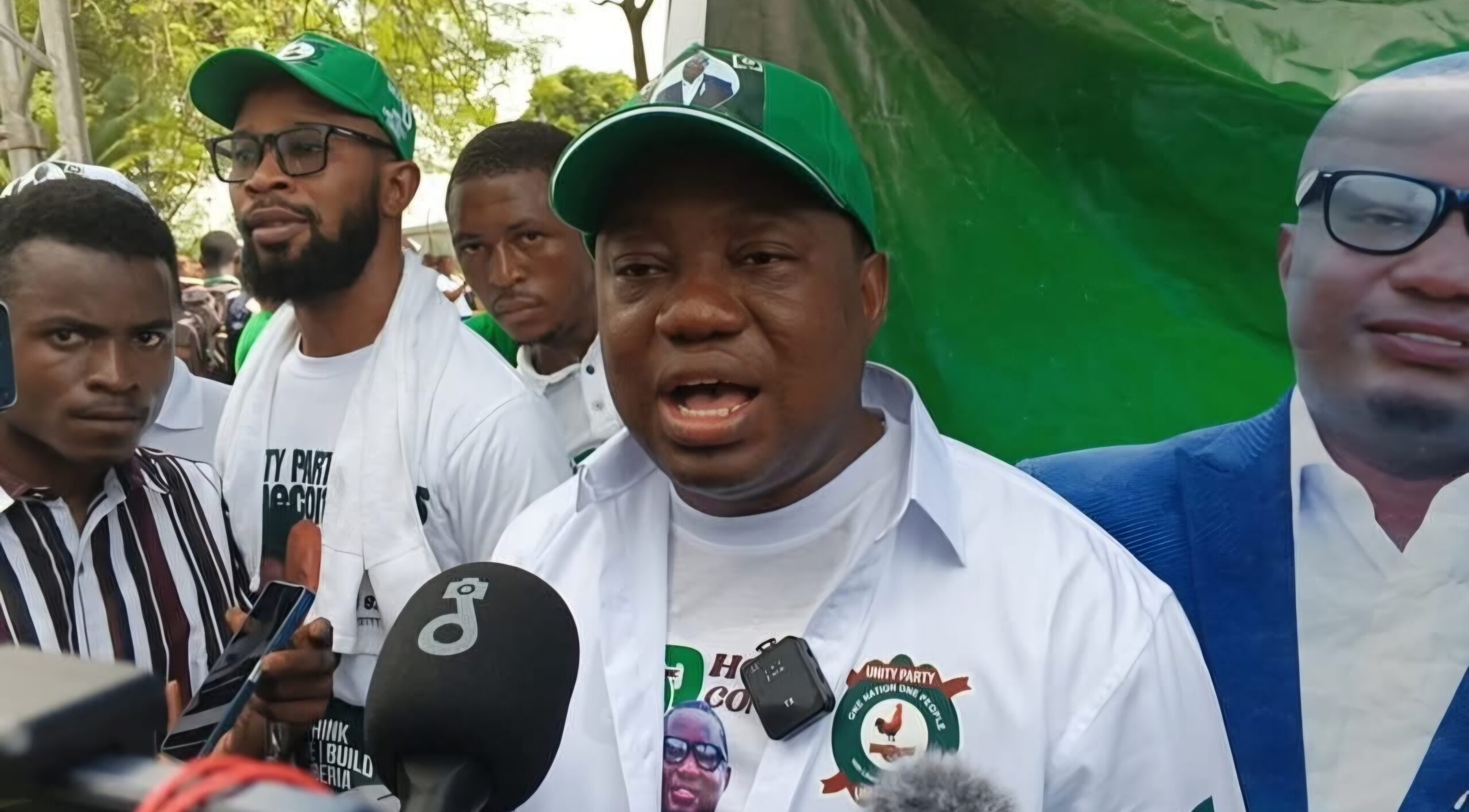
The defection occurred during the Unity Party’s Homecoming and Fundraising Ceremony, an event that saw an unusual wave of political crossovers from various auxiliaries and civil society groupings.
But none drew more attention or controversy than Mr. Mulbah, a senior government appointee and key operational figure within Liberia’s aviation sector.
A High-Profile Defection at a Politically Charged Moment
Clad in the ruling party’s green and white regalia, Mr. Mulbah declared to jubilant supporters that his decision was not only deliberate but rooted in years of collaboration with the Unity Party.
“We are going to stay with the Unity Party… we will work to make it sustainable,” he said.
“Today, we have 800 of our members from different auxiliaries officially joining the UP.”
Mulbah claims his team had been working informally with the Unity Party for eight years, but only now felt it was the “right political moment” to formalize their allegiance.
The auxiliaries he introduced include:
Boakai’s Empowerment Network
The Boakai Connection
James Mulbah for Margibi
James Mulbah for Paynesville
James Mulbah for Clara Town
James Mulbah for Freeport and
James Mulbah for New Kru Town auxiliaries.
The RIA boss described the groups as a “force multiplier” that would strengthen the ruling party’s grassroots machinery.
Political Shockwaves: Critics Warn of Abuse of Incumbency
The move has stirred intense public debate, especially regarding the political neutrality expected of public officials managing critical national institutions such as the RIA Liberia’s main international gateway, which handles 90% of the country’s air traffic and services an estimated 200,000 passengers annually (pre-COVID average).
With the 2026 electoral season fast approaching, analysts say the timing raises legitimate questions about:
Whether top government appointees should openly participate in partisan politics
The potential use of state resources to advance ruling party interests
The pressure such defections place on lower-ranking public employees
Electoral observers note that Liberia has seen similar patterns in the past, where public servants aligned with ruling parties ahead of elections, triggering accusations of state capture and soft intimidation of voters.
An analyst at the Center for Democratic Governance (CEDEG) argues:
“When a high-ranking appointee defects to the ruling party with hundreds of followers, it creates the perception real or not that state institutions are becoming political machinery.”
Opposition parties have long expressed concern over what they describe as “abuse of incumbency”, especially in a country where nearly 70% of the population lives below the poverty line and political allegiance can directly influence access to public services or employment.
Mulbah Defends His Decision
The RIA Managing Director, however, dismissed criticisms that his defection is politically sensitive or strategically manipulative.
“I bring my knowledge, experience and numbers to the UP,” he said.
“Anyone coming with selfish motives will be frustrated; only those with good mindsets will succeed.”
He insists the transition is rooted in personal conviction and long-standing loyalty rather than political calculation.
Opposition Reaction: “Too Early, Too Suspicious”
Opposition parties and independent critics argue the crossover is “too early and too troubling”, particularly for someone leading a critical state-run enterprise.
“There is nothing wrong with political participation,” one opposition spokesperson noted,
“but public officials managing national assets should not double as political mobilizers. It compromises fairness.”
Political watchers fear similar crossovers may follow as elections draw near, with public officials using their:
Influence
Patronage power
Control over state resources
to sway populations, especially in rural counties.
A Sign of Things to Come?
With Liberia now approaching the mid-term of President Joseph Boakai’s administration, the ruling Unity Party appears to be reinforcing and expanding its political base.
Mulbah’s dramatic crossover with 800 supporters in tow is seen as both a symbolic and strategic win for the ruling party.
But it also spotlights the recurring tension in Liberia’s democracy: the blurred line between governance and political loyalty.
As the nation inches toward the next electoral cycle, the controversy surrounding this high-profile defection may be just the beginning of a larger, more explosive political narrative.
EDITOR’S NOTE
The decision of James A. Mulbah , Managing Director of Liberia’s most strategic public asset, the Roberts International Airport to openly join the ruling Unity Party is more than a political headline.
It is a moment that captures the familiar tension at the heart of Liberia’s democratic evolution: the uneasy intersection between public service and partisan loyalty.
At a time when the 2026 elections are already casting long shadows, Mulbah’s defection along with 800 supporters forces the national conversation to confront uncomfortable, but necessary questions.
How politically neutral should public officials be? What safeguards exist to prevent the blurring of state authority and partisan interests? And how prepared is Liberia to ensure that public institutions remain public during election seasons?
This article examines not just Mulbah’s personal choice, but the broader implications such moves carry for a country where political allegiance often dictates economic opportunity, where incumbency remains a powerful tool, and where public confidence in state neutrality is still fragile.
As Liberia steps into another high-stakes electoral cycle, this story should be read not simply as a political event, but as a reflection of deeper structural dilemms ones that will shape the credibility, fairness, and stability of the nation’s democratic processes in the months ahead.
