
By: Julius Konton
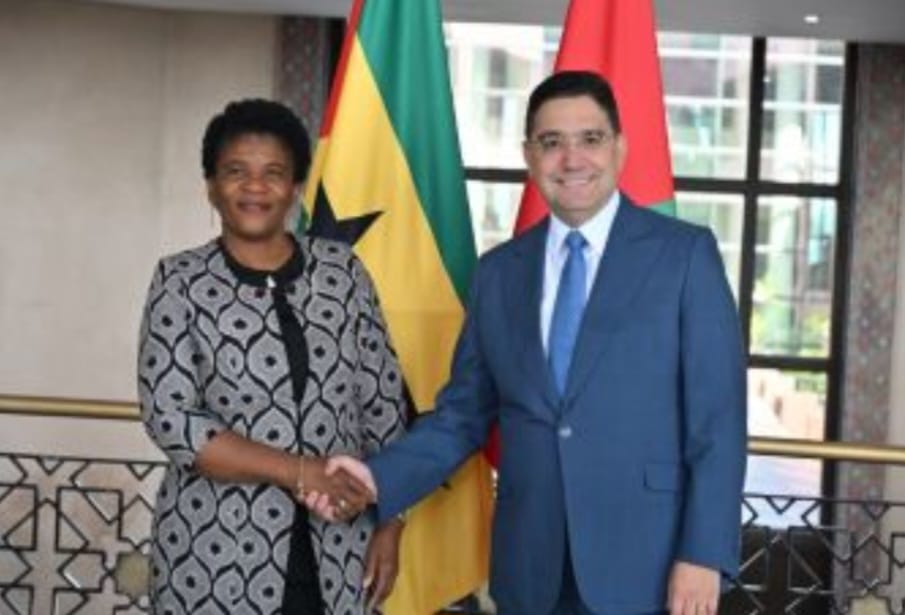
The Minister of State for Foreign Affairs, Cooperation and Communities of São Tomé and Príncipe, Ilza Maria dos Santos Amado Vaz, has praised the leadership of King Mohammed VI, describing his role as instrumental in advancing peace, stability, and sustainable development across Africa.
During high-level talks in Rabat on Tuesday with Nasser Bourita, Morocco’s Minister of Foreign Affairs, African Cooperation and Moroccan Expatriates, Mrs. Amado Vaz expressed admiration for the monarch’s diplomatic initiatives and growing contribution to regional cooperation.
She noted that King Mohammed VI’s strategic engagement has elevated Morocco’s role as a leading force in Africa, particularly through initiatives promoting economic integration, security cooperation, and South-South solidarity.
Strengthening Bilateral Relations
The visiting minister reaffirmed her country’s commitment to deepening bilateral ties with Morocco, emphasizing a future partnership built on mutual respect, solidarity, and adherence to international law.
Diplomatic relations between Morocco and São Tomé and Príncipe have expanded steadily in recent years, reflecting Rabat’s broader strategy of strengthening alliances across the continent. Morocco has significantly increased trade, investment, and diplomatic outreach in Sub-Saharan Africa since rejoining the African Union in 2017.
Analysts say Morocco’s African policy has become one of the kingdom’s defining foreign policy pillars, with growing partnerships in banking, agriculture, energy, and infrastructure.
Focus on Atlantic African Cooperation
Both ministers welcomed progress under the Process of African Atlantic States (PAAS), a Morocco-backed platform aimed at transforming the African Atlantic region into a major geostrategic and economic zone.
The initiative seeks to boost cooperation among Atlantic-facing African states in sectors such as:
Environmental protection
Food security
Public health
Energy development
Maritime logistics
Infrastructure interconnectivity
Resource sharing
Technical exchanges
Officials described the framework as a pathway toward creating a zone of shared prosperity, peace, and regional resilience.
With more than 20 African nations bordering the Atlantic Ocean, the region possesses vast maritime resources, growing trade routes, and significant energy potential.
Experts say closer Atlantic coordination could reshape Africa’s global trade position over the coming decade.
Support for Sahel Access and Gas Pipeline Project
Mrs. Amado Vaz also welcomed Morocco’s flagship initiative to facilitate access to the Atlantic Ocean for landlocked Sahel countries, a proposal designed to improve trade routes and economic opportunities for nations such as Mali, Niger, and Burkina Faso.
She further commended the ambitious Nigeria-Morocco African-Atlantic Gas Pipeline project, which aims to transport natural gas from Nigeria through several West African states to Morocco and onward to Europe.
The proposed pipeline, estimated to span over 5,600 kilometers, is considered one of Africa’s largest planned energy infrastructure projects and could significantly improve regional energy access while strengthening economic integration.
Morocco’s Expanding Continental Influence
The Rabat meeting underscores Morocco’s increasing diplomatic influence across Africa as it positions itself as a bridge between Europe, Africa, and the Atlantic world.
For São Tomé and Príncipe, a small island state in the Gulf of Guinea, stronger ties with Morocco may open new opportunities in trade, tourism, maritime cooperation, renewable energy, and technical assistance.
Observers say the discussions reflect a wider shift toward African-led partnerships focused on infrastructure, peacebuilding, and regional self-reliance.
