
By: Julius Konton
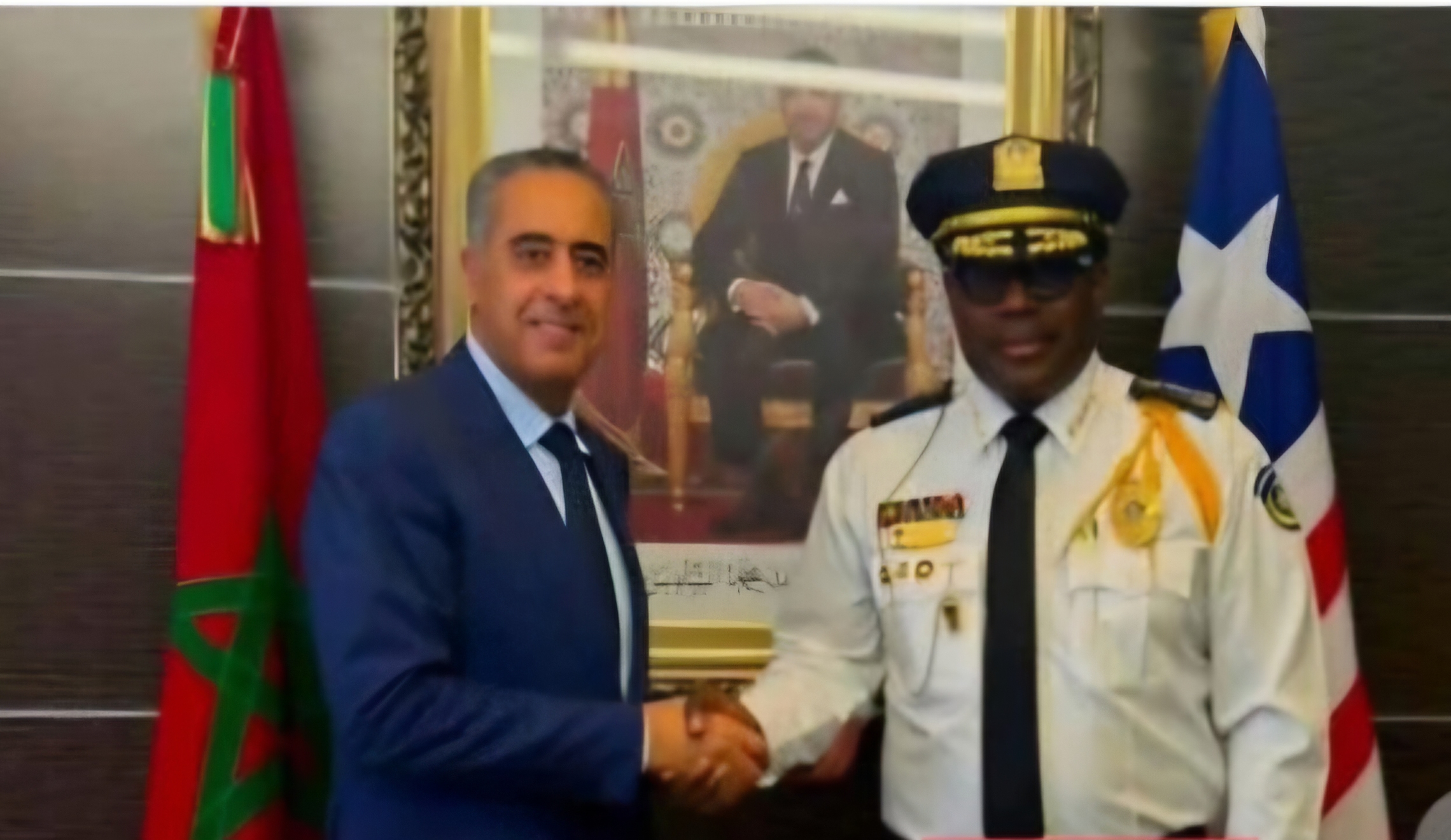
Morocco is reinforcing its position as a regional and international security leader following high-level talks in Rabat between Abdellatif Hammouchi, Director General of National Security and Territorial Surveillance, and Gregory Coleman, Inspector General of Police of Liberia.
The meeting, held at the headquarters of Morocco’s powerful dual security apparatus the General Directorate of National Security (DGSN) and the Directorate General for Territorial Surveillance underscores a growing trend of South-South cooperation in security and intelligence across Africa.
Coleman led a high-ranking Liberian delegation that included senior police officials and diplomatic representatives, signaling Monrovia’s strategic interest in strengthening its internal security capacity through collaboration with Rabat.
A Model of Security Reform and Intelligence Integration
Morocco’s security architecture is widely regarded as one of the most sophisticated in Africa and the Arab world.
Since a series of reforms initiated in the early 2000s particularly after the 2003 Casablanca bombings the country has significantly enhanced its intelligence-gathering, counterterrorism operations, and inter-agency coordination.
The Central Bureau of Judicial Investigations (BCIJ), often described as Morocco’s equivalent of the FBI, has played a central role in dismantling extremist cells.
According to official figures, Moroccan authorities have disrupted over 2,000 terrorist plots and arrested thousands of suspects over the past two decades.
Liberia, emerging from years of civil conflict (1989–2003) and continuing to rebuild its institutions, is seeking to adopt elements of this model to address challenges such as organized crime, trafficking networks, and border security vulnerabilities.
Focus Areas: Counterterrorism, Forensics, and Organized Crime
Discussions between the two sides focused on operational and technical cooperation, particularly:
Advanced counterterrorism strategies
Intelligence-sharing frameworks
Forensic science and criminal investigation techniques
Capacity building and training for law enforcement personnel
Liberian officials expressed particular interest in the methodologies employed by the Central Bureau of Judicial Investigations and the National Brigade of Judicial Police, both known for their effectiveness in dismantling criminal and terrorist networks.
Morocco has also invested heavily in forensic science, establishing modern laboratories equipped with DNA analysis, digital forensics, and cybercrime detection capabilities areas that Liberia aims to develop in its own policing system.
Toward a Formal Security Agreement
Both parties agreed on the need to formalize their cooperation through a structured bilateral framework.
Officials confirmed that work is underway to finalize a Memorandum of Understanding (MoU) that will outline priority areas, operational mechanisms, and long-term collaboration goals.
The agreement is expected to be signed in May 2026 in Rabat, coinciding with the 70th anniversary of the DGSN a milestone marking seven decades of Morocco’s evolving security institutions.
Growing Role of Morocco in Global Security Diplomacy
Morocco has increasingly positioned itself as a hub for international security cooperation, maintaining partnerships with European, African, and Middle Eastern countries.
It is a key player in global counterterrorism efforts and regularly collaborates with organizations such as INTERPOL and Europol.
In recent years, Rabat has expanded its training programs for African security forces, hosting dozens of delegations annually and providing technical assistance aimed at strengthening regional stability.
Implications for West Africa
The Morocco–Liberia engagement reflects a broader shift toward intra-African solutions to security challenges.
West Africa, in particular, has seen rising threats from extremist groups and transnational crime, especially in the Sahel region, where violence has surged by over 300% since 2015, according to international security reports.
By aligning with Morocco’s proven security framework, Liberia aims to enhance its preparedness and resilience, while contributing to wider regional stability.
The Rabat meeting marks a significant step in deepening bilateral ties between Morocco and Liberia, highlighting the growing importance of African-led security partnerships.
As both nations move toward formalizing their cooperation, the initiative could serve as a model for cross-continental collaboration in tackling some of the most pressing security challenges of the 21st century.
