
By: Julius Konton
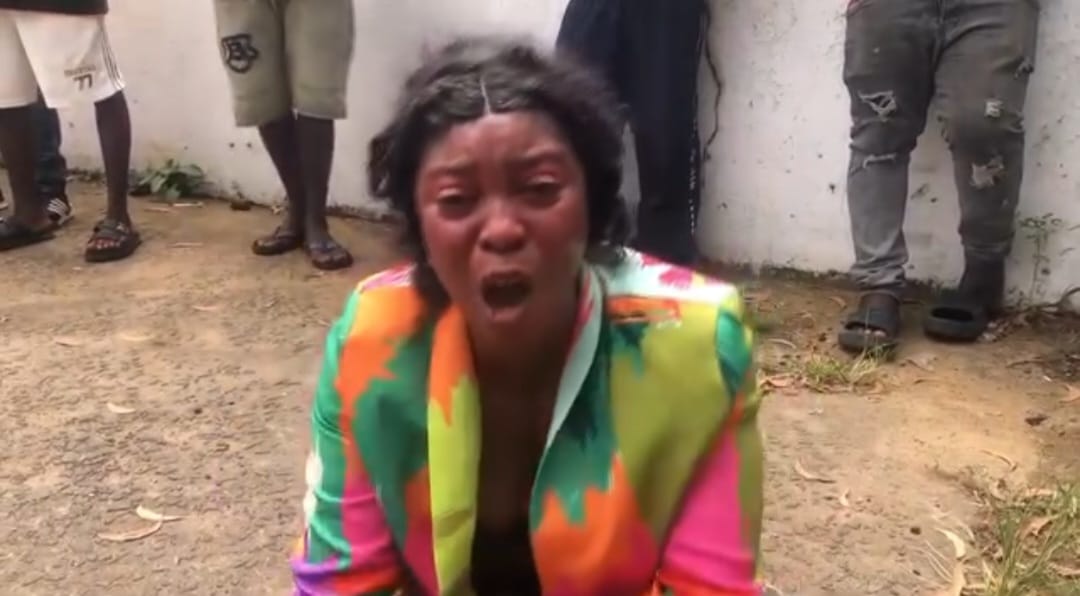
In scenes that have ignited fresh controversy over property rights, military authority, and post-war governance in Liberia, a local businesswoman in Paynesville’s 72nd Community has broken down in tears after receiving a thirteen-day ultimatum from the Armed Forces of Liberia (AFL) to vacate and demolish her property an investment she values at approximately US$500,000.
The visibly distraught woman, Chief Executive Officer Frances Yonger Morsay of Help Your Self Business Center, an entertainment and recreational facility in the densely populated City of Paynesville, described the order as devastating, abrupt, and inhumane.
“My money, oh, my money,” she cried repeatedly. “AFL said I should leave this place in thirteen days. Everything I worked for is gone.”
Her emotional appeal, captured by local reporters, has since gone viral, fueling nationwide debate over forced evictions, military involvement in civil land disputes, and the government’s commitment to protecting ordinary citizens.
A Business Built, Then Branded Illegal
Help Your Self Business Center sits near the site of former military barracks, land that has remained legally contentious since Liberia’s brutal civil wars (1989–2003).
During the conflict, thousands of civilians settled on abandoned military and state-owned lands, often with no formal documentation but with the tacit tolerance of successive governments.
According to land governance data from civil society organizations, over 65% of urban property holders in Liberia lack formal land titles, a legacy of war, displacement, and weak cadastral systems.
Paynesville, now home to nearly one-third of Greater Monrovia’s population, has become a flashpoint for such disputes.
Despite this reality, the businesswoman insists she invested heavily in the property, employing dozens of young people in a country where youth unemployment exceeds 70%, according to World Bank estimates.
Military Demolitions and Civilian Fear
The AFL’s action forms part of an ongoing demolition exercise targeting structures built around the old 72nd military barracks.
Several homes and small businesses have already been flattened, leaving families displaced and livelihoods destroyed.
Critics argue that the use of the military rather than civilian land or court authoroties raises serious constitutional and human rights concerns.
“Why is the army demolishing civilian property?” asked one local rights advocate.
“This is not wartime Liberia.”
The businesswoman further alleged that she was prevented from freely leaving the premises, a claim that, if substantiated, could amount to unlawful detention.
‘Rescue Team’ Under Scrutiny
In a powerful political rebuke, the woman repeatedly invoked the ruling Unity Party’s campaign slogan, “Rescue Team”, a phrase that helped propel President Joseph Nyuma Boakai to power in 2023 on promises of compassion, reform, and respect for the rule of law.
“You said you came to rescue us,” she cried. “I am drowning now. I need you to rescue me.”
Her words have resonated deeply in a country where post-war governments have struggled to balance state authority with citizen protection.
Since January 2024, civil society groups estimate that hundreds of households nationwide have been affected by demolition or eviction actions tied to land reclamation, road expansion, or security concerns often without compensation.
A Familiar Pattern in Liberia’s History
Liberia’s land crisis is deeply rooted in history.
From the Americo-Liberian era, through decades of centralized control, to the chaotic redistribution of land during the civil wars, ownership has remained a volatile issue.
Despite the passage of the Land Rights Act of 2018, implementation has been slow.
The Act recognizes customary land ownership, but urban enforcement mechanisms remain weak, leaving room for arbitrary decisions and elite influence.
Analysts warn that without transparent processes, forced demolitions risk reopening old wounds, undermining trust in the state, and exacerbating poverty.
International Community Urged to Intervene
In desperation, the businesswoman appealed directly to the international community, urging foreign missions, human rights organizations, and development partners to intervene.
“This is not the Liberia we wanted,” she said. “This is pain.”
Her plea comes as Liberia continues to depend heavily on international goodwill, with over 40% of the national budget supported by external aid.
A Test for Liberia’s Democracy
As bulldozers advance and eviction notices multiply, the Paynesville incident has become more than a local dispute, it is now a litmus test for Liberia’s democratic credentials, civil-military relations, and respect for economic rights.
For many observers, the question is no longer just about one businesswoman or one building, but whether Liberia’s post-war promise of justice and dignity is being quietly demolished, brick by brick.
