




By: Julius Konton
Liberia has intensified efforts to improve public-sector workforce planning and strengthen control over personnel expenditures as the government begins preparations for the Fiscal Year 2027 national budget.
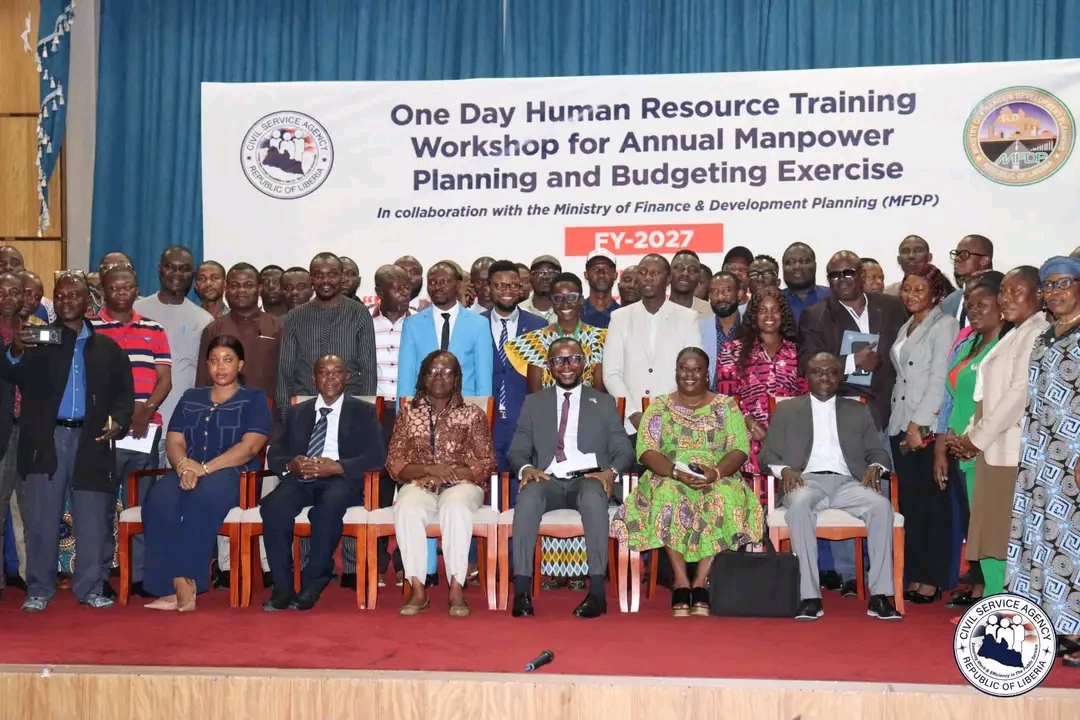
The Civil Service Agency (CSA), in collaboration with the Ministry of Finance and Development Planning (MFDP), on Tuesday conducted a one-day Human Resource Training on Manpower Planning and Budgeting for Human Resource Directors and Technical Personnel Officers representing 109 Government Spending Entities.
The training, held at the Ellen Johnson Sirleaf Ministerial Complex in Congo Town, is designed to prepare government institutions for the upcoming Annual Manpower Planning and Budgeting Exercises for FY2027, placing greater emphasis on linking recruitment and staffing decisions to institutional needs, fiscal realities and national development priorities.
The exercise was held under the theme, “Planning Today for a Stronger Civil Service Tomorrow.”
Workforce Planning at the Center of Reform
The training comes as Liberia continues efforts to modernize its public administration and improve the efficiency of a government workforce that has expanded significantly in recent years.
Government workforce data referenced in Liberia’s recent public-sector planning discussions put the Civil Service workforce at approximately 63,130 employees in 2025, compared with about 60,900 in 2024—an increase of roughly 2,230 employees, or 3.7 percent, in one year.
The growth underscores the importance of stronger manpower forecasting, payroll controls and institutional workforce planning, particularly in a country where public-sector compensation represents a significant component of recurrent government expenditure.
Against this backdrop, officials say manpower planning must increasingly move beyond simply determining how many workers an institution requires.
Speaking on behalf of the Director-General of the Civil Service Agency, Deputy Director-General for Administration and Finance Atty. Dahnu Mianyen stressed that strategic manpower planning is essential to building an effective, sustainable and responsive civil service.
Mianyen urged Government Spending Entities to work closely with the CSA when determining staffing requirements, emphasizing that personnel decisions should be based on clearly identified institutional needs, available financial resources and broader government priorities.
He said effective workforce planning involves ensuring that institutions have the right number of personnel, with the right skills, in the right positions, to fulfill their mandates and improve service delivery.
The approach is particularly significant as Liberia seeks to balance demands for additional public-sector personnel with the need to maintain fiscal discipline and ensure that limited public resources are directed toward priority programs.
The CSA’s Principal Administrative Officer, Alfred Drosaye, provided participants with an overview of the forthcoming Annual Manpower Hearings and Budgeting Exercises.
The hearings are expected to provide government institutions with an opportunity to present and justify their personnel requirements, identify staffing gaps and demonstrate how proposed positions are connected to institutional mandates.
The process is also intended to improve coordination between human-resource planning and national budget preparation, helping government determine whether proposed staffing increases are financially sustainable before they are incorporated into the national budget framework.
A major component of the training was delivered by Marvelous D. Weah, Director of Compensation and Expenditure Controls at the Ministry of Finance and Development Planning.
Weah addressed participants on “Linking Manpower Planning to the National Budget: Fiscal Discipline, Resource Allocation and Effective Public Service Delivery.”
His presentation highlighted the close relationship between government staffing decisions and national fiscal management.
As personnel commitments can extend for years through salaries, benefits and other employment-related costs, officials emphasized the importance of ensuring that every proposed position is properly justified, budgeted and aligned with the government’s capacity to finance it.
The message reflects a broader public-finance principle: workforce expansion without corresponding budgetary planning can create long-term fiscal pressures, while inadequate staffing can weaken government institutions and reduce the quality of public services.
Training Targets Accuracy, Compliance and Payroll Integrity
Participants also took part in technical sessions focused on the preparation of personnel listings, common errors and quality assurance, and the preparation of manpower plans.
The sessions were intended to strengthen the ability of HR professionals and technical personnel officers to produce accurate submissions, reduce administrative errors and comply with established government manpower-planning and budgeting procedures.
Accurate personnel listings are particularly important for ensuring that government payroll and staffing records correspond with authorized positions and legitimate institutional needs.
The August 11 training forms part of the CSA’s broader effort to strengthen human-resource management, institutional planning and accountability across Liberia’s public sector.
For a country managing competing demands for education, healthcare, infrastructure, security and other essential services, officials say improving the efficiency of the civil service remains critical to maximizing the impact of public spending.
The FY2027 manpower-planning process will therefore provide an important test of the government’s ability to balance staffing needs, fiscal discipline and public-service delivery.
With 109 government spending entities participating in the preparatory exercise, the CSA and MFDP are seeking to establish a more systematic approach to workforce planning, one that connects the size and composition of Liberia’s public workforce directly to institutional performance, available resources and national development priorities.
The central message emerging from the training is clear: Liberia’s next generation of public-sector reform will depend not only on how much government spends, but also on how strategically it plans, recruits, deploys and manages the people responsible for delivering public services.


