
By: Wilfred Wil Duosi
A prominent women’s rights organization, Initiative for Women and Youth Empowerment (IWYE), is calling on the Government of Liberia to prioritize family planning by significantly increasing the national budgetary allocation for the sector.
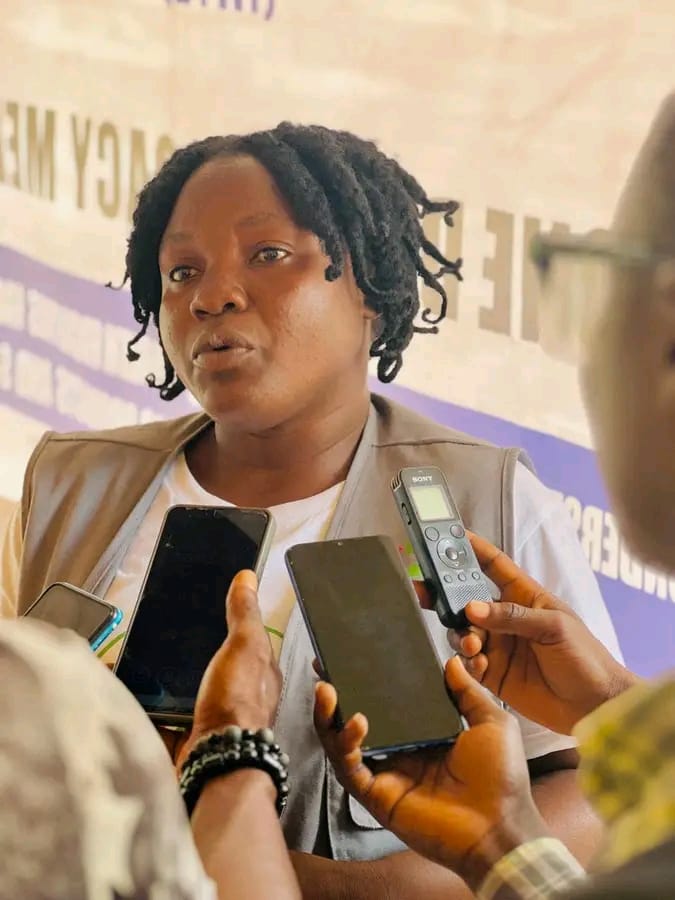
Speaking to journalists in Monrovia, the IWYE,Executive Director, Musu W. Davis, stressed that the government must give urgent and full attention to family planning programs, noting that the current allocation remains far below what is needed to curb the rising rate of teenage pregnancies across the country.
Madam Davis appealed to both the National Legislature and the Executive Branch to make a substantial increase in the Family Planning (FP) budget through the Ministry of Health as lawmakers debate the expenditure component of the FY2026 national budget.
She described the recent increment from US$50,000 to US$75,000 as “a mere peanut,” arguing that the amount is insignificant when compared to family planning support in neighboring countries.“Go and visit Bong County, for example.
The rising number of teenage pregnancies has overwhelmed health care workers,” she said. “We need the government to support things that are priority and essential to the future of this country.”
While acknowledging the government’s effort in making a previous adjustment to the FP budget, Madam Davis insisted that the current amount is still grossly inadequate to address the growing crisis of teenage and unplanned pregnancies.
She noted that unplanned pregnancies among teenagers and young women are escalating, largely due to limited access to contraceptives, especially in rural communities.
“Across this country, the phrase ‘pregnant women’ has now changed to ‘pregnant girls,’” she lamented. “Most of the people you see running to health centers are girls between 13 and 14 years old. Does anyone think this is normal? Hell no!”
The group Executive Director also highlighted the devastating impact of recent USAID funding cuts, noting that Liberia remains one of the most vulnerable countries affected by the reduction in international support for reproductive health services.
She warned that the cuts have left many healthcare workers unpaid and unmotivated, forcing essential programs to shut down and several rural health facilities to close.
She urged the government and lawmakers to act decisively during the ongoing budget hearings. “The ratio of babies giving birth to babies is sky-high,” she said. “The need for the government to act cannot be overemphasized.”
