




By: Julius Konton
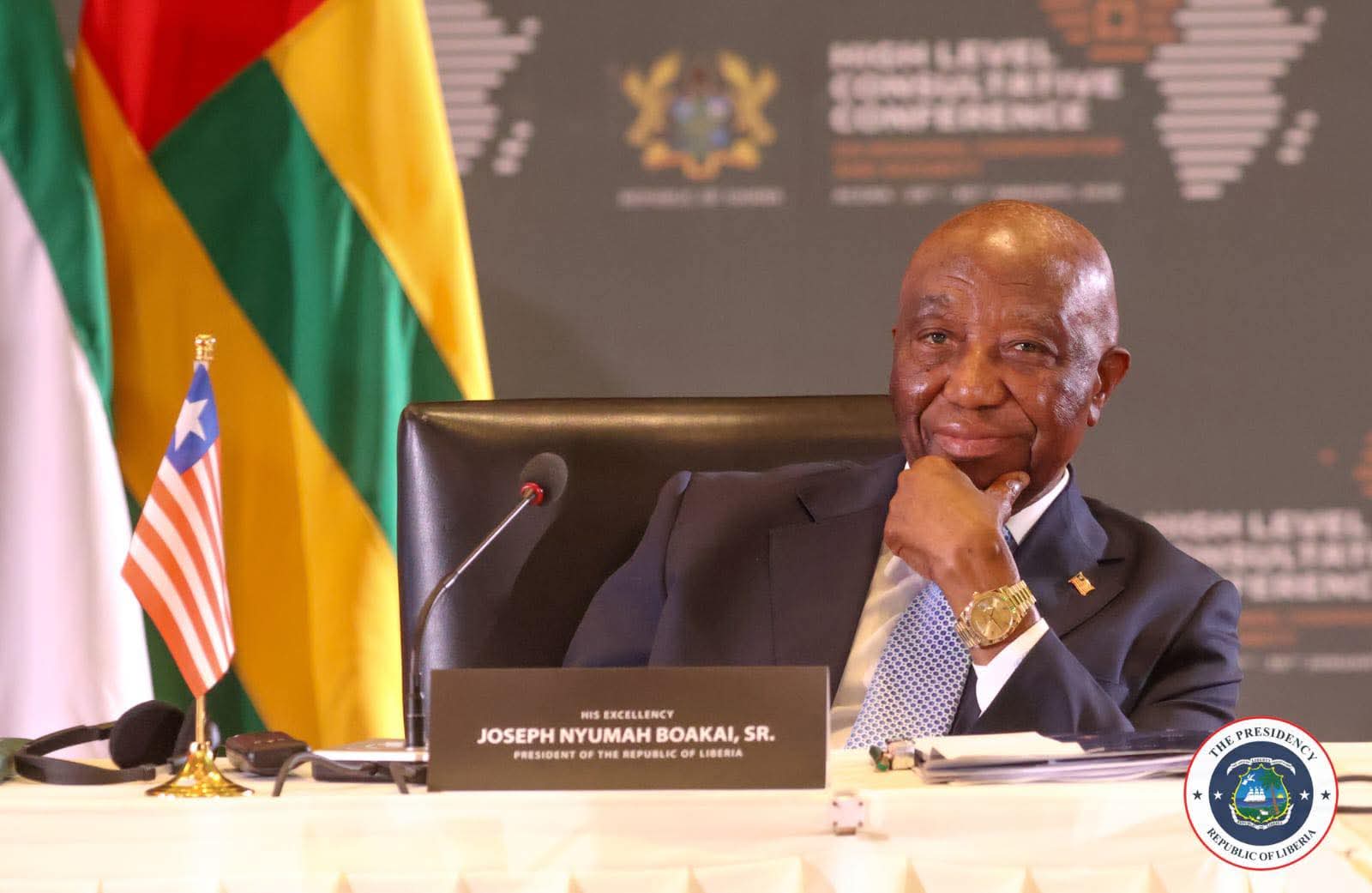
West African leaders convened in Accra for a high-level consultative conference on regional cooperation and security amid mounting instability across the Sahel and coastal West Africa, with Liberia’s President Joseph Nyuma Boakai Sr. delivering a stark warning that the region faces “no option but collective survival.”
Speaking at the High-Level Consultative Conference on Regional Cooperation and Security, President Boakai said recent developments in Niger, where political upheaval and security uncertainty continue to reverberate across the Sahel, serve as a “rude awakening” for the sub-region and validate the urgency of coordinated action.
“Wars and violent conflicts, once started, have no boundaries,” Boakai warned. “They leave nations wrecked, economies crippled, and development stalled.”
The conference, hosted by Ghanaian President John Dramani Mahama, brought together heads of state, intelligence chiefs, ministers of foreign affairs and national security, and representatives of international organizations at a time when West Africa is confronting one of its most complex security environments in decades.
A Region Under Pressure
West Africa and the Sahel have become one of the world’s fastest-growing epicenters of insecurity.
According to international security assessments, violent extremist incidents in the Sahel have increased more than fivefold over the past decade, spilling southward into coastal states.
Terrorist networks, transnational criminal syndicates, illicit arms trafficking, and maritime piracy now intersect with governance deficits, climate stress, and youth unemployment.
President Boakai catalogued a broad spectrum of threats confronting the region, including:
Terrorism and violent extremism
Transnational organized crime and illicit financial flows
Maritime insecurity and illegal fishing
Proliferation of small arms and light weapons
Human trafficking and drug abuse
Cybercrime and emerging digital threats
Climate-driven resource conflicts and illegal mining
“These threats are interconnected and overwhelm our limited national resources when faced individually,” Boakai said.
The United Nations estimates that more than 60 percent of West Africa’s population is under the age of 25, yet youth unemployment and underemployment remain persistently high, creating fertile ground for criminal recruitment and radicalization.
Liberia’s Perspective: Lessons from Conflict
Drawing from Liberia’s own history, President Boakai emphasized the long-term cost of violent conflict.
Liberia’s civil wars between 1989 and 2003 claimed an estimated 250,000 lives, displaced nearly half the population, and destroyed much of the country’s economic and institutional infrastructure.
“Liberia lived it, experienced it, and continues to bear the scars,” Boakai said.
“That history compels us to prioritize conflict prevention nationally, regionally, and globally.”
He stressed that instability in any West African country poses a direct threat to all others, noting that borders have become increasingly porous due to globalization, migration, and digital connectivity.
“Liberia is not safe if an inch of Ghana is in terror,” he said.
Multilateralism at the Center of Liberia’s Foreign Policy
President Boakai reaffirmed Liberia’s commitment to multilateral cooperation, noting that the country currently serves as a non-permanent member of the United Nations Security Council, where it advocates for regional approaches to peacebuilding and security.
He argued that international responses to crises must extend beyond conflict epicenters to include neighboring countries and regional institutions capable of dismantling cross-border support networks.
“Focusing only on the epicenter is no longer sufficient,” Boakai said. “Regional engagement is essential to neutralizing cells, logistics, and financing that operate across borders.”
The Liberian leader said the Accra meeting aligns with Liberia’s national security strategy and foreign policy, both of which emphasize regional cooperation as a tool for collective security, intelligence-sharing, and resource mobilization.
Technology, Cyber Threats, and the New Security Frontier
Boakai also highlighted emerging security fault lines, particularly cybercrime, warning that technological advances are outpacing investment in regional security architecture.
“With borders increasingly non-existent, cyber threats now pose risks equal to physical attacks,” he said, urging governments to modernize intelligence systems and invest in digital resilience.
Path Forward: From Security to Socio-Economic Stability
Beyond military and intelligence cooperation, Boakai stressed that sustainable security must be rooted in economic opportunity and social inclusion.
He called for:
Activation of regional economic
mechanisms to stimulate growth
Coordinated job creation programs targeting youth
Joint education, training, and healthcare initiatives
Cultural and technical exchange programs to strengthen regional cohesion
“These issues are not isolated,” he said. “We confront them daily, often simultaneously.”
A Call for Immediate and Unified Action
President Boakai laid out four principles he said must guide regional leaders:
Collective survival is not optional.
No country can be stable while its neighbor is insecure.
Fragmented responses guarantee collective failure.
Delay is dangerous in an era of rapid technological change.
“We must act together,” Boakai concluded. “Otherwise, we perish together.”


