
By: Julius Konton
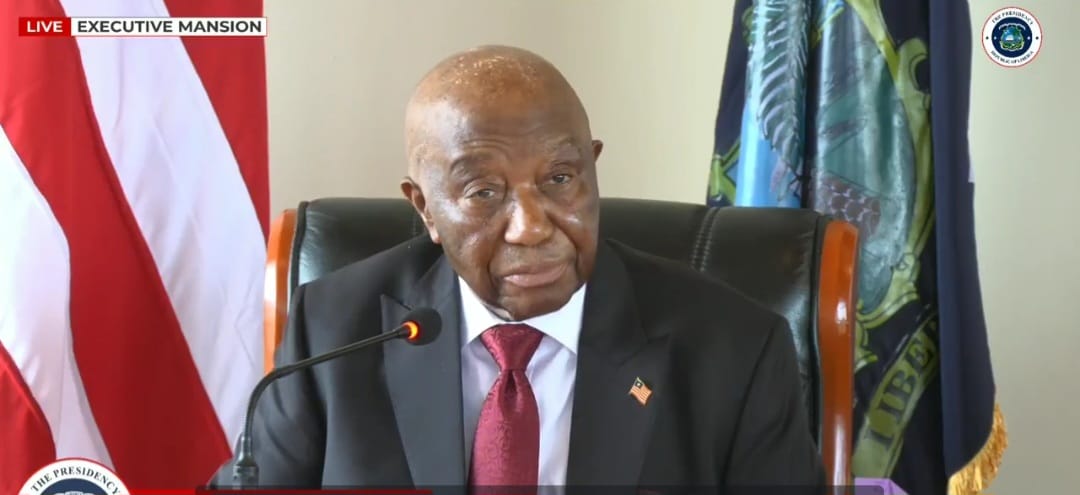
President Joseph Nyuma Boakai has commended key members of his cabinet for what he described as “courageous and honest service,” while simultaneously calling for greater coordination, accountability, and policy caution in the face of mounting economic and urban challenges.
Speaking at the opening of a high-level cabinet meeting, the Liberian leader revealed that he has been closely monitoring the performance of government officials and acknowledged notable efforts across several ministries.
“We appreciate those who have the guts to do the work they are supposed to do,” President Boakai stated, emphasizing that public service must always be rooted in integrity and national interest.
GOVERNMENT RESPONSE TO GLOBAL ECONOMIC SHOCKS
Addressing Liberia’s economic outlook, President Boakai pointed to the impact of global instability on the domestic economy particularly supply chain disruptions and rising commodity prices.
Liberia, like many developing economies, remains highly import-dependent, with over 70% of essential goods sourced from abroad, making it vulnerable to international shocks such as geopolitical conflicts and fuel price volatility.
The President disclosed that his administration undertook early procurement measures to cushion citizens against anticipated shortages:
Strategic stockpiling of petroleum products
Early importation of essential commodities
Fiscal interventions to stabilize pricing
He praised the Ministry of Finance and Development Planning for mobilizing financial resources, alongside the Liberia Petroleum Refining Company (LPRC) for its sectoral role in ensuring fuel availability.
However, he cautioned that such measures are temporary buffers, warning:
“These interventions may not last long depending on how the global situation evolves.”
TOURISM POLICY PUT ON HOLD
In a significant policy shift, President Boakai ordered a temporary pause on newly introduced tourism-related fees and regulations proposed by the government.
While acknowledging the need to generate revenue and regulate the sector, he expressed concern about the potential burden on citizens and investors, especially given that Liberia’s tourism industry is still in its early developmental stage, contributing less than 5% to GDP.
The President emphasized the need for impact assessment and stakeholder consultation before implementation:
“We must justify the figures.
It is important to understand how these policies affect our people before enforcement.”
POST-WAR URBAN EXPLOSION: A GROWING CRISIS
Highlighting Liberia’s post-conflict transformation, President Boakai pointed to rapid urbanization as one of the country’s most pressing challenges.
Monrovia’s population, once estimated at approximately 350,000 before the civil war, has now surged to over 1.5 million residents.
He stressed that this represents a more than fourfold increase in less than two decades
This population boom has placed immense pressure on infrastructure: naming
Water supply systems overstretched
Aging pipelines in urgent need of replacement
Electricity demand exceeding capacity
Increased informal housing and slum expansion
The President referenced the Liberia Water and Sewer Corporation, noting that existing infrastructure is no longer adequate:
“The pipes we have are too small for the population we now serve.”
ZONING VIOLATIONS AND UNPLANNED CONSTRUCTION
A major concern raised during the meeting was the widespread disregard for zoning laws and building regulations.
President Boakai lamented that:
Buildings are increasingly constructed in alleys and restricted zones
Flood-prone areas are being occupied
Citizens often bypass official approval processes
He recalled his own experience of following proper procedures through the Ministry of Public Works when constructing his home, contrasting it with current trends.
“The laws have not changed, but people no longer follow them.”
Urban planning experts estimate that over 60% of Monrovia’s structures are informally developed, contributing to:
Flooding during rainy seasons
Traffic congestion
Public health risks
SOCIAL SERVICES UNDER PRESSURE
With population growth comes rising demand for essential services.
The President stressed that increased urban density inevitably requires:
More schools
Expanded healthcare facilities
Improved sanitation systems
Enhanced electricity and water distribution
Liberia currently faces:
A doctor-to-patient ratio of approximately 1:15,000
Limited access to quality education in densely populated communities
President Boakai acknowledged that while government is working to address these issues, systemic gaps remain significant.
CALL FOR DISCIPLINE, ACCOUNTABILITY, AND REFORM
The President urged Liberians to adopt a culture of lawfulness and civic responsibility, noting that sustainable development depends on collective discipline.
“In other countries, people follow the rules. We must begin to do the same.”
He also issued a strong message to public officials:
Uphold transparency
Avoid targeting individuals unfairly
Ensure policies are implemented justly
He warned that public servants are accountable to the people and must be prepared to justify their actions.
REFORMS AND MINISTERIAL PERFORMANCE
President Boakai highlighted ongoing reforms across key sectors, including:
Education Sector: Removal of “ghost names” from payroll systems
Health Sector: Strengthening service delivery
Local Government: Enhancing
decentralization effort
These reforms, he noted, are part of a broader agenda to eliminate corruption and improve efficiency.
MESSAGE TO THE DIASPORA AND YOUTH
In a candid reflection, President Boakai addressed the growing trend of emigration among young Liberians.
While acknowledging the global pursuit of opportunities, he emphasized the importance of building Liberia’s future at home:
“Not everyone can leave and not everyone should. We must create opportunities here.”
He called on the diaspora to contribute meaningfully to national development rather than merely criticizing from afar.
FINAL WORD: “POSTERITY WILL JUDGE US”
Concluding his remarks, President Boakai reaffirmed his administration’s commitment to ethical governance and long-term national progress.
“There is a right way and a wrong way to do everything. We must choose what is right because posterity will judge us.”
