
By: Julius Konton
Liberia’s Finance and Development Planning Minister, Augustine Kpehe Ngafuan, has described the partnership between the Government of Liberia and the United Nations system as “strong, resilient, and tested,” particularly during a year marked by global economic uncertainty and major shifts in international development financing.
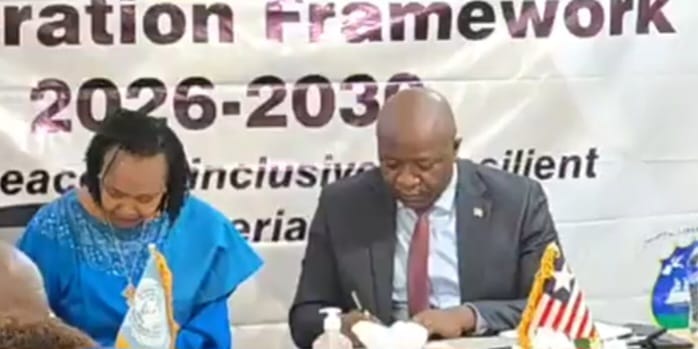
Speaking at the signing ceremony of the United Nations Cooperation Framework, Minister Ngafuan said Liberia’s relationship with the UN had been reinforced not in moments of ease, but during what he called one of the country’s most challenging periods in recent years.
“Partnerships and friendships are tested not in good times, but in difficult moments,” Ngafuan said. “This year has been a very tough one for Liberia”, he re-emphasized.
Global Aid Shocks and Domestic Pressure
Ngafuan noted that sweeping changes in the global development architecture earlier this year significantly affected aid-dependent economies, with Liberia among the hardest hit.
He recalled that by March and April, uncertainty over financing flows, fiscal pressures, and external shocks created fears of economic collapse.
“At that point, it felt as though the sky might collapse on our heads,” he reflected.
Liberia, a country of about 5.3 million people, remains heavily reliant on external development assistance, which historically accounts for more than 30 percent of public investment financing, according to government planning data.
Reductions or delays in donor support therefore have immediate implications for service delivery, infrastructure, and social protection.
Ngafuan said that while some partners scaled back engagement during the crisis, the United Nations system stepped forward.
“It was at that moment that the UN rallied around Liberia. They were deeply concerned about what was happening,” he said, adding that the government held frank discussions with UN leadership on managing the economic headwinds.
‘Turbulence Does Not Mean Failure’
Using an aviation metaphor, Ngafuan compared Liberia’s current journey to a flight experiencing turbulence.
“Good pilots don’t promise there will be no turbulence. They tell you to fasten your seatbelts and they ensure the aircraft reaches its destination,” he said.
He praised President Joseph Nyuma Boakai’s leadership, saying the administration remained steady despite external shocks.
“I can assure the Liberian people that President Boakai is a good pilot. Despite the turbulence, the flight remains on course”, he added.
Ngafuan emphasized that while the global system may be unsettled, fundamental human values , solidarity, compassion, and concern for the poor must not be abandoned.
“We are not wrong to care for the poor, the needy, and persons with disabilities,” he said. “Turbulence must not cause us to lose our core values”, he warned.
US$883 Million Plan Through 2028
At the center of the renewed partnership is the United Nations Cooperation Framework, a multi-year development plan aligned with Liberia’s national priorities and costed at US$883 million through 2028.
“This is a big number, with big plans and big hopes,” Ngafuan said.
He stressed that planning and conceptualization were now complete and that implementation would be the government’s primary focus.
“The time for planning is over. Now is the time for performance and execution,” he said, warning that delays and bureaucratic bottlenecks would no longer be tolerated.
The government, he disclosed, is strengthening its Aid Management Unit to improve coordination, transparency, and timely project delivery, as Liberia seeks to convert large development commitments into measurable outcomes at the community level.
“The Liberian people are impatient for results and rightly so,” Ngafuan said. “As they push us, we will push our partners to deliver”, he noted.
UN: A Strategic Framework Anchored in National Ownership
United Nations Resident Coordinator Christine Umutoni described the signing of the UN Cooperation Framework (2026–2030) as a “major milestone” in UN–Liberia relations.
“This framework reaffirms our shared vision of a peaceful, inclusive Liberia, where children, youth, women, and vulnerable groups can realize their full potential,” Umotoni said.
She emphasized that the framework is built on principles of national ownership, accountability, and mutual responsibility, ensuring that both the UN and the Liberian government honor their commitments.
Alignment With National, Regional and Global Agendas
Umutoni noted that the framework aligns directly with Liberia’s ARREST Agenda for Inclusive Development, while also supporting Agenda 2063, ECOWAS regional priorities, and the 2030 Sustainable Development Goals (SDGs).
“By aligning national, regional, and global goals, Liberia is strengthening its pathway toward inclusive, resilient, and sustainable development,” she said.
Three Strategic Priority Areas
The framework focuses on three jointly agreed priority pillars:
- Human Capital Development
Improved health and nutrition outcomes
Expanded social protection systems
Increased access to quality education and basic social services
- Good Governance and Rule of Law
Strengthening democratic institutions
Enhancing accountability and justice systems
Promoting transparent and effective public administration
- Economic Sustainability and Climate Resilience
Inclusive economic growth and job creation
Climate-resilient livelihoods
Sustainable natural resource management
At the core of the framework, Umotoni said, is a commitment to equity and inclusion, ensuring that marginalized and vulnerable populations are not left behind.
Results-Based Monitoring and Innovation
The framework introduces clear results matrices, measurable targets, and performance indicators, allowing progress to be tracked annually through high-level steering committees co-chaired by the UN and the Government of Liberia.
A key innovation is the introduction of flagship programs, designed to accelerate results in priority sectors, including:
Education and skills development for employment
Adolescent girls’ health and empowerment
Digital governance and e-government solutions to improve service delivery and accountability
The framework is supported by an indicative resource envelope, combining existing funding with resources to be mobilized, alongside a strong emphasis on innovative financing and domestic resource mobilization.
UN Pledges Long-Term Commitment
Umutoni said the UN will contribute policy expertise, data and analytics, advocacy, financing support, and institutional strengthening to help Liberia achieve its development goals.
“Liberia’s development journey presents both promise and challenges,” she said. “But working together, we see clear hope and enormous potential.”
She reaffirmed the UN’s readiness to work with government institutions, civil society, the private sector, and the media to ensure sustained progress.
“We stand ready to walk this journey with Liberia,” Umotoni concluded. “Together, we will achieve this vision”, she reechoed.
Editor’s Note
The signing of the US$883 million United Nations Cooperation Framework marks a defining moment in Liberia’s development partnership at a time when global aid flows are under unprecedented strain.
Beyond the headline figure, the agreement signals renewed confidence in Liberia’s policy direction, national ownership, and institutional resilience amid economic turbulence.
Finance Minister Augustine Kpehe Ngafuan’s remarks underscore a central message of this moment: that effective partnerships are measured not in periods of abundance, but in times of crisis.
As donor priorities shift worldwide and fiscal pressures mount, the UN’s decision to deepen engagement positions it as a stabilizing partner in Liberia’s recovery and reform agenda.
Equally significant is the government’s emphasis on execution. With planning largely complete, public expectations are now firmly focused on delivery, transparency, and measurable impact at the community level.
The strengthened Aid Management Unit and results-based monitoring framework will be critical tests of whether large-scale commitments can translate into tangible improvements in education, health, governance, jobs, and climate resilience.
As Liberia moves toward 2028, the Cooperation Framework aligns national ambitions with regional and global development goals, placing people, equity, and accountability at the center.
The success of this partnership will ultimately be judged not by pledges signed, but by lives improved, an outcome that both the Government of Liberia and the United Nations have publicly committed to achieve.
