




By: Julius Konton
Liberia is preparing to launch a nationwide data-collection exercise as part of its second National Risk Assessment on Money Laundering, Terrorist Financing and Proliferation Financing, a major step aimed at strengthening the country’s financial-crime prevention architecture and bringing its risk-management system into closer alignment with evolving international standards.
The exercise, scheduled to run from September through November 2026, will be conducted by specialized working groups established to collect and analyze information from key public institutions, financial-sector operators, designated non-financial businesses and professions, law-enforcement agencies and other relevant stakeholders.
The assessment is expected to provide updated evidence on the nature, scale and vulnerabilities associated with illicit financial flows in Liberia and guide the government in allocating resources toward the country’s highest-risk areas.
The second assessment comes against the backdrop of Liberia’s first National Risk Assessment, conducted between November 2018 and August 2020 and published in 2021.
That assessment found Liberia’s overall money-laundering risk to be high, driven by a combination of high-level criminal threats and significant national vulnerabilities.
Terrorist-financing risk, by contrast, was assessed as low, although authorities warned that regional developments required continued vigilance.
The 2019 assessment identified corruption and bribery, illicit drug trafficking, robbery and theft, tax evasion, human trafficking and migrant smuggling, counterfeiting and piracy among the country’s principal predicate crimes generating illicit proceeds.
Liberia’s financial environment has also undergone significant changes since the first assessment.
The 2019 report highlighted the country’s predominantly cash-based economy, weaknesses in financial transparency and record-keeping, limited institutional capacity and challenges associated with porous borders.
It also identified emerging financial products including mobile payments, prepaid cards and internet-based payment services as areas requiring closer monitoring because of their potential exposure to money-laundering and terrorist-financing risks.
The need for an updated assessment has become even more pronounced as financial transactions become increasingly digital and criminal networks adopt more sophisticated methods to move, conceal and integrate illicit proceeds.
The new NRA will therefore examine not only traditional financial channels but also emerging technologies, new payment systems, evolving criminal methodologies and vulnerabilities associated with proliferation financing.
Liberia’s Anti-Money Laundering and Countering the Financing of Terrorism policy framework is being coordinated through the Inter-Ministerial Steering Committee, which has designated Mohammed Ali Nasser, Officer-in-Charge of the Financial Intelligence Agency (FIA), as Chairperson of the National Steering Committee for the second assessment.
The National Steering Committee is expected to coordinate the nationwide exercise, bring together relevant competent authorities and stakeholders, oversee the collection and analysis of information, and ultimately support the preparation of an evidence-based national risk assessment report for consideration through the Inter-Ministerial Steering Committee and submission to the Inter-Governmental Action Group Against Money Laundering in West Africa (GIABA).
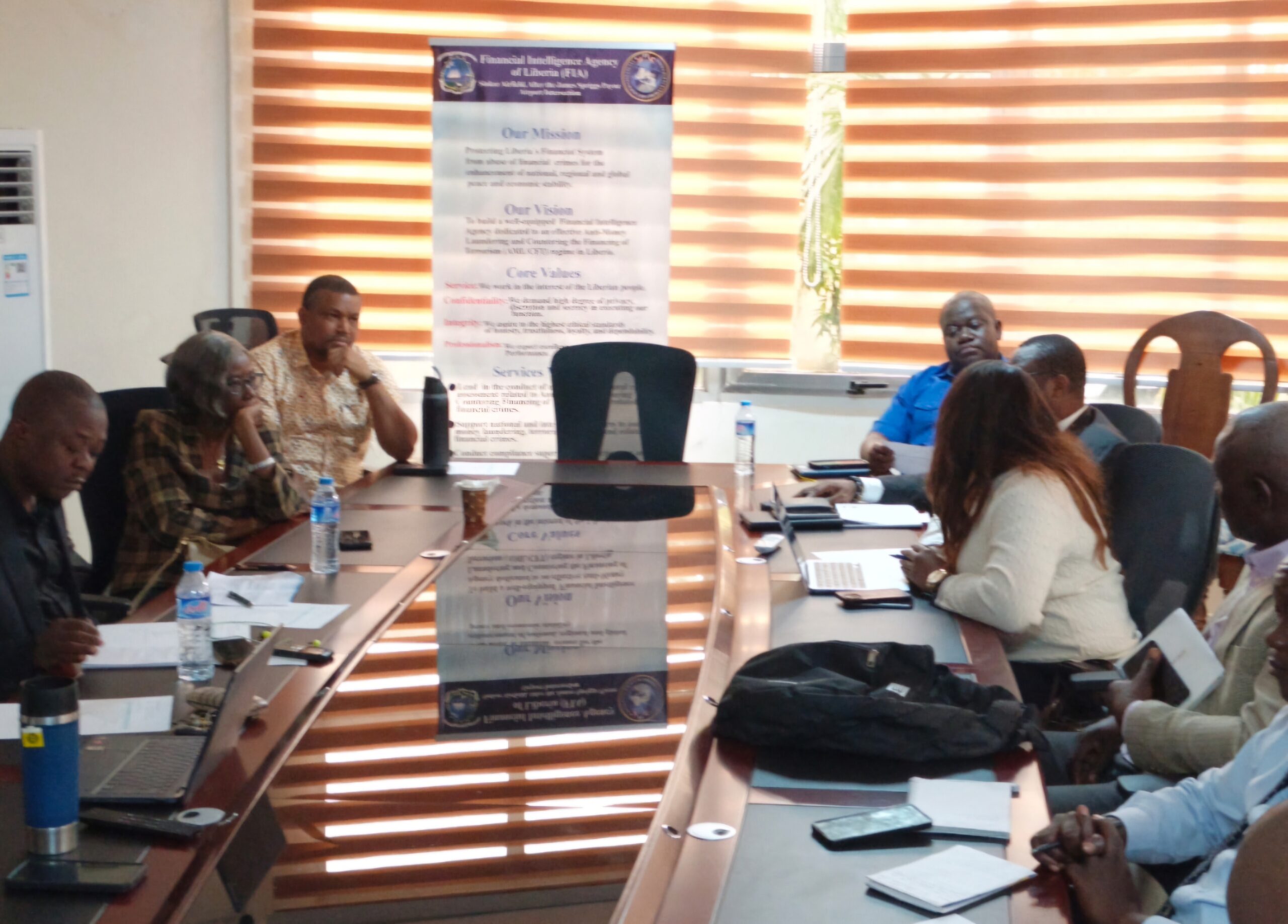
The current process follows a five-day pre-risk assessment workshop held in Monrovia from March 23 to 27, 2026, which brought together representatives of Liberia’s public and private sectors to identify key risks, vulnerabilities and institutional gaps within the country’s Anti-Money Laundering and Countering the Financing of Terrorism framework.
Participants included representatives from the Central Bank of Liberia, Financial Intelligence Agency, Ministry of Justice, Liberia National Police, Liberia Drug Enforcement Agency, National Lottery Authority, Ministry of Mines and Energy, Liberia Revenue Authority and Liberia Bank for Development and Investment, among other institutions.
The stakeholders have subsequently been organized into 10 specialized working groups, which are expected to undertake sector-specific assessments and collect primary and secondary data across the country.
The exercise is intended to improve national ownership of the assessment while ensuring that its conclusions are supported by verifiable evidence.
Liberia’s first NRA provided a detailed picture of the country’s financial-crime vulnerabilities.
It was conducted using the World Bank’s National Money Laundering and Terrorist Financing Risk Assessment Tool, with working groups collecting information through questionnaires, interviews, legal and regulatory documents and sector-specific data.
The assessment covered banks, non-bank financial institutions, securities, insurance, other financial institutions, designated non-financial businesses and professions, financial inclusion products and national money-laundering and terrorist-financing threats.
The 2019 assessment originally operated through eight working groups, reflecting the country’s effort at the time to develop a comprehensive risk profile.
Among its findings, the assessment rated Liberia’s national vulnerability to money laundering as high, citing low enforcement capacity, weaknesses in supervision, inadequate coordination, limited resources and gaps in institutional capacity.
The report also highlighted weaknesses in customer due diligence, record-keeping and the availability of reliable information for financial investigations.
The report further found that Liberia’s insurance and securities sectors accounted for less than 2 percent and 0.56 percent of GDP, respectively, and were assessed as comparatively lower-risk sectors at the time.
Meanwhile, designated non-financial businesses and professions including casinos, betting operators, dealers in precious minerals and stones, and real-estate businessesnwere considered particularly vulnerable because of regulatory and supervisory weaknesses.
The second NRA will also be taking place in the context of Liberia’s 2023 GIABA mutual evaluation, which was based on an on-site assessment conducted from April 11 to 29, 2022 and subsequently reviewed and endorsed by the Financial Action Task Force (FATF).
The evaluation gave Liberia a “largely compliant” rating on Recommendation 1, dealing with assessing risks and applying a risk-based approach, and the same rating for national cooperation and coordination. However, several other areas received only partial or non-compliant ratings.
These included the money-laundering offence, confiscation, terrorist-financing offences, targeted financial sanctions, customer due diligence, new technologies, wire transfers, beneficial ownership and supervision of financial institutions and designated non-financial businesses.
Of particular significance for the new assessment, Liberia was rated “non-compliant” on Recommendation 15 concerning new technologies, while proliferation-related targeted financial sanctions under Recommendation 7 and safeguards concerning non-profit organizations under Recommendation 8 were also rated non-compliant.
On effectiveness, the 2023 evaluation rated Liberia at a moderate level only for Immediate Outcome 1, which concerns risk, policy and coordination, while the remaining 10 immediate outcomes were rated at a low level of effectiveness.
The findings underline the importance of translating risk assessments into stronger enforcement, supervision, financial intelligence, investigations, prosecutions and asset recovery.
To address some of the information and coordination challenges experienced during the first assessment, enumerators involved in the 2026 exercise have reportedly been trained to use Kobo Collect, a digital data-collection platform capable of operating both online and offline.
The use of digital questionnaires is expected to improve consistency in data gathering, reduce delays associated with paper-based information collection and allow field teams to transmit information more efficiently where connectivity is available. It could also help working groups identify gaps in responses and improve the standardization of information collected from institutions across Liberia.
The emphasis on stronger data is critical because Liberia’s 2019 assessment identified several constraints during its own collection process, including insufficient data on predicate offences, budget and manpower limitations, difficulty reaching respondents in rural areas and inadequate management-information systems within some institutions.
NRA-2 as a Strategic Policy Tool
The second assessment is expected to be built around three central principles: national ownership, sustainable capacity and actionable results.
Rather than treating the final report as a static document, authorities intend for it to function as a continuously relevant strategic reference for government institutions, regulators, law-enforcement agencies and private-sector entities.
That approach is consistent with FATF Recommendation 1, which requires countries to identify, assess and understand their money-laundering and terrorist-financing risks and to apply a risk-based approach so that resources are directed toward mitigating the most significant threats.
FATF also recognizes national risk assessment as an important foundation for determining policy priorities and allocating resources.
For Liberia, the exercise comes at an important point in the country’s broader effort to strengthen its financial integrity system.
The country has moved considerably from the situation documented in earlier assessments, when it lacked many of the institutional and legal mechanisms now in place. Yet the 2023 evaluation shows that important gaps remain in effectiveness and implementation.
The history of Liberia’s AML/CFT development stretches back more than a decade.
A 2010 mutual evaluation, published in 2011, identified major deficiencies in the country’s AML/CFT system.
Since then, Liberia has established and strengthened institutions and legal frameworks, including its financial-intelligence architecture. The first national risk assessment was subsequently undertaken from 2018 onward, providing the country with its first comprehensive national picture of money-laundering and terrorist-financing risks.
The 2026 NRA-2 therefore represents more than another data-gathering exercise. It is expected to provide Liberia with an updated map of financial-crime threats and vulnerabilities and help determine where regulatory, investigative, prosecutorial and supervisory resources should be concentrated.
As Liberia moves toward the completion of the second assessment, the credibility of the exercise will ultimately depend on the quality of data supplied by participating institutions, the independence and accuracy of analysis, and the government’s ability to convert the findings into measurable reforms.
For a country seeking stronger financial-sector integrity, greater investor confidence and deeper integration into the regional and international financial system, the success of NRA-2 could become a significant indicator of Liberia’s capacity to identify emerging threats, close institutional gaps and respond more effectively to illicit financial activity.


