


By: Julius Konton
Liberia must urgently strengthen its economic, institutional and social resilience to withstand a rapidly changing global environment marked by conflict, economic uncertainty, shrinking development assistance, climate shocks, disrupted supply chains and rising food and energy costs, Finance and Development Planning Minister Augustine Kpehe Ngafuan has warned.
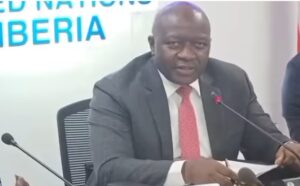
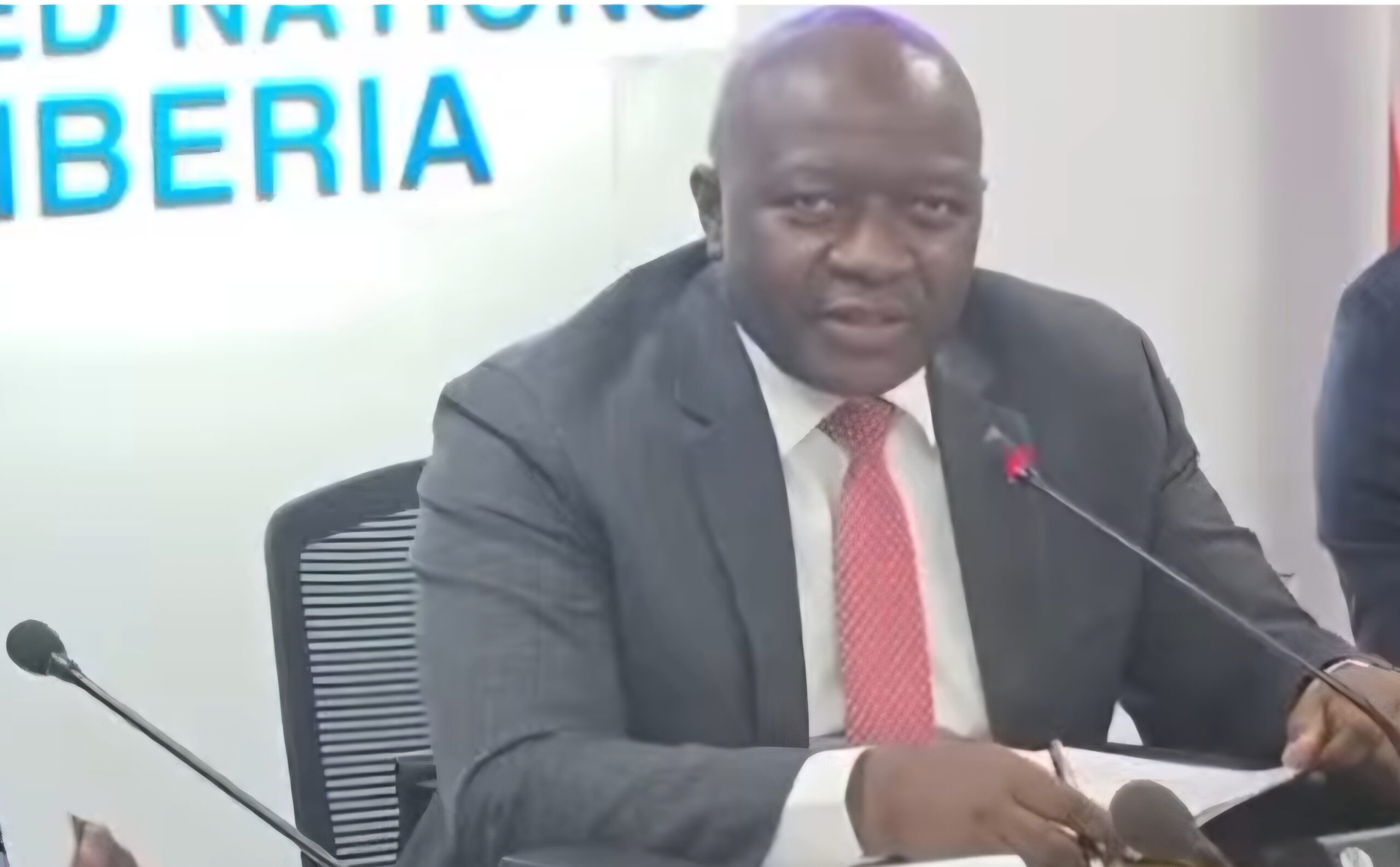
Speaking on behalf of the Government of Liberia at the United Nations Development Programme’s Inclusive Hour: High-Level Development Dialogue on Thursday, September 3, Minister Ngafuan said the country could not isolate itself from international crises, arguing that global turbulence eventually reaches households and businesses in Liberia through higher fuel, food, medicine, cement and transportation costs.
“When conflict thousands of miles away pushes up oil prices, the impact eventually reaches the taxes and the kekeh drivers in Monrovia,” Ngafuan said, stressing that disruptions in global supply chains ultimately translate into higher prices for basic commodities and essential services.
His warning comes as international development financing faces one of its sharpest contractions in decades.
The Organisation for Economic Co-operation and Development says official development assistance from its Development Assistance Committee members fell by 23.1 percent in 2025 to US$174.3 billion, the largest annual decline on record, while the OECD projects another decline of about 7 percent in 2026. Aid to sub-Saharan Africa fell particularly sharply in 2025.
For Liberia, whose post-war reconstruction and social-service delivery have historically depended heavily on external financing, the changing aid environment presents a significant fiscal challenge.
The country has experienced repeated shocks from two civil wars that ended in 2003 to the Ebola epidemic, commodity-price collapses and the COVID-19 pandemic.
The World Bank has described Liberia’s development trajectory as highly vulnerable to external shocks, noting that the country’s commodity-dependent economic structure has repeatedly contributed to cycles of stagnation and recovery.
Ngafuan argued that resilience must therefore be built before, rather than after, a crisis arrives.
“Resilience is built before it. We build it by strengthening institutions and public financial management; we build it through roads and electricity, agriculture, education and healthcare, economic diversification and institutions capable of continuing to function when circumstances become difficult,” he said.
The Finance Minister pointed to Liberia’s recent economic performance as evidence that stronger macroeconomic management can create space for development.
The International Monetary Fund projects Liberia’s real GDP growth at 5.5 percent in 2026, driven largely by mining, construction and manufacturing, while inflation averaged about 4.5 percent during the first half of 2026. The IMF also projects a primary fiscal surplus, excluding grants, equivalent to 2.4 percent of GDP this year.
But Ngafuan cautioned that economic growth alone should not be mistaken for development.
“The question can’t be how much the government spends, but rather, what did the Liberian people get from what government spent?” he asked, challenging policymakers to measure public expenditure by its tangible impact on citizens.
He cited roads, reliable electricity, functioning schools, medicines in health facilities, agricultural productivity and job creation as the practical indicators by which government performance should ultimately be judged.
Liberia has made measurable progress in some of these areas.
World Bank data show that electricity access has expanded significantly over the past decade, while approximately 81,776 new household connections, reaching nearly 376,000 people, were added between January and December 2025 through World Bank-financed projects and other development-partner interventions.
At the center of Ngafuan’s argument was the growing importance of domestic resource mobilization.
He said Liberia remains grateful to its bilateral and multilateral partners but must increasingly develop the capacity to finance its own priorities through stronger tax administration, improved customs systems, reduced leakages, better management of natural resources and broader economic activity.
“Every additional dollar the government legitimately mobilizes gives Liberia greater control over its development destiny,” he said, describing domestic resource mobilization not simply as a Ministry of Finance responsibility but as an issue of development sovereignty.
Ngafuan disclosed that Liberia expects to reach the US$1 billion revenue target sometime in September, describing the milestone as part of the government’s continuing effort to expand the country’s domestic fiscal capacity.
But he acknowledged that raising revenue represents only one side of the equation. The other, he said, is ensuring that public money is spent efficiently, transparently and in ways that generate measurable social and economic returns.
The minister also called for greater innovation in development financing, including concessional resources, partnerships with the World Bank and African Development Bank, responsible mobilization of private capital and the preparation of bankable projects capable of attracting investment.
“Government cannot finance Liberia’s transformation alone, neither can development partners,” he said. “Ultimately, the country needs a productive private sector creating businesses, jobs, exports, income and tax revenue.
Aid can help finance development, but only a productive economy can sustain development.”
Ngafuan placed equity alongside resilience as another defining requirement of Liberia’s development strategy.
He warned that economic shocks do not affect all households equally.
A 10 percent increase in food prices might represent an inconvenience for one household but could force another family to reduce its meals from three to two or from three to one.
The minister called for macroeconomic stability to be accompanied by effective social protection and inclusive investment, arguing that national development must reach citizens across Liberia rather than remain concentrated in Monrovia.
He specifically referenced farmers in Lofa, market women at Red Light, fishermen in Grand Kru, rubber farmers in Margibi, young entrepreneurs in Ganta and mothers seeking healthcare for their children in River Gee.
“GDP matters. Revenue matters.
But ultimately, development must have a human face,” Ngafuan said. “People must be able to feel it, touch it in their everyday lives.”
His emphasis on inclusion comes against the backdrop of Liberia’s youthful population.
World Bank demographic data indicate that people aged 15–24 account for about 39.1 percent of Liberia’s population, underscoring both the enormous opportunity and the potential pressure created by the country’s demographic structure.
Ngafuan said investment in education, vocational skills, agriculture, entrepreneurship, technology and employment could transform Liberia’s young population into its greatest economic asset.
“Without opportunities, youth can generate frustration. But with opportunity, it becomes a demographic dividend,” he said.
The Finance Minister also linked Liberia’s economic future to environmental stewardship, rejecting the traditional separation between economic development and environmental protection.
Liberia’s forests, coastline, biodiversity, water resources and ecosystems, he argued, are not only environmental assets but also economic assets and part of the inheritance owed to future generations.
“Our forest must create value without disappearing. Our minerals must generate prosperity without leaving environmental devastation behind.
Our cities must grow without becoming overwhelmed by flooding, pollution and waste,” he said.
He called for an energy transition capable of expanding electricity access while progressively moving Liberia toward cleaner and more sustainable sources.
Liberia’s energy challenge remains substantial.
The country’s current electricity access rate is around 32.7 percent, while the government has set a target of reaching at least 75 percent access by 2030 and increasing the share of renewable energy in the generation mix to 75 percent.
Ngafuan concluded by emphasizing the importance of partnerships, transparency and public trust.
He said Liberia must continue working with the United Nations, World Bank, African Development Bank, bilateral partners, civil society and the private sector, while simultaneously strengthening public institutions at home.
That includes improving procurement and public financial management, combating corruption, strengthening transparency and ensuring that public resources increasingly translate into measurable development outcomes.
“Trust is also development capital,” he said.
The minister acknowledged that Liberia cannot determine when wars will erupt elsewhere, how international oil prices will move or when climate-related disasters will occur.
But, he argued, the country can determine how prepared it is to withstand those shocks.
Liberia can choose stronger institutions over weaker ones, mobilize more domestic resources, prioritize productive investments over waste, diversify its economy, protect vulnerable citizens, manage natural resources responsibly and deepen partnerships, he said.
“The turbulence around us should not cause Liberia to lower its ambitions,” Ngafuan declared.
“It should cause us to strengthen the foundation beneath those ambitions.”
His remarks frame Liberia’s development challenge as more than a question of economic growth.
They present resilience, fiscal self-reliance, equity, environmental stewardship and institutional accountability as interconnected pillars of a national strategy designed to ensure that future shocks do not erase hard-won development gains.
“Development is not measured by how fast the country moves when the road is smooth, but by how firmly the country stands when the road becomes tough,” he said.
“Our task is therefore to build a Liberia that can withstand shocks without losing direction, pursue prosperity without leaving people behind and use the gifts of nature without stealing the future.
That is resilience. That is equity. That is planetary stewardship and that is the development journey we must travel together.”


