
By: Julius Konton
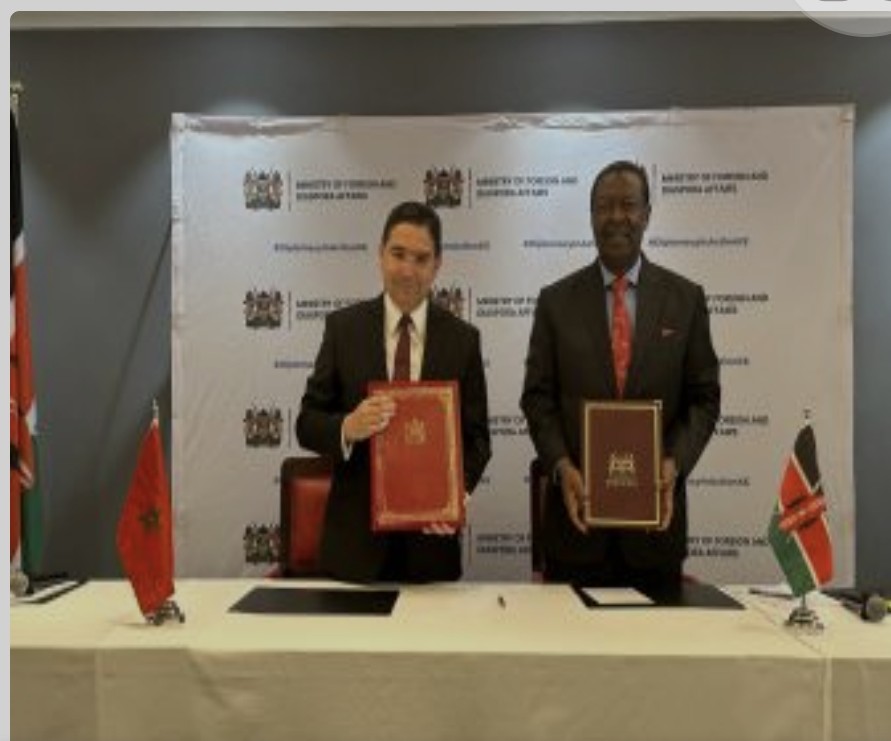
The Kingdom of Morocco and the Republic of Kenya have taken a significant step toward strengthening bilateral relations following the signing of eleven wide-ranging cooperation agreements at a high-level ministerial meeting held in Nairobi on Thursday.
The session of the Joint Cooperation Commission was co-chaired by Morocco’s Minister of Foreign Affairs, African Cooperation and Moroccan Expatriates, Nasser Bourita, and Kenya’s Prime Cabinet Secretary and Cabinet Secretary for Foreign and Diaspora Affairs, Musalia Mudavadi.
The meeting marks a continuation of diplomatic engagements that began with senior officials’ consultations in Rabat in October 2025, underscoring a growing commitment to South–South cooperation across the African continent.
Broad-Based Agreements Across Key Sectors
The Nairobi session culminated in the signing of eleven bilateral instruments covering a diverse range of sectors critical to economic growth and social development.
These include:
Agriculture and food security
Justice and legal cooperation
Public health systems
Maritime fisheries and aquaculture
Gender equality and women’s empowerment
Cultural exchange and diplomacy
Higher education and research
Youth and sports development
Wildlife conservation
Visa exemptions for diplomatic and official passport holders
Academic scholarships, internships, and knowledge exchange
These agreements build upon five earlier memoranda of understanding signed in May 2025, which focused on diplomatic training, housing, trade, youth engagement, and public service capacity building.
Strategic Framework for Long-Term Cooperation
Both delegations adopted the official minutes of the Joint Cooperation Commission, establishing a structured roadmap to guide bilateral relations in priority sectors.
The framework includes a monitoring and implementation mechanism designed to ensure accountability and coordinated execution of commitments.
Analysts say such mechanisms are crucial in Africa, where implementation gaps have historically undermined bilateral agreements despite strong political goodwill.
Trade Imbalance and Investment Opportunities in Focus
A central theme of the discussions was the need to address the trade imbalance between the two nations.
While trade volumes between Morocco and Kenya have steadily grown, both sides acknowledged that the current structure does not fully reflect their economic potential.
Officials emphasized:
Expanding market access for agricultural and value-added goods
Promoting cross-investment in high-growth sectors such as renewable energy, agro-industry, pharmaceuticals, and automotive manufacturing
Strengthening infrastructure development partnerships
With Morocco emerging as a key industrial and financial hub in North Africa, and Kenya maintaining its status as East Africa’s economic gateway, experts view the partnership as strategically positioned to reshape intra-African trade flows.
Push for New Agreements and Regional Integration
The two countries also agreed to accelerate negotiations on several pending agreements, including:
Port development and logistics
Double taxation avoidance
Energy cooperation
Air transport services
Mining sector collaboration
Tourism development
These initiatives align with broader continental goals under the African Continental Free Trade Area (AfCFTA), which aims to boost intra-African trade currently estimated at around 15% significantly lower than other global regions.
Reviving Direct Flights to Boost Connectivity
In a move expected to have immediate economic impact, both governments prioritized the resumption of direct flights between Nairobi and Morocco.
Officials say improved air connectivity will:
Facilitate business travel and investment
Increase tourism flows between North and East Africa
Strengthen cultural and people-to-people exchanges
A Growing Model for Intra-African Cooperation
The Nairobi meeting reflects a broader shift toward deeper intra-African partnerships, as countries seek to reduce dependency on external markets and build resilient regional value chains.
With over a dozen agreements now in place and more under negotiation, Morocco–Kenya relations are increasingly seen as a model of pragmatic, multi-sectoral cooperation capable of advancing economic integration across the continent.
As both nations look ahead, the success of these agreements will depend not only on political will but on effective implementation an area both sides have pledged to prioritize in the months ahead.
