





By: Julius Konton
Liberia’s pursuit of accountability for past atrocities and public sector corruption received another significant boost on Wednesday as the Office of the United Nations High Commissioner for Human Rights (OHCHR) donated essential operational equipment to the Law Reform Commission (LRC), reinforcing the country’s ongoing efforts to establish the War and Economic Crimes Court (WECC) and the National Anti-Corruption Court (NACC).
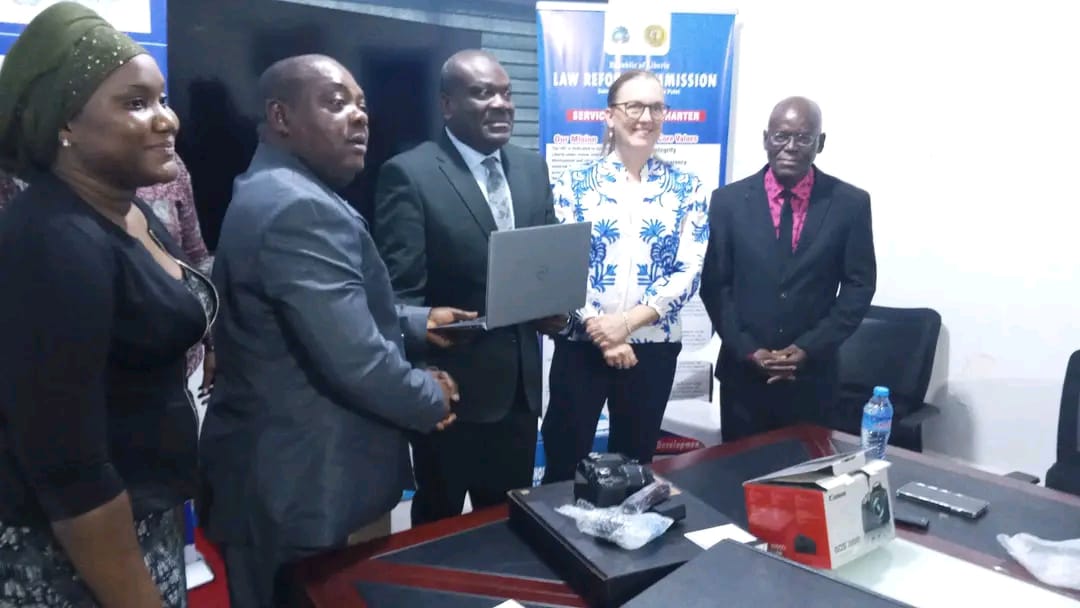
The donation which included laptops, desktop printers, a high-resolution digital camera, and office supplies is intended to strengthen the Commission’s institutional capacity as it undertakes critical legal reviews and drafts legislation necessary for Liberia’s ambitious transitional justice program.
The support comes at a pivotal moment as President Joseph Nyuma Boakai’s administration advances reforms aimed at implementing recommendations of Liberia’s Truth and Reconciliation Commission (TRC), whose landmark 2009 report called for the creation of a special court to prosecute those responsible for serious human rights violations committed during Liberia’s two civil wars between 1989 and 2003.
The conflicts claimed an estimated 250,000 lives, displaced nearly half of the country’s population, and devastated national institutions.
Presenting the equipment, Christian Mukosa, OHCHR Representative to Liberia, reaffirmed the United Nations’ commitment to helping Liberia strengthen institutions responsible for delivering justice, accountability, and respect for human rights.
He emphasized that the assistance reflects OHCHR’s determination to support the development of victim-centered judicial and non-judicial transitional justice mechanisms, ensuring that the proposed War and Economic Crimes Court and National Anti-Corruption Court are credible, inclusive, transparent, and aligned with international human rights standards.
According to Mukosa, strengthening the Law Reform Commission is fundamental because the institution is responsible for reviewing and modernizing Liberia’s legal framework to ensure that legislation establishing both courts complies with international law while protecting victims’ rights and promoting due process.
“The establishment of strong legal foundations is essential to ensuring that future accountability mechanisms inspire public confidence and contribute meaningfully to national reconciliation,” Mukosa noted.
Established through an Act of the National Legislature in 2011, the Law Reform Commission serves as Liberia’s principal statutory body responsible for reviewing, codifying, reforming, and modernizing the country’s laws.
Its role has become increasingly significant as Liberia seeks to align domestic legislation with international legal obligations and democratic governance standards.
As part of the ongoing reform process, the Commission is expected to undertake a comprehensive review of laws governing serious human rights violations, corruption-related offenses, criminal accountability, and institutional reforms necessary for the operationalization of both the WECC and the National Anti-Corruption Court.
The Embassy of Sweden, one of Liberia’s longstanding development partners, also reaffirmed its commitment to strengthening governance, justice, and accountability institutions.
According to the Embassy, empowering the Law Reform Commission is essential for ensuring that Liberia’s transitional justice architecture is built upon sound legal principles consistent with international human rights obligations and best practices.
Since January 2025, Sweden has provided financial support to OHCHR for capacity-building initiatives benefiting several institutions central to Liberia’s transitional justice agenda.
These include the Office for the Establishment of the War and Economic Crimes Court for Liberia (OWECC-L), the Independent National Commission on Human Rights (INCHR), the Liberia Anti-Corruption Commission (LACC), civil society organizations, academic institutions, and members of the media.
The partnership is intended to strengthen institutional readiness while promoting public participation, transparency, and national ownership of Liberia’s justice reform process.
Receiving the equipment on behalf of the Commission, LRC Chairman and Chief Executive Officer, Cllr. Bornor M. Varmah, expressed profound appreciation to OHCHR and the Government of Sweden for their sustained partnership in strengthening Liberia’s justice sector.
Varmah pledged that the Commission would continue executing its statutory mandate by reviewing, drafting, and reforming laws that respond to emerging national realities while collaborating closely with OWECC-Liberia and other transitional justice stakeholders to uphold the rule of law, protect human rights, and promote accountability.
He also acknowledged OHCHR’s previous assistance in establishing the Commission’s Gender and Human Rights Desk, describing the support as instrumental in enhancing the institution’s capacity to mainstream human rights considerations into legal reform initiatives.
OHCHR disclosed that it is supporting the recruitment of a national legal consultant who will assist the Law Reform Commission in reviewing Liberia’s anti-corruption laws to ensure that the proposed National Anti-Corruption Court is established on a robust legal framework capable of effectively prosecuting corruption, strengthening public integrity, and combating impunity.
The latest intervention underscores growing international confidence in Liberia’s democratic and judicial reform agenda.
As the country approaches more than two decades since the end of its civil conflict, many observers view the establishment of the War and Economic Crimes Court and the National Anti-Corruption Court as historic milestones that could strengthen the rule of law, reinforce institutional accountability, restore public trust, and advance long-awaited justice for victims.
Liberia has not yet prosecuted most perpetrators of atrocities committed during its civil wars, making the proposed WECC one of the country’s most consequential post-war governance reforms.
Human rights advocates argue that successful implementation of both the WECC and NACC could significantly strengthen accountability, deter future abuses, improve governance, and reinforce Liberia’s commitment to international human rights and anti-corruption standards.


