





By: Julius Konton
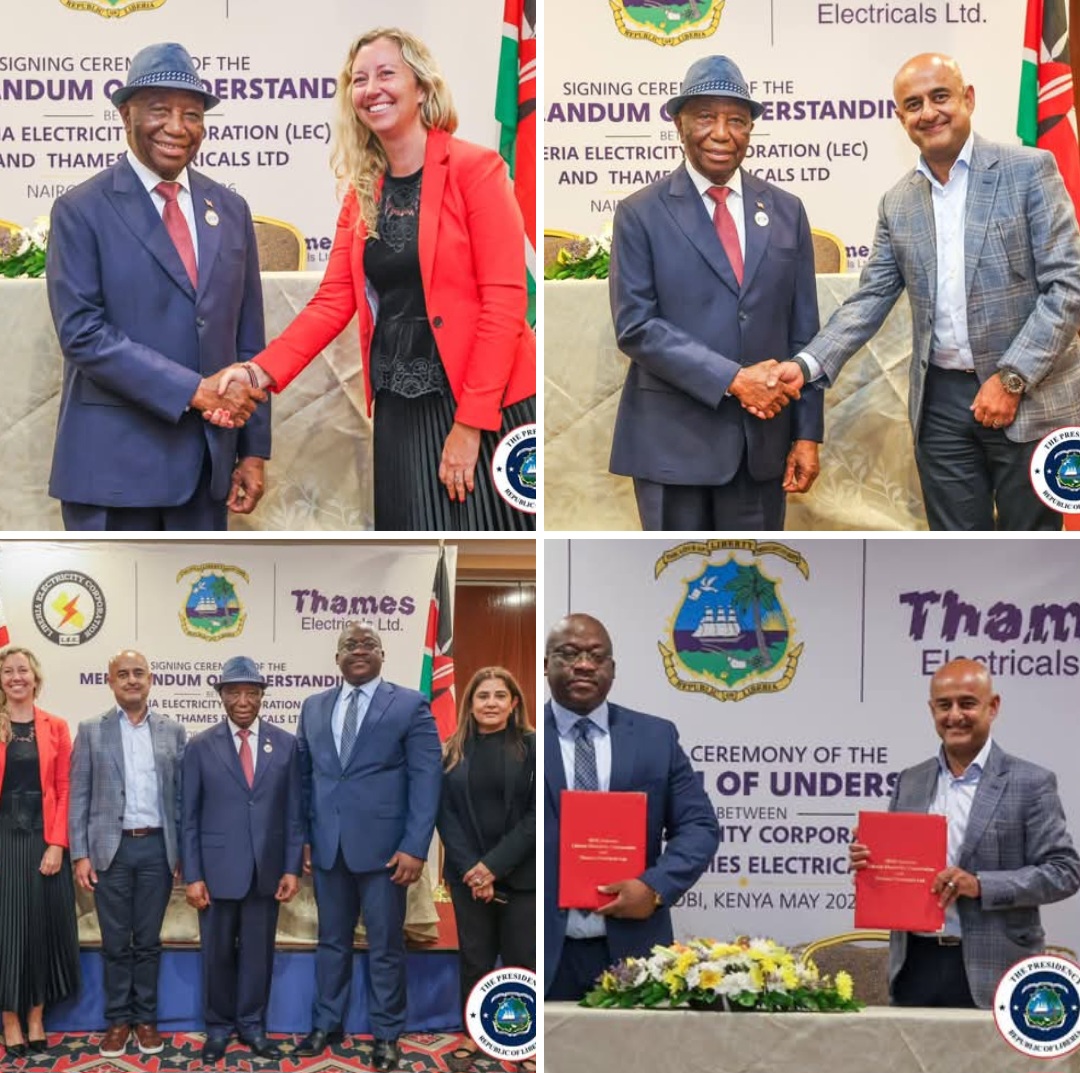
In a move widely seen as a transformative step for Liberia’s energy and industrial sectors, President Joseph Nyuma Boakai has overseen the signing of a landmark US$6 million agreement to establish Liberia’s first-ever electrical manufacturing plant.
The agreement, signed on the sidelines of the Africa Forward Summit in Nairobi, brings together the Government of Liberia through the Liberia Electricity Corporation and Kenyan-based Thames Electrical Limited in what officials describe as a major breakthrough for the country’s industrialization agenda.
The proposed manufacturing facility will produce transformers, conductors, switchgears, smart meters and other electrical materials locally, a development expected to significantly reduce Liberia’s long-standing dependence on imported electrical equipment.
Government officials say the project could dramatically improve procurement timelines, reduce operational costs, strengthen power infrastructure and accelerate electrification efforts across Liberia.
President Boakai hailed the initiative as a historic turning point in the country’s economic transformation drive.
“This represents the beginning of the end of Liberia’s dependence on imported electrical materials,” President Boakai declared during the signing ceremony.
“By producing these materials locally, we will drastically reduce procurement and delivery timelines while creating opportunities for industrial growth and job creation.”
A Critical Step for Liberia’s Energy Sector
Liberia continues to face major electricity challenges despite years of post-war reconstruction efforts. According to regional energy assessments, Liberia still records one of the lowest electricity access rates in West Africa, particularly in rural communities where access to stable power remains limited.
Electricity tariffs in Liberia have historically ranked among the highest on the African continent, driven largely by heavy dependence on imported energy infrastructure, limited domestic production capacity and logistical bottlenecks.
Analysts believe the establishment of a domestic electrical manufacturing industry could help reduce some of these structural costs while improving maintenance and expansion of the national grid.
The new plant is expected to support ongoing energy projects tied to the regional West African Power Pool, which seeks to integrate electricity networks across West Africa.
President Boakai emphasized that reliable electricity remains central to economic growth, industrial development, healthcare delivery, education and regional trade integration.
“Reliable energy infrastructure is fundamental to national development,” the Liberian leader said.
“This investment positions Liberia not only to address domestic energy demands but also to seize opportunities within the wider West African market.”
Liberia Eyes Regional Manufacturing Hub Status
Officials say Liberia’s strategic geographic location and existing energy interconnections with neighboring Sierra Leone, Guinea and Côte d’Ivoire could enable the country to emerge as a regional supply hub for electrical equipment and energy infrastructure materials.
The project aligns with the Boakai administration’s broader economic agenda focused on industrialization, private sector expansion, infrastructure modernization and value-added production.
The Liberian President stressed that Africa must increasingly prioritize domestic manufacturing instead of depending heavily on imported finished products from outside the continent.
“This is not just an agreement; it is a pathway to transformation,” President Boakai stated. “Africa must focus more on manufacturing and value addition within our continent.”
Economists say the agreement also reflects growing momentum behind the African Continental Free Trade Area (AfCFTA), which aims to expand intra-African trade and industrial cooperation among African nations.
Kenya-Liberia Partnership Deepens
The agreement follows a series of bilateral engagements between President Boakai and Kenyan President William Samoei Ruto, during which industrial cooperation and electrical manufacturing emerged as priority areas.
Executives of Thames Electrical Limited welcomed the partnership, describing Liberia as a promising destination for long-term industrial investment.
The company’s Chief Executive Officer praised the Liberian government for its confidence in the firm and pledged to deliver quality results through strong collaboration with Liberian stakeholders.
“We will do our best to make Kenya proud in Liberia and ensure that Liberia feels that our countries are not just on the same continent, but are like family,” the CEO stated.
The company further noted that stronger intra-African investment partnerships remain essential for accelerating sustainable development across the continent.
LEC Highlights Faster Procurement and Infrastructure Expansion
Meanwhile, Managing Director of the Liberia Electricity Corporation, Mohammed Sheriff, underscored the strategic importance of the investment for Liberia’s electricity sector.
According to him, local manufacturing will significantly shorten procurement timelines for essential electrical materials, helping improve maintenance and expansion projects nationwide.
Energy sector experts believe the initiative could also create hundreds of direct and indirect jobs for Liberians in manufacturing, engineering, logistics, construction and technical services once operations commence.
The investment comes at a time when Liberia is intensifying efforts to modernize its aging energy infrastructure while pursuing broader economic diversification after years of dependence on raw commodity exports.
If successfully implemented, the project could mark the beginning of a new era of industrial production in Liberia and reinforce growing calls for greater African self-reliance in manufacturing and infrastructure development.


