



By: Julius Konton
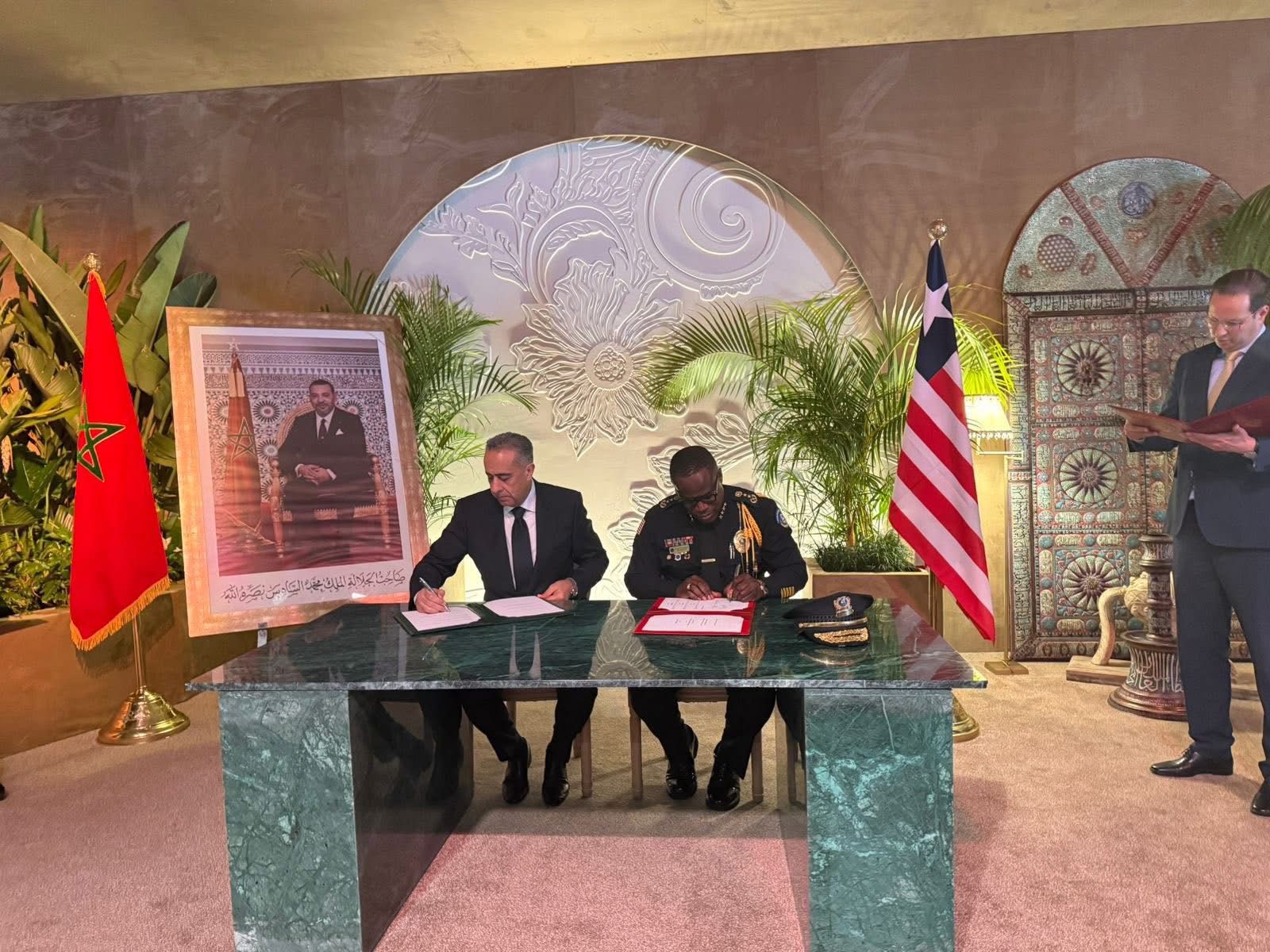
The Liberia National Police and Morocco’s General Directorate of National Security have signed a landmark Memorandum of Understanding (MoU) aimed at strengthening bilateral security and police cooperation, marking what officials describe as a significant milestone in Liberia’s evolving security modernization agenda and international law enforcement engagement.
The agreement, signed today, establishes a formal framework for collaboration in key areas including intelligence sharing, counterterrorism, cybersecurity, forensic science, specialized police training, organized crime prevention, and border security cooperation.
Officials say the partnership is expected to deepen institutional coordination while equipping Liberian security personnel with enhanced technical expertise to address increasingly complex transnational security threats.
The pact comes at a time when global security institutions are confronting heightened threats ranging from cybercrime and human trafficking to violent extremism and transnational organized criminal networks.
Across West Africa and the Sahel region, governments have intensified collaboration on intelligence and border security as instability, illicit trafficking, and extremist activity continue to reshape national security priorities.
Morocco has increasingly positioned itself as a regional hub for security diplomacy and counterterrorism cooperation, expanding partnerships across Africa, Europe, and Asia through intelligence-sharing frameworks and police modernization programs.
For Liberia, the agreement represents another step in strengthening institutions rebuilt after years of civil conflict.
The Liberian police service, originally established in 1956, underwent major reforms following the country’s civil wars, particularly during the post-conflict transition supported by the United Nations Mission in Liberia (UNMIL).
Today, the police service employs approximately 4,100 officers operating through specialized commands in administration, crime services, training, and operations, although challenges relating to resources, logistics, staffing, and technology continue to shape reform efforts.
Morocco’s national security system, by contrast, is widely recognized for its expansive operational capabilities and structured intelligence architecture.
The Moroccan security service, established in 1956, reportedly employs nearly 80,000 personnel and has developed extensive experience in counterterrorism, forensic investigations, intelligence coordination, and border management.
Moroccan authorities have, in recent years, strengthened security partnerships with multiple countries to confront emerging threats linked to terrorism, organized crime, cyber threats, and regional instability.
Security analysts say the Liberia–Morocco partnership could improve institutional professionalism, strengthen investigative capacities, and support technology-driven policing reforms in Liberia.
Areas such as forensic science and cybercrime investigation are expected to receive renewed emphasis as Liberia seeks to modernize public safety systems and improve national preparedness against evolving criminal threats.
The signing of the memorandum also reinforces growing diplomatic and technical ties between Monrovia and Rabat under broader South–South cooperation frameworks, which encourage collaboration among developing countries in governance, infrastructure, education, and security.
Earlier engagements between Liberian and Moroccan security leaders laid the groundwork for the agreement, with discussions centered on institutional cooperation, operational coordination, and specialized training exchanges.
Liberian authorities extended appreciation to Joseph Nyuma Boakai Sr., the Government of Liberia, and international partners for supporting what officials describe as a transformative step toward institutional modernization, professional policing, and strengthened public safety systems nationwide.
Officials say the agreement underscores Liberia’s continued commitment to international cooperation in law enforcement as the country seeks to align domestic security systems with emerging global standards.


