
By: Staff Writer
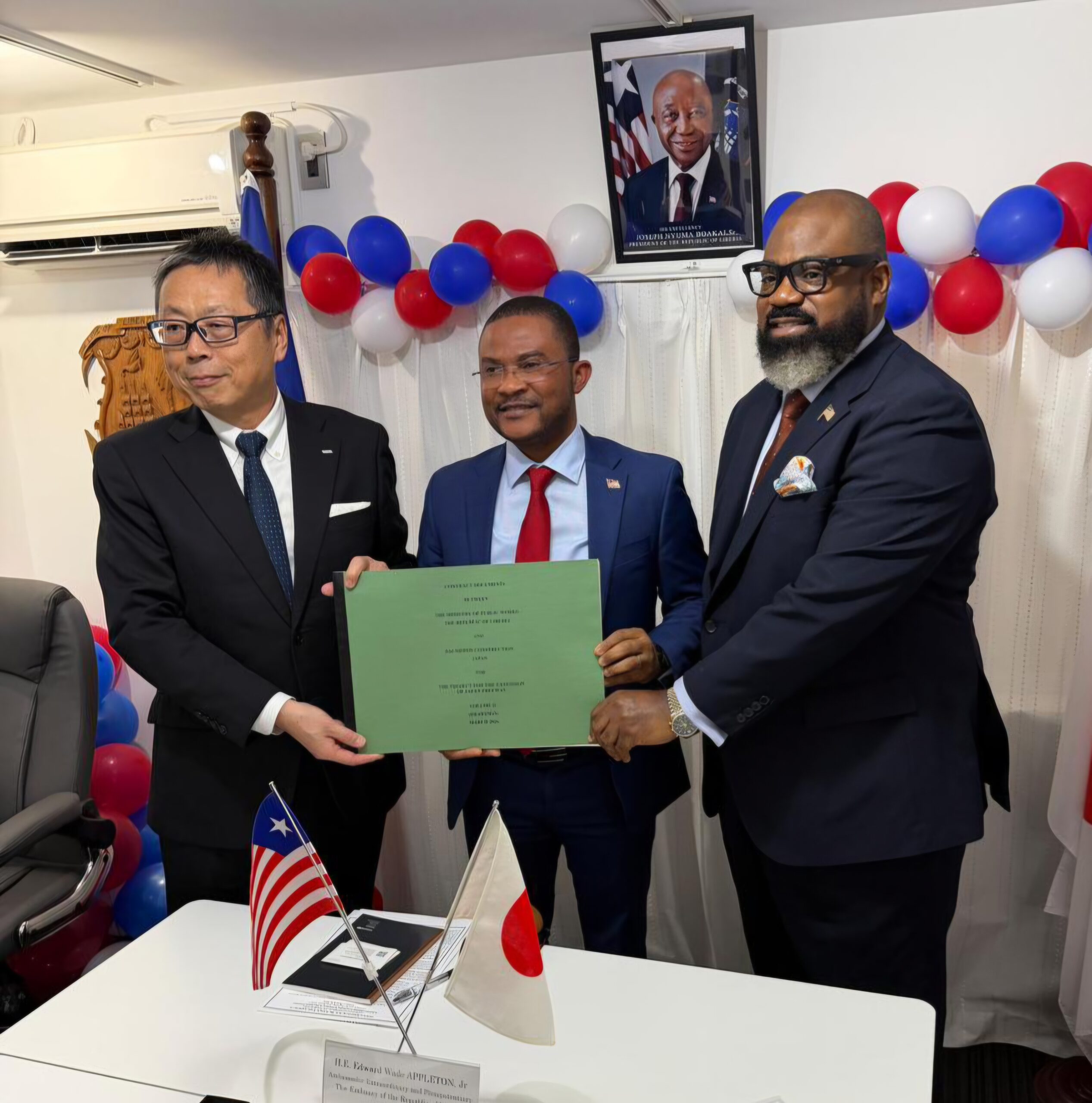
The Government of Liberia has secured a major infrastructure boost after signing a JPY 2.45 billion (approximately US$16 million) grant agreement with the Government of Japan for the rehabilitation and reconstruction of the critical Freeport–Gabriel Tucker Bridge corridor in Monrovia.
The agreement, signed in Tokyo on Friday, marks one of the most significant grant-funded urban road rehabilitation projects in Liberia’s capital in recent years, aimed at easing congestion, improving drainage, and strengthening access to the country’s busiest maritime gateway.
The contract was signed on behalf of Liberia by Deputy Minister for Technical Services at the Ministry of Public Works, Prince Tambah, following a week of negotiations and technical consultations with the Japan International Cooperation Agency (JICA) and Eight-Japan Engineering Consultants Inc. (EJEC).
The construction contract has been awarded to Dai Nippon Construction, which will undertake the rehabilitation and reconstruction of the 1.9-kilometer dual carriageway corridor connecting the Freeport of Monrovia to the Gabriel Tucker Bridge, one of the capital’s most important urban transport routes.
A Strategic Economic Lifeline
The Freeport–Gabriel Tucker Bridge corridor serves as a key artery linking the Freeport of Monrovia—Liberia’s principal maritime gateway to the capital’s commercial districts and surrounding suburbs.
The Freeport of Monrovia handles over 90 percent of Liberia’s international trade, including imports of petroleum products, food supplies, machinery, and construction materials.
Efficient road connectivity to the port is therefore vital for sustaining economic activity and reducing logistics costs across the country.
Officials say deteriorating pavement conditions, inadequate drainage infrastructure, and chronic flooding during Liberia’s heavy rainy season have significantly reduced traffic efficiency along the corridor.
Once completed, the rehabilitation project is expected to:
Improve traffic flow and transport efficiency
Reduce congestion and travel time for port-bound cargo trucks
Strengthen stormwater drainage systems
Enhance urban road safety for motorists and pedestrians
Support economic activities linked to port logistics and trade
Urban planners estimate that more than 20,000 vehicles use sections of the corridor daily, including heavy-duty trucks transporting goods to and from the port.
Construction Timeline and Scope
According to Deputy Minister Tambah, the project will begin implementation later this year.
The contractor is expected to mobilize equipment and technical teams in May 2026, while full civil works are scheduled to commence in July 2026.
The overall implementation period is projected at 26 months, placing completion sometime in late 2028, barring weather-related delays.
Engineering works will include:
Complete rehabilitation of the existing roadway structure
Expansion and reinforcement of the dual carriageway
Installation of modern drainage systems to address flooding
Construction of improved sidewalks and safety features
Upgrading traffic management infrastructure
Japan’s Expanding Development Role in Liberia
The project is financed through a 100 percent grant from the Government and people of Japan, highlighting the expanding development partnership between Liberia and Japan in infrastructure, capacity-building, and technical cooperation.
Through the Japan International Cooperation Agency, Japan has supported several projects in Liberia over the past decades, particularly in:
Road infrastructure
Public health
Agricultural development
Human resource capacity-building
Japan has previously financed major road upgrades in Monrovia and surrounding counties, while also providing technical assistance to strengthen Liberia’s public sector institutions.
Development analysts say Japan’s grant-based model provides a significant advantage for low-income countries like Liberia, allowing infrastructure expansion without adding to the national debt burden.
Liberia’s public debt currently stands at roughly US$2.2 billion, representing about 52 percent of GDP, according to recent government fiscal reports.
Diplomacy and Institutional Coordination
Deputy Minister Tambah expressed appreciation to the Government of Japan for its continued commitment to Liberia’s development priorities.
He also acknowledged the role of Liberia’s diplomatic and government leadership in securing the agreement.
Particular recognition was given to Foreign Minister Sara Beysolow Nyanti, whose efforts have strengthened diplomatic engagement between Liberia and Japan.
Liberia’s Ambassador to Japan, Edward Wade Appleton Jr., was also praised for facilitating negotiations and sustaining bilateral cooperation between the two nations.
Within the government, the Ministry of Public Works leadership under Minister Roland Lafette Giddings was credited for guiding the project from concept to implementation.
Officials say the agreement reflects growing international confidence in Liberia’s infrastructure development agenda.
Addressing Monrovia’s Urban Infrastructure Deficit
Liberia’s capital city, Monrovia, faces significant infrastructure challenges after decades of underinvestment and damage caused during the country’s Second Liberian Civil War (1999–2003).
Since the end of the conflict, successive governments have worked to rebuild the country’s road network, though large portions of urban and rural roads remain in poor condition.
According to Liberia’s Ministry of Public Works:
Liberia has over 10,000 kilometers of roads nationwide
Less than 1,600 kilometers are paved
Urban congestion in Monrovia continues to increase due to rapid population growth
Monrovia’s population is estimated at more than 1.5 million people, representing nearly one-third of Liberia’s total population.
Infrastructure development experts say modernizing key corridors like the Freeport access road is essential for supporting trade, investment, and urban mobility.
A Step Toward Modern Urban Mobility
Government officials say the Freeport–Gabriel Tucker Bridge corridor project represents another milestone in Liberia’s broader plan to modernize transport infrastructure and strengthen international development partnerships.
By improving one of the capital’s most heavily used transport routes, the government hopes to reduce logistical bottlenecks while facilitating smoother trade operations through the country’s main seaport.
When completed, the upgraded corridor is expected to transform access to the Freeport of Monrovia, boost economic productivity, and improve daily commuting conditions for thousands of residents and businesses across the capital.
