
By: Julius Konton
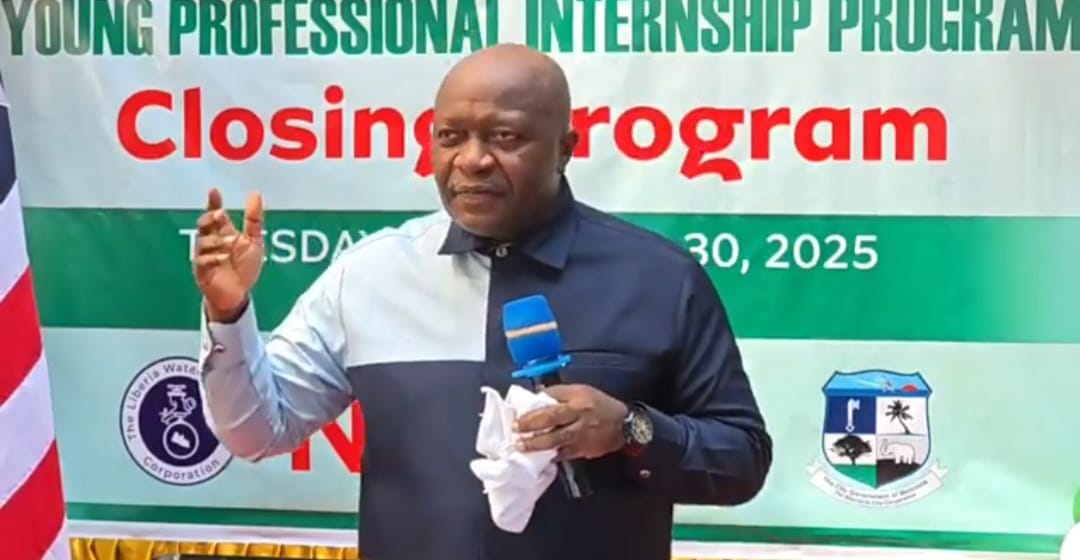
Liberia’s Ministry of Finance and Development Planning (MFDP) has concluded the pilot phase of its Young Professionals Internship Program, with more than 200 young Liberians successfully completing intensive professional and practical job training, marking a significant milestone in the government’s youth empowerment and public sector reform agenda.
The closing ceremony, held in Monrovia, brought together senior government officials, development partners, and beneficiaries of the program, which was designed to bridge the long-standing gap between academic training and workplace readiness in Liberia’s public sector.
Presidential Vision for Youth Empowerment
Speaking at the event, Minister of Finance and Development Planning Augustine Kpehe Ngafuan emphasized that the internship program is rooted in the vision of President Joseph Nyuma Boakai, who has made youth development a central pillar of his administration.
“We are implementers of the grand vision of the President,” Ngafuan said. “President Boakai is deeply concerned about the future of this country, especially its young people.”
The minister explained that the initiative was deliberately launched as a pilot, allowing government to learn lessons, evaluate outcomes, and improve future cohorts.
“The purpose of piloting is not to down-skill, but to skill up,” he stressed.
Backed by a Record National Budget
Liberia’s national budget has crossed the US$1 billion mark, a historic first that Minister Ngafuan say reflects growing fiscal ambition despite economic challenges.
Ngafuan disclosed that embedded within the budget are key youth-focused allocations, including:
US$3 million for the Presidential Youth Empowerment Initiative, and
US$1 million for a National Service Program under the Ministry of Youth and Sports.
In addition, multiple ministries and agencies have rolled out their own internship and apprenticeship schemes, signaling a broader shift toward skills development and workforce readiness across government.
“Some critics looked at the budget with negative lenses,” Ngafuan noted. “But they missed what matters most, investment in people, especially young people.”
Pathways to Employment and Inclusion
The Finance Minister confirmed that government will now conduct stock-taking and evaluation to determine:
which interns can be immediately absorbed into government service,
who requires further skills development, and
how to support those not yet ready for permanent placement.
“One of our greatest intentions is that no one should be left behind,” he said, adding that exceptional interns may be employed across various government institutions.
Notably, Ngafuan assured participants that political affiliation will not be a criterion in recruitment.
“We are hiring Liberians. You are Liberians and that is what matters,” he declared.
A Personal Journey from Intern to Minister
In an emotional moment, Ngafuan reflected on his own career, revealing that he began as an intern at age 18 after graduating from Booker T. Washington Institute, serving in the Accounts Department at the Liberia Petroleum Refining Company (LPRC) in 1988.
“That was where my journey began,” he recalled. “I see some of you becoming managing directors, ministers, and national leaders. Dream big, and never give up.”
Attitude as the Key to Success
Beyond technical skills, the program emphasized professional ethics and work attitude, which Ngafuan described as decisive factors for long-term success.
“At some point, it is your attitude that will determine your altitude,” he told interns.
He encouraged punctuality, respect, meeting deadlines, and strong work ethics, noting that in highly competitive environments, attitude often distinguishes success from failure.
Broader Development Gains Highlighted
Ngafuan defended the administration’s development record, pointing to tangible improvements, including:
US$50 million allocated to expand the Liberia Electricity Corporation,
increased funding for road infrastructure,
expanded employee transportation services at the Ministry of Finance and Development Planning now supported by seven buses, and renewed investment in public health facilities among others.
He cited the long-delayed Redemption Hospital project, initiated in 2016, which is now nearing completion and expected to be dedicated by March or April next year.
The Finance Ministry boss also referenced stalled infrastructure projects, such as major overpass bridges, that the current administration has pledged to complete.
“We will score the goals,” Ngafuan said metaphorically. “And the chief striker is President Boakai.”
While the internship program has officially closed, the minister clarified that the pause is temporary, assuring graduates that future cohorts will follow as government scales up youth-focused interventions nationwide.
“We are not sending you back home,” he concluded. “We are opening more doors, lighting more candles, and creating more opportunities across all counties”, he reassured them.
The MFDP Young Professionals Internship Program is widely viewed as a cornerstone initiative in Liberia’s efforts to tackle youth unemployment, modernize public service, and ensure inclusive national development in the post-conflict era.
Editor’s Note:
At a time when youth unemployment and skills mismatch remain among Liberia’s most pressing development challenges, the conclusion of the Ministry of Finance and Development Planning’s Young Professionals Internship Program represents more than a ceremonial graduation, it signals a policy direction.
This article captures how the Boakai’s administration is positioning youth empowerment not as rhetoric, but as a strategic investment anchored in budgetary commitments, institutional reform, and leadership accountability.
Beyond the statistics of over 200 graduates and a billion-dollar national budget, the story highlights a deeper narrative: the attempt to rebuild public confidence in government by investing in human capital, merit-based opportunity, and inclusive growth.
Minister Augustine Kpehe Ngafuan’s personal journey from intern to cabinet minister adds a human dimension that reinforces the program’s core message that pathways to national leadership can begin with structured opportunity and disciplined mentorship.
As Liberia continues its post-conflict development journey, initiatives like this internship program will be judged not only by their scale, but by their sustainability, transparency, and ability to translate training into long-term employment and service delivery.
The editors consider this piece an important contribution to the ongoing national conversation on youth, governance reform, and the future of Liberia’s public sector.
