
By: Julius Konton
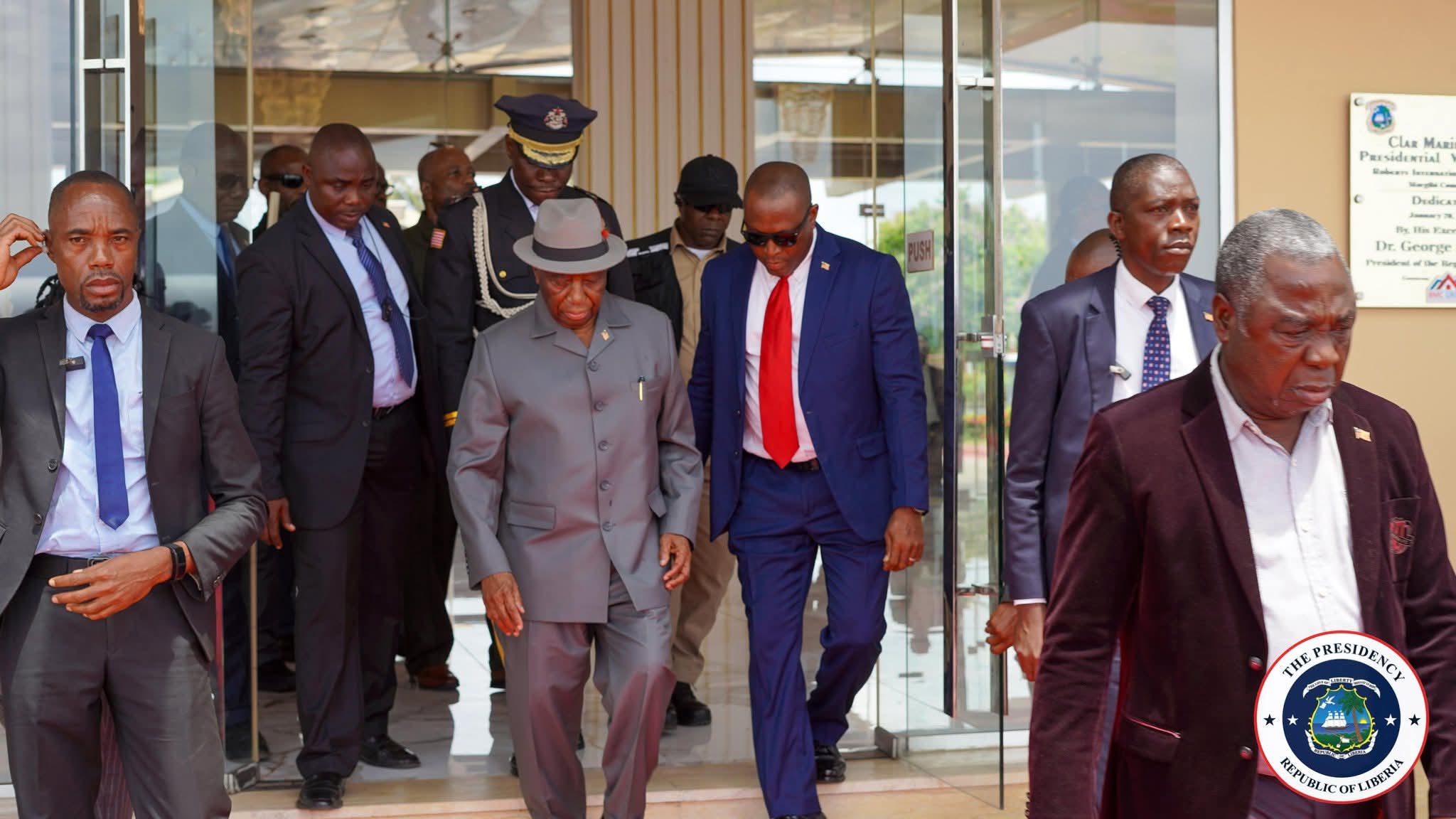
President Joseph Nyuma Boakai has departed Monrovia for Conakry, the capital of Guinea, where he will participate in a high-level regional meeting aimed at de-escalating tensions along the Liberia–Guinea border in Lofa County.
The emergency dialogue will bring together President Boakai, Guinea’s transitional leader Mamadi Doumbouya, and Sierra Leone’s President Julius Maada Bio.
The leaders are expected to discuss security concerns following recent confrontations reported near the border town of Sorlumba in the Foya District.
Regional diplomats say the meeting could play a crucial role in preventing the situation from escalating and in strengthening long-standing cross-border cooperation within the Mano River Union, the regional bloc that includes Liberia, Guinea, Sierra Leone, and Côte d’Ivoire.
Rising Tensions Along a Sensitive Frontier
Recent incidents along the Liberia–Guinea border have raised concerns among local authorities and residents after reports that Guinean soldiers allegedly crossed into territory claimed by Liberia near Sorlumba.
Community leaders in the region say tensions escalated after confrontations between Guinean troops and Liberian civilians.
The Liberia–Guinea border stretches approximately 590 kilometers (about 366 miles), cutting through remote forest regions and rural communities where border demarcation remains historically sensitive.
The frontier has periodically witnessed disputes due to unclear boundary markers, informal settlements, and cross-border movement.
Security analysts note that the area has also served as a strategic corridor for trade and migration among Mano River Union countries, with thousands of traders and farmers relying on cross-border markets for their livelihoods.
Historical Context of Cross-Border Challenges
The Mano River region has a complex history shaped by civil conflicts and cross-border security challenges during the late 20th and early 21st centuries.
During Liberia’s civil wars between 1989 and 2003, large numbers of refugees fled across the borders into Guinea and Sierra Leone, creating humanitarian pressures and occasional military tensions.
In recent years, regional leaders have intensified efforts to maintain stability through diplomatic engagement and joint security initiatives.
The Mano River Union has promoted cross-border cooperation in areas such as peacebuilding, trade facilitation, and border management.
According to regional economic data, cross-border trade among Mano River Union countries contributes hundreds of millions of dollars annually to local economies, particularly in agricultural commodities such as rice, palm oil, cocoa, and livestock.
Regional Leaders Seek Diplomatic Solution
The summit in Conakry is expected to provide a platform for regional leaders to address the dispute through dialogue while reinforcing mechanisms for peaceful border management.
Also expected at the talks is the President of Côte d’Ivoire, Alassane Ouattara, whose country shares borders with Liberia and Guinea and plays a key role in regional security cooperation.
Diplomatic observers say the participation of multiple West African heads of state underscores the strategic importance of maintaining peace along interconnected borders in the region.
High-Level Liberian Delegation
President Boakai is accompanied by a senior government delegation that includes:
Sara Beysolow Nyanti, Minister of Foreign Affairs
Mamaka Bility, Minister of State without Portfolio
Samuel Kofi Woods II, National Security Advisor
Francis Nyumalin, Minister of Local Government
Geraldine Janet George, Minister of National Defense
Davidson F. Forleh, Chief of Staff of the Armed Forces of Liberia
Members of the Liberian delegation are expected to engage with their counterparts from Guinea, Sierra Leone, and Côte d’Ivoire in discussions aimed at strengthening diplomatic dialogue, preventing further escalation, and reinforcing mechanisms to address border disputes peacefully.
Strategic Importance of Stability
Experts warn that instability along the Liberia–Guinea frontier could disrupt trade routes and undermine regional economic cooperation.
The border region serves as a lifeline for thousands of rural residents who depend on cross-border markets, transportation routes, and agricultural trade.
The outcome of the Conakry meeting is therefore expected to be closely watched across West Africa, as regional leaders seek to ensure that the Mano River basin remains a zone of peace, cooperation, and economic integration.
